A mysterious galaxy with a bright center and a face that suggests spiral structure but lacks visible spiral arms has been captured by the NASA Hubble Space Telescope. The galaxy's whole face is partially obscured by reddish-brown dust clumps and filaments, while the inky-black background is dotted with red, blue, and orange light from far-off galaxies shining through its diffuse outer regions.
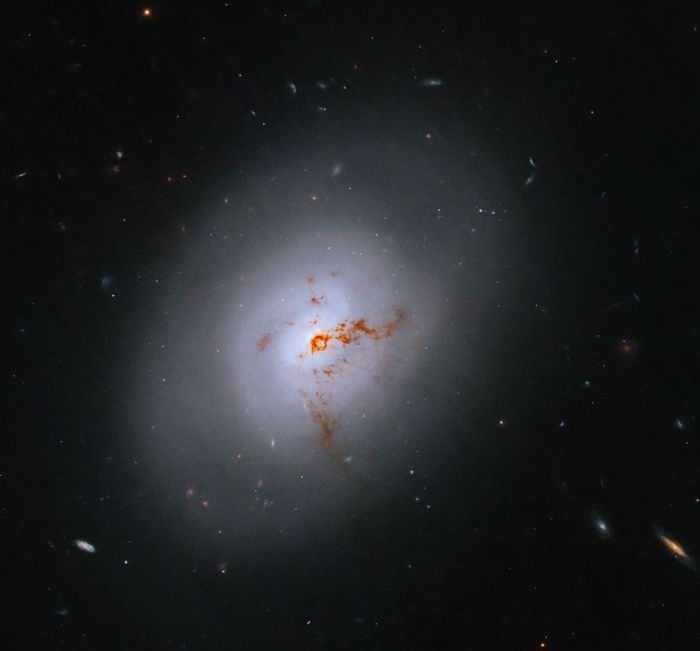 This NASA Hubble Space Telescope image reveals the lenticular galaxy, NGC 1266. This enigmatic post-starburst galaxy has a bright center and a face that hints at spiral structure, yet it holds no discernible spiral arms. Image Credit: NASA, ESA, K. Alatalo (STScI); Image Processing: G. Kober (NASA/Catholic University of America)
About 100 million light-years away in the constellation Eridanus lies the lenticular galaxy NGC 1266. Lenticular galaxies are classified by astronomers as transitional systems that bridge the evolutionary gap between spiral and elliptical galaxies. Unlike spirals, which feature prominent arms and active star formation, lenticular galaxies are more “lens-shaped,” with a bright central bulge surrounded by a flattened disk and only faint spiral structure.
While its structure and classification are intriguing, the most compelling aspect of NGC 1266 is its evolutionary state. The galaxy is considered a rare post-starburst system, meaning it is transitioning from a period of intense star formation into a quieter, more passive phase resembling an elliptical galaxy. Post-starburst galaxies still contain traces of their active past, including pockets of star-forming regions and relatively young stellar populations, but their overall star production has dramatically slowed. These galaxies are uncommon, making up only about 1% of galaxies in the local universe.
Astronomers believe that around 500 million years ago, NGC 1266 experienced a minor merger with another galaxy. This interaction likely funneled large amounts of gas toward the galaxy’s supermassive black hole while also triggering an intense burst of star formation and increasing the mass of the central bulge. As additional material spiraled inward, the black hole became far more active, creating what astronomers classify as an active galactic nucleus (AGN).
The heightened activity surrounding the black hole likely generated powerful winds and high-speed jets of gas along its rotational axis. At the same time, the rapid formation of massive stars consumed enormous quantities of cold gas, the raw material required for future star formation. Together, the AGN-driven outflows and stellar activity gradually depleted the galaxy’s reservoir of star-forming gas. The turbulence created by these energetic processes also prevented much of the remaining gas from cooling and collapsing into new stars, effectively shutting down large-scale star formation within the galaxy.
Hubble and other observatories' observations show that the galaxy's interstellar space is shocked or severely disturbed, and that there is a significant gas outflow from the galaxy. Researchers discovered that very little to no star formation occurs outside of the galaxy's core, and that any surviving stellar nurseries are located there.
These findings imply that by removing or expelling star-forming gas from the galaxy, the supermassive black hole at its core may be preventing the formation of new stars. In order to prevent any leftover matter from gravitationally condensing into young stars, the shockwaves from this process would produce turbulence that sufficiently disrupts the gas and dust between stars.
Astronomers can examine the intricate physical processes that prevent star formation in post-starburst galaxies such as NGC 1266. They aid in the understanding of the interactions between supermassive black holes and their hosts, as well as the evolution of galaxies.