Scientists at The University of Manchester's National Graphene Institute have demonstrated that electrons in ultra-clean graphene may be precisely directed while retaining their spin information, a critical prerequisite for future low-power electronics and quantum technologies. The study was published in Physical Review X.
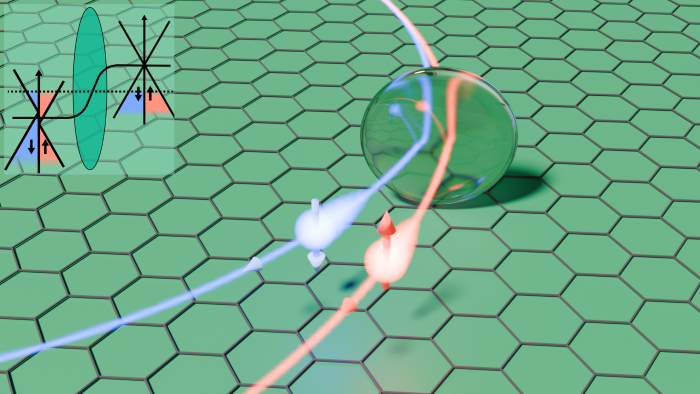 Illustration of electron refraction across a potential step. Image Credit: The University of Manchester
The team showed that electrons in graphene can move ballistically, meaning they travel without resistance or scattering, over micrometer distances at low temperatures while maintaining spin coherence up to ambient temperature. Using transverse magnetic focusing (TMF), they bent electron trajectories like light rays passing through a lens and demonstrated that these curved pathways carry a distinct spin signature.
What’s exciting here is that we can shape the path of electrons in graphene and, at the same time, tune how their spins behave. It’s a bit like using a set of lenses and mirrors, but for spin-polarised electrons. This opens a practical way to control spin without needing strong spin–orbit interaction in the material.
Dr. Daniel Burrow, Study Co-Author, The University of Manchester
Electron Paths Reveal Spin Behavior
The team’s graphene device injects and detects spin-polarized electrons along the edge of an enclosed graphene channel using ferromagnetic cobalt contacts. When a modest out-of-plane magnetic field is applied, the electrons follow curved paths known as cyclotron orbits. If these orbits reach the correct size, the electrons are focused directly onto the detector contact, producing distinct signal peaks at specific magnetic field strengths. These TMF peaks provide a clear fingerprint of ballistic electron transport, and the researchers successfully resolved three such peaks.
Importantly, the alignment of the magnetic contacts influenced both the height and sign of the TMF peaks, showing that spin information was carried within the focused signal. This confirms that spin transport through the device occurred via ballistic electron trajectories rather than through diffusive scattering processes.
Control at the Flick of a Gate Voltage
The researchers were able to significantly modify the spin signal by adjusting the voltage applied to the back gate, which controls the electron density in graphene. Under certain conditions, the signal was enhanced compared to conventional nonlocal spin-valve measurements, while in others, its polarity could be completely reversed.
This tunability arises from a coupling between the electrons’ spin and orbital motion, driven by the proximity-exchange effect and local charge-transfer doping at the graphene edge introduced by the ferromagnetic contacts.
As a result, the graphene region near the contact acquires magnetic characteristics, and the spin-dependent electron optics emerge from the ballistic flow of electrons from this magnetically influenced region into the surrounding non-magnetic graphene channel. The overall effect is transistor-like control of spin transport without the need to introduce spin–orbit coupling into the graphene channel itself.
A Route Toward Practical Spin-Based Devices
At low temperatures (25 K), the team saw distinct ballistic behavior, while at normal temperatures, quasi-ballistic transport was still evident. The researchers show that spin-coherent ballistic transport can endure under conditions appropriate for practical devices since the TMF peaks remained responsive to spin at these higher temperatures.
This method offers a novel working principle for spintronic components, which are gadgets that regulate the spin of electrons instead of their charge. Similar to the Datta–Das spin field-effect transistor, the process uses electron optics effects instead of spin–orbit interactions to produce spin modulation.
We have shown that electron optics in graphene can do more than guide electrons; it can actively shape their paths in a spin-dependent manner. Being able to control spin in this way, using low-power and scalable materials, moves us closer to practical spin-based technologies and future quantum systems.
Dr. Ivan Vera Marun, Study Co-Author, The University of Manchester
Journal Reference:
Burrow, D., et al. (2026) Ballistic Spin Valve in Graphene Realized via Electron Optics. Physical Review X. DOI: 10.1103/nz6m-kb4l. https://journals.aps.org/prx/abstract/10.1103/nz6m-kb4l.