A multi-observatory study led by the Center for Astrophysics | Harvard & Smithsonian has characterized the impact of a newly discovered secondary star, Siwarha, on the circumstellar environment of Betelgeuse. Utilizing Hubble Space Telescope ultraviolet spectroscopy and ground-based data, researchers identified a high-density gas stream within the primary's extended atmosphere. The study will be published in The Astrophysical Journal.
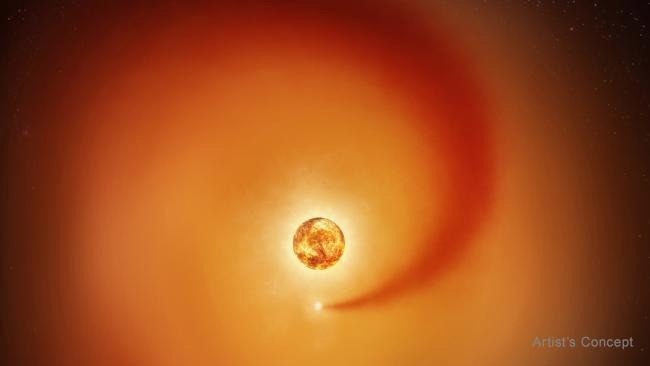 This artist’s concept shows the red supergiant star Betelgeuse and an orbiting companion star. The companion, which is orbiting clockwise from this point of view, generates a dense wake of gas that expands outward. It is so close to Betelgeuse that it is passing through the extended outer atmosphere of the supergiant. The companion star is not to scale; it would be a pinprick compared to Betelgeuse, which is hundreds of times larger. The companion’s distance from Betelgeuse is to scale relative to the diameter of Betelgeuse. Image Credit: NASA, ESA, Elizabeth Wheatley (STScI)
The study suggests that the gravitational and hydrodynamic interactions between Betelgeuse and Siwarha are the primary drivers of the red supergiant's observed atmospheric anomalies and stochastic brightness variations.
The team identified Siwarha's wake by meticulously monitoring variations in the star's luminosity over a span of nearly eight years. These variations reveal the influence of the previously unverified companion as it traverses the outer atmosphere of Betelgeuse. This finding clarifies one of the most significant enigmas surrounding the giant star, aiding scientists in elucidating its behavior and evolution while also paving the way for a deeper understanding of other massive stars approaching the end of their life cycles.
Situated approximately 650 light-years from Earth in the Orion constellation, Betelgeuse is a red supergiant star so immense that it could contain over 400 million Suns within its volume. Due to its vast size and relative closeness, Betelgeuse is among the few stars whose surface and surrounding atmosphere can be directly examined by astronomers, rendering it a crucial and accessible laboratory for investigating the aging process, mass loss, and eventual supernova explosions of giant stars.
Utilizing NASA's Hubble Space Telescope alongside ground-based telescopes at the Fred Lawrence Whipple Observatory and the Roque de Los Muchachos Observatory, the research team successfully identified a pattern of alterations in Betelgeuse. This discovery provided substantial evidence of a long-suspected companion star and its influence on the outer atmosphere of the red supergiant.
The observed changes include variations in the star's spectrum, which refers to the distinct colors of light emitted by various elements, as well as the velocity and direction of gases in the outer atmosphere, influenced by a trail of denser material, known as a wake. This wake becomes evident shortly after the companion star passes in front of Betelgeuse every six years, approximately every 2,100 days, thereby validating existing theoretical models.
It's a bit like a boat moving through water. The companion star creates a ripple effect in Betelgeuse's atmosphere that we can actually see in the data. For the first time, we're seeing direct signs of this wake, or trail of gas, confirming that Betelgeuse really does have a hidden companion shaping its appearance and behavior.
Andrea Dupree, Astronomer and Study Lead Author, Center for Astrophysics | Harvard & Smithsonian
For many years, astronomers have monitored variations in the brightness and surface characteristics of Betelgeuse, aiming to understand the reasons behind the star's peculiar behavior. Interest heightened when the massive star seemed to "sneeze" and unexpectedly dimmed in 2020. Two notable periods of fluctuation in the star's brightness have particularly baffled researchers: a brief 400-day cycle, which has recently been linked to pulsations occurring within the star, and a longer, 2,100-day secondary cycle.
Scientists have explored various explanations, including large convection cells, dust clouds, magnetic activity, and the potential existence of a concealed companion star. Recent research has suggested that the long secondary cycle is most effectively accounted for by a low-mass companion orbiting deep within the atmosphere of Betelgeuse. Another group of researchers has reported a possible detection of this companion. Astronomers have not had the evidence necessary to substantiate their theories. They possess solid evidence indicating that a companion is indeed influencing the atmosphere of this supergiant star.
The idea that Betelgeuse had an undetected companion has been gaining in popularity for the past several years, but without direct evidence, it was an unproven theory. With this new direct evidence, Betelgeuse gives us a front-row seat to watch how a giant star changes over time. Finding the wake from its companion means we can now understand how stars like this evolve, shed material, and eventually explode as supernovae.
Andrea Dupree, Astronomer and Study Lead Author, Center for Astrophysics | Harvard & Smithsonian
As Betelgeuse currently obscures its companion from one’s perspective, astronomers are preparing for new observations for its upcoming reappearance in 2027. This significant development may also assist in elucidating comparable enigmas in other giant and supergiant stars.