Scientists from the Institute of Metal Research (IMR) of the Chinese Academy of Sciences have proposed a new deep correlation between the spin splitting torque (SST) and the Fermi surface geometry, achieving a quantum limit of 100% in a system with a flat Fermi surface. The results were published in Physical Review Letters on December 16th, 2025.
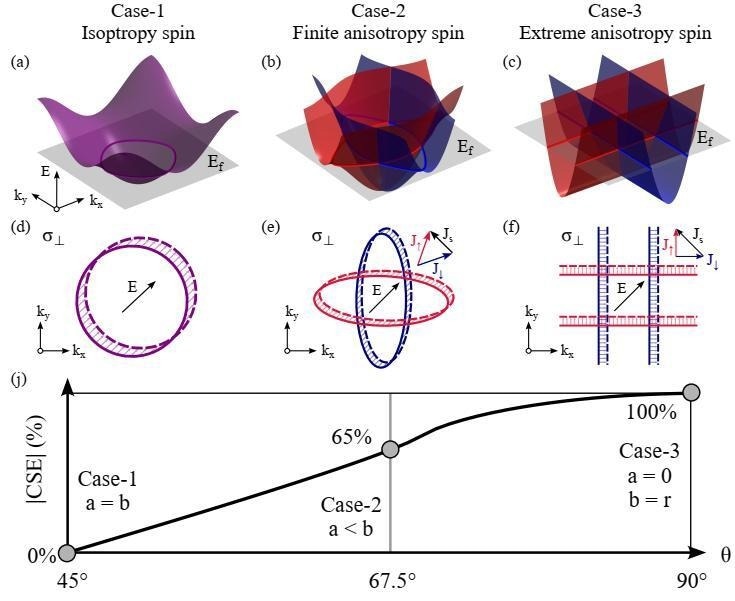 Effective model of altermagnets with different spin-splitting anisotropy. Image Credit: IMR
Spintronic devices operate by leveraging spin currents to transmit momentum, facilitating efficient, rapid data retention and signal manipulation at reduced energy consumption. These mechanisms are typically regulated through electric currents and fields. The charge-to-spin conversion efficiency (CSE) represents a fundamental performance indicator for assessing device capability.
Traditional spintronic architectures rely on electric currents or fields through two principal pathways. The spin-transfer torque (STT) mechanism permits spin control but encounters constraints from spin scattering phenomena. The spin-orbit torque (SOT) approach facilitates transverse signal generation; however, it is constrained by restricted spin diffusion lengths, which accelerate spin current degradation during transmission and diminish spin angular momentum delivery effectiveness.
In contrast to standard antiferromagnets, which do not produce spin currents, altermagnets demonstrate spin splitting derived from magnetic ordering instead of relativistic spin-orbit interactions. This inherent characteristic naturally facilitates extended spin diffusion lengths. As spin-anisotropic splitting within the material intensifies, a time-reversal-odd (T-odd) spin current manifests, producing measurable CSE. Upon emergence of a flat Fermi surface geometry, d-wave spin anisotropy attains the quantum limit for T-odd CSE.
Guided by theoretical framework examination, researchers executed computational investigations on the room-temperature d-wave altermagnet KV2O2Se. Findings demonstrated a flat Fermi surface exhibiting minimal variation along the kz direction.
Furthermore, two orthogonal Fermi surface configurations are populated by opposing spin populations. This correspondence strongly supports the theoretical predictions and suggests potential for remarkably elevated CSE.
Computational assessments indicate the material generates transverse and longitudinal spin currents oriented along the [110] and [100] axes. The CSE attains 78% at the charge neutrality point, extending to 98% following modest electron doping. Investigations demonstrated that KV2O2Se's elevated CSE exhibits substantial insensitivity to thermal fluctuations and structural imperfections.
Practical calculations demonstrate that the material may produce transverse and longitudinal spin currents in the [110] and [100] directions. The CSE achieves 78% at charge neutrality and up to 98% with little electron doping. The researchers discovered that the high CSE in KV2O2Se is very resistant to temperature and defect effects.
Compared to other T-odd spin current materials, KV2O2Se is a viable contender for future applications. KV2O2Se has a substantially greater CSE at the charge neutrality point than other alternatives, surpassing even the renowned material RuO2 by a factor of two. This sets a new record for T-odd CSE efficiency. KV2O2Se has a spin conductivity of 3.2×10⁴ (h/2e) (S/cm) in both transverse and longitudinal directions, with a higher current density than other intrinsic magnetic materials.
The study provides a new technique, "Fermi surface geometry engineering," for tailoring materials' spin-related characteristics to the quantum limit and identifies interesting candidate materials.
Journal Reference:
Lai, J. et.al. (2025) d-Wave Flat Fermi Surface in Altermagnets Enables Maximum Charge-to-Spin Conversion. Physical Review Letters. DOI:10.1103/bf1n-sxdl. https://journals.aps.org/prl/abstract/10.1103/bf1n-sxdl