The Hubble Space Telescope has detected the most expansive protoplanetary disk documented to date, extending across 400 billion miles, approximately 40 times the size of the solar system. The findings were published in The Astrophysical Journal.
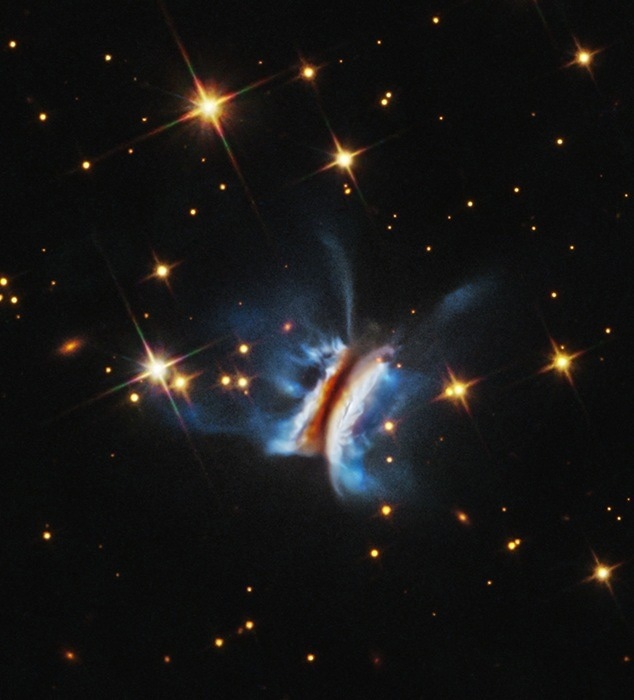 This Hubble Space Telescope image shows the largest planet-forming disk ever observed around a young star. It spans nearly 400 billion miles, 40 times the diameter of our solar system. Tilted nearly edge-on as seen from Earth, the dark, dusty disk resembles a hamburger. Hubble reveals it to be unusually chaotic, with bright wisps of material extending far above and below the disk, more than seen in any similar circumstellar disk. Cataloged as IRAS 23077+6707, the system is located approximately 1,000 light-years from Earth. The discovery marks a new milestone for Hubble and offers fresh insight into planet formation in extreme environments across the galaxy. Image Credit: NASA, ESA, STScI, Kristina Monsch (CfA); processing: STScI/ Joseph DePasquale
Three centuries after Immanuel Kant proposed that planets in our solar system formed from a compressed ring of gas and dust, NASA's Hubble Space Telescope has confirmed that these kinds of stellar nurseries are common across the galaxy.
This massive formation, located about 1,000 light-years away, reveals a surprisingly chaotic and unstable environment for planet formation. Hubble's detailed observations reveal tendrils of material projecting significantly beyond the upper and lower boundaries of the disk. This observation creates an exceptional opportunity to examine the intricate mechanisms and circumstances that direct the emergence of planetary systems.
Researchers employing NASA's Hubble Space Telescope have captured images of the most massive protoplanetary disk ever documented orbiting a developing star. Through visible light observation for the first time, Hubble has demonstrated that the disk contains unexpected disorder and instability, featuring material strands extending substantially farther outward and inward compared to what has been documented in comparable structures.
Notably, long, thread-like structures appear only on one side of the disk. The findings, published Tuesday in The Astrophysical Journal, mark a major milestone for Hubble and offer new insight into how planets might form under extreme conditions.
Located about 1,000 light-years away, IRAS 23077+6707, nicknamed “Dracula’s Chivito”, spans nearly 400 billion miles, making it roughly 40 times wider than our solar system. Its reach extends out to the equivalent of the Kuiper Belt’s outer edge, where icy, comet-like material resides.
The disk obscures the forming star at its center, which researchers believe could be either a bright, high-mass star or a binary star system. Beyond its sheer size, this enormous disk isn't just the largest known planet-forming disk, it also stands out as one of the most unusual.
The level of detail we're seeing is rare in protoplanetary disk imaging, and these new Hubble images show that planet nurseries can be much more active and chaotic than we expected. We're seeing this disk nearly edge-on and its wispy upper layers and asymmetric features are especially striking.
Kristina Monsch, Study Lead Author, Center for Astrophysics Harvard and Smithsonian
Monsch added, “Both Hubble and NASA's James Webb Space Telescope have glimpsed similar structures in other disks, but IRAS 23077+6707 provides us with an exceptional perspective, allowing us to trace its substructures in visible light at an unprecedented level of detail. This makes the system a unique, new laboratory for studying planet formation and the environments where it happens.”
The designation "Dracula's Chivito" humorously acknowledges the geographic origins of its scientific team: one investigator hailing from Transylvania and another from Uruguay, where a traditional sandwich called a chivito constitutes the national cuisine. The perpendicular disk configuration resembles a sandwich, featuring a shadowed middle section bordered by luminous upper and lower strata of dust and gas.
Puzzling Asymmetry
The remarkable height of these structures was not the sole element drawing scientific interest. The recent observations indicated that vertically elongated thread-shaped structures manifest on merely one side of the disk, whereas the opposite side demonstrates a defined boundary with no observable threads.
This asymmetrical configuration implies that energetic phenomena, including recent accumulation of dust and gas, or gravitational interactions with neighboring matter, are modifying the disk's structure.
We were stunned to see how asymmetric this disk is. Hubble has given us a front row seat to the chaotic processes that are shaping disks as they build new planets – processes that we don't yet fully understand but can now study in a whole new way.
Joshua Bennett Lovell, Study Co-Investigator and Astronomer, Center for Astrophysics Harvard and Smithsonian
All planetary systems originate from rings of gas and dust surrounding developing stars. Throughout time, gas transfers into the star, and planets develop from the leftover substance.
IRAS 23077+6707 might exemplify an enlarged rendition of the early solar system, with disk material estimated at 10 to 30 Jupiter masses, sufficient substance for generating numerous gas giants. Combined with the recent observations, this establishes it as a remarkable instance for investigating planetary system formation.
In theory, IRAS 23077+6707 could host a vast planetary system. While planet formation may differ in such massive environments, the underlying processes are likely similar. Right now, we have more questions than answers, but these new images are a starting point for understanding how planets form over time and in different environments.
Kristina Monsch, Study Lead Author, Center for Astrophysics Harvard and Smithsonian
Journal Reference:
Monsch, K. et.al. (2025) Hubble Reveals Complex Multiscale Structure in the Edge-on Protoplanetary Disk IRAS23077+6707. The Astrophysical Journal. DOI:10.3847/1538-4357/ae247f. https://iopscience.iop.org/article/10.3847/1538-4357/ae247f