Quantum computers are unlikely to replace the spectrometers, microscopes and supercomputers already found in pharmaceutical labs. But for a narrow set of molecular problems that defeat classical simulation, they could become the newest specialized instrument on the bench.1
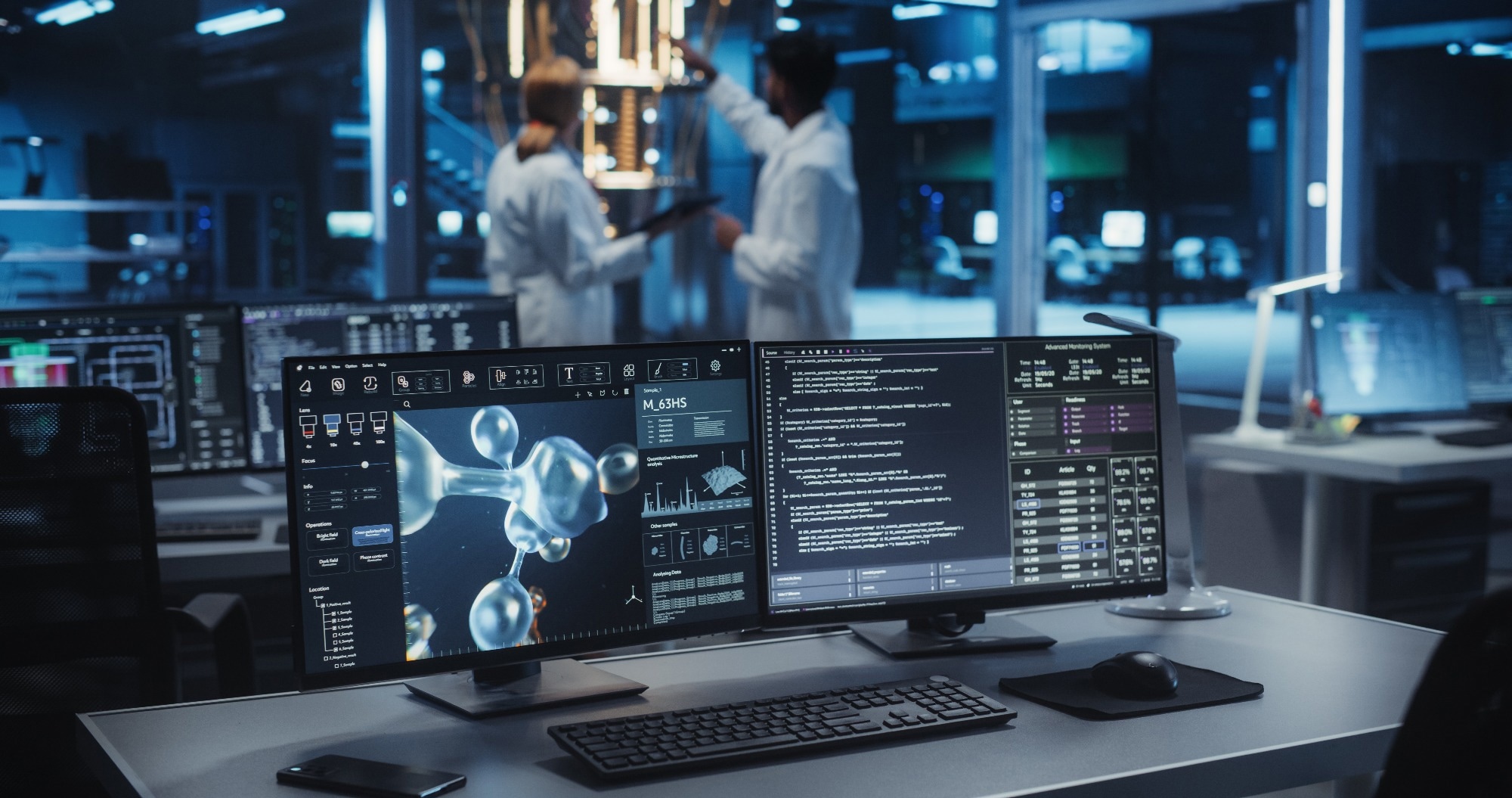
Image Credit: Gorodenkoff/Shutterstock.com
Putting Quantum Computing on the Pharma Lab Bench
Walk through a modern pharmaceutical research site and you will find spectrometers, microscopes, chromatography systems and clusters of high-performance computers. Quantum computers may one day sit on that list. Not as a replacement for any of these tools, but as another specialized instrument used when the question demands it.1
The case for quantum computing in drug research is narrow and specific. Molecules obey quantum mechanics, and simulating the behavior of their electrons becomes exponentially harder for classical computers as systems grow and electrons interact strongly. A quantum processor, in principle, handles this kind of problem natively.1
That does not make chemists, conventional computers or experimental instruments obsolete. The more useful question is practical: what would need to happen for quantum computing to move from specialist research technology to a tool pharmaceutical scientists use routinely?
Download the PDF of this article here
From NMR and Cryo-EM to Quantum Computing
No single instrument tells a drug discovery team everything it needs to know. Research depends on a set of complementary techniques, each answering a different question.
Nuclear magnetic resonance (NMR) reveals atomic connectivity and molecular dynamics in solution. Cryogenic electron microscopy (cryo-EM) resolves the three-dimensional structures of large proteins and complexes. Mass spectrometry identifies compounds and metabolites with high sensitivity. Molecular modeling, from docking to molecular dynamics, predicts how candidate molecules might bind and behave.2
Quantum computing could join this ecosystem as another specialist tool. What it might offer that others cannot efficiently deliver is accurate electronic-structure information: the energies and electron distributions that govern bonding, reactivity and binding.2
Experiments measure the consequences of that electronic behavior, and classical methods approximate it. A mature quantum processor could calculate it more directly for systems where approximations break down.2
What Could a Quantum Computer Actually Do in a Pharmaceutical Lab?
The most plausible applications are electronic-structure calculations: molecular energies, reaction pathways, transition states and the fine detail of drug–target interactions. These matter most for molecules containing transition metals or strongly correlated electrons, such as the iron-containing cytochrome P450 enzymes that metabolize many drugs, where classical methods struggle to reach reliable accuracy.3
Such calculations would complement experiments, not replace them. An NMR spectrum or crystal structure provides ground truth; a quantum calculation could help explain it, or predict which candidates merit synthesis.3
Three levels of capability should be kept separate. Theory suggests fault-tolerant machines could simulate systems beyond classical reach. Current hardware has demonstrated hybrid calculations on real chemistry, but not a clear advantage over the best classical methods. Routine, decisive use in drug design will require much more mature machines.3
A Hybrid Laboratory: Connecting Quantum Computers with Existing Tools
In a realistic future workflow, a cryo-EM structure or NMR data set defines a binding site. Classical high-performance computing (HPC) prepares the model and runs molecular dynamics. AI models screen and prioritize candidates. A quantum processor is then called only for the small, chemically critical fragment where electron behavior decides the outcome, and results flow back to the experimental team.4
A September 2026 preprint from Argonne, NVIDIA and Northwestern researchers describes this convergent laboratory, with quantum processors supplying high-fidelity validation data inside loops that also include AI agents and self-driving labs.4
Most scientists would not touch the hardware. They would access quantum resources through cloud platforms and software layers, much as they already use remote HPC. The laboratory of the future is therefore likely to be hybrid: experimental, classical, AI and quantum methods working in sequence.4
What Is Stopping Quantum Computers from Becoming Routine Tools?
Today’s machines remain noisy intermediate-scale quantum (NISQ) devices, with dozens to hundreds of qubits and no full error correction. Hardware errors and decoherence limit how deep a circuit can run before results degrade. Fault-tolerant machines will need many physical qubits for each reliable logical qubit, plus substantial control and cooling infrastructure.5
Qubit counts alone are therefore a poor guide to pharmaceutical usefulness. What matters is whether an algorithm delivers a scientifically meaningful answer faster, cheaper or more accurately than strong classical alternatives, which keep improving.5
Pharmaceutical settings add their own demands. Results must be reproducible and validated against experiment. Tools must integrate with existing software and data systems, justify their cost, be usable by non-specialists and, where calculations inform regulated decisions, meet documentation and quality expectations.5
From Hardware to Usable Scientific Instruments
For quantum computing to feel like an instrument rather than experimental infrastructure, the complexity must move behind the interface. That means user-friendly software, automated workflows, standardized interfaces, error correction handled invisibly, and independent benchmarks showing when a quantum calculation is worth running. Integration with established chemistry packages is essential, so a chemist can request a calculation from familiar tools.3
NMR rests on nuclear spin physics, and cryo-EM on electron optics and heavy image processing, yet medicinal chemists and structural biologists use both routinely without being physicists. Quantum computing could follow the same path, with pharmaceutical scientists specifying the molecule and the question while the software chooses algorithms, manages errors and reports uncertainty.2
Are Pharmaceutical and Quantum Companies Already Building This Future?
Several collaborations are testing pieces of this workflow, and it is worth being precise about what each demonstrates.
- IonQ, AstraZeneca, AWS and NVIDIA ran a hybrid simulation of a Suzuki–Miyaura coupling step, a reaction widely used in small-molecule synthesis, on IonQ’s 36-qubit Forte system via Amazon Braket and NVIDIA CUDA-Q. They reported a more than 20-fold improvement in end-to-end time-to-solution over their earlier implementation (IonQ, 2025).
- Cleveland Clinic, RIKEN and IBM simulated the 12,635-atom protein trypsin by splitting it into fragments, using up to 94 qubits on IBM Heron processors alongside the Fugaku and Miyabi-G supercomputers. The partners call it a starting point, not a drug-discovery result (IBM, 2026).
- Boehringer Ingelheim and PsiQuantum focused on future fault-tolerant hardware, cutting estimated runtimes for cytochrome P450 and FeMoco simulations by 234-fold and 278-fold (The Quantum Insider, 2025).
- Qubit Pharmaceuticals and Singapore’s Centre for Quantum Technologies began a two-year program in April 2026 to develop algorithms including quantum phase estimation and quantum Markov chain Monte Carlo, validated on Quantinuum systems (The Quantum Insider, 2026).
When Could Quantum Computing Become a Standard Pharmaceutical Tool?
No credible source can give a firm date. Some vendors point to 2026 for hybrid quantum advantage and around 2030 for fault-tolerant machines, but those are targets, not guarantees. Clearer signals are these milestones:
- Fault-tolerant hardware with reliable logical qubits
- Demonstrated quantum advantage on chemistry problems relevant to drug discovery
- Steadily lower error rates and deeper usable circuits
- Algorithms whose cost scales to realistic molecules
- Straightforward integration into existing pharmaceutical software and workflows
Adoption will likely be incremental. Specialized quantum services, accessed through the cloud or contract research partners, should arrive well before dedicated quantum computers sit in pharmaceutical labs, if they ever do.
The important question is not whether quantum computers replace NMR, cryo-EM or classical simulation. It is which problems will eventually justify adding quantum computation to the scientist’s toolbox.
Check out how quantum techniques can help with early microbial detection
References
- Zhou, Y.; Chen, J.; Cheng, J.; Cao, X.; Zhang, Y.; Karemore, G.; Zitnik, M.; Chong, F. T.; Liu, J.; Fu, T., Quantum-Machine-Assisted Drug Discovery. npj Drug Discovery 2026, 3, 1.
- Niazi, S. K., Quantum Computing and Quantum Technologies in Drug Discovery and Therapeutics: Evidence, Benchmarking, and Translational Integration. Drug Design, Development and Therapy 2026, 590730.
- Li, J.; Wei, L.; Tong, H. H.; Zou, Q., Quantum Computing Applications in Drug Discovery. Briefings in Bioinformatics 2026, 27, bbag274.
- Huerta, E.; Wang, X.; Gupta, G.; Sargent, E. H.; Owen, C. J.; Fung, V.; Mitra, A.; Cheng, A.; Bouchard, E.; Mehdi, S., The Convergent Laboratory: When Ai Reasoning, Autonomous Experiments, High Performance and Quantum Computing Reshape Chemistry. arXiv preprint arXiv:2609.05643 2026.
- Gadbail, H.; Rewatkar, R.; Jumde, N.; Manker, M.; Nagre, P.; Zade, S., Quantum Computing in Drug Discovery. Frontiers in Drug Discovery 2026, 6, 1815176.
Disclaimer: The views expressed here are those of the author expressed in their private capacity and do not necessarily represent the views of AZoM.com Limited T/A AZoNetwork the owner and operator of this website. This disclaimer forms part of the Terms and conditions of use of this website.