Through its Wildcard program, the Carl-Zeiss-Stiftung (CZS foundation) will be sponsoring from next year two research projects at Johannes Gutenberg University Mainz (JGU), providing a total of some EUR 767,000 in funding. It was announced by the CZS foundation that the undertakings in question are the projects ‘Spin-Selective Chiral Nanoscale Cooling (NanoCool)’ and ‘MeasurIng room tempeRAture high-frequency maGnEtic quantum effects in solids (MIRAGE)’. By means of its Wildcard program, the CZS foundation is supporting interdisciplinary consortia consisting of three to five researchers working in the STEM fields (science, technology, engineering and mathematics) who have unconventional ‘wild’ ideas with major innovation potential.
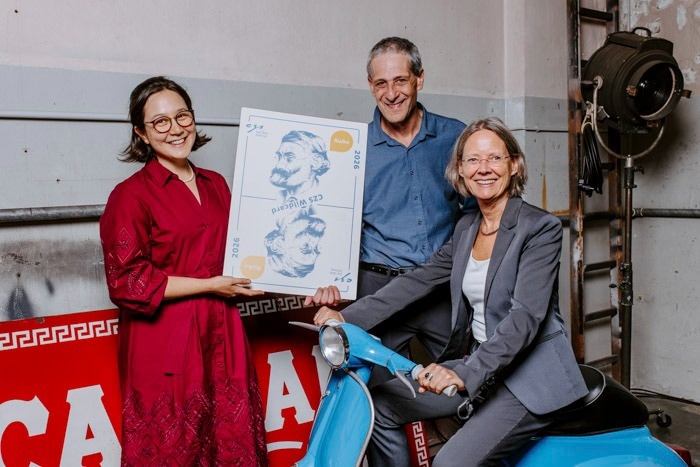 The participants in the ‘NanoCool’ project (fltr): Professor Angela Wittmann, Professor Yossi Paltiel, Professor Eva Rentschler. Image Credit: Laura Holzmann
The Project Spin-Selective Chiral Nanoscale Cooling (NanoCool)
Heat generation is increasingly becoming a limiting factor hindering the development of more powerful computers and the advancement of artificial intelligence. The capacity of conventional cooling systems is being overwhelmed, particularly when tiny areas of computer chips become extremely hot. With this in mind, the researchers in the project NanoCool are taking a completely new approach. This involves exploiting the spin of electrons, one of their quantum properties, which enables electrons to act as miniature magnets. When an electric current flows through chiral molecules that are characterized by a specific spatial structure, the spins of the electrons can be brought into targeted alignment. This so-called ‘spin polarization’ followed by the loss of the alignment results first of all in the release of heat and then subsequently in the absorption of heat. This means that the molecules act like microscopic heat pumps. The NanoCool team intends to investigate this process and make the cooling effect viable for use directly on computer chips, without the need for magnets or moving parts. The project could thus pave the way to the creation of a new generation of more powerful and energy-efficient AI hardware.
JGU members involved in the project are Professor Eva Rentschler of the Department of Chemistry, who also acts as the coordinator, and Professor Angela Wittmann of the Institute of Physics. A further member of the team is Yossi Paltiel, Professor of Applied Physics at the Hebrew University of Jerusalem. The CZS foundation will be providing EUR 894,000 in funding to the project from February 2027 to January 2029. Of this, some EUR 654,000 will be donated to the work undertaken at JGU.
The Project Measuring Room Temperature High-Frequency Magnetic Quantum Effects in Solids (MIRAGE)
Information technology faces a fundamental speed gap: While fiber-optic networks already transmit data at several terabits per second, electronic processing remains limited to gigahertz frequencies. The aim in MIRAGE is to bridge this gap with regard to speed and develop an ultra-fast, energy-efficient quantum information platform that is compatible with optical communication. To achieve this, the project will be using collective spin excitations – known as ‘magnons’ – as information carriers. These can operate in the multi-terahertz range without causing the heat losses associated with conventional electronics. The goal is to demonstrate for the first time that magnons in solids can exhibit quantum correlations at room temperature. These correlations are to be measured indirectly via the light emitted by pairs of magnons. This means that the MIRAGE team will be opening up a new field of research in high-frequency quantum dynamics and laying the foundations for future quantum information technologies that will far exceed today’s performance limits.
Participating in the project are Dr. Davide Bossine of the Department of Physics of the University of Konstanz, the project coordinator, Professor Olena Gomonay of JGU’s Institute of Physics, and Professor Hariom Jani, Associate Professor of Materials at the University of Oxford. The CZS foundation will be providing EUR 900,000 in funding to the project from March 2027 to February 2029. JGU will be receiving roughly EUR 113,000.