Researchers at the University of Leicester have been conducting calibration measurements with the Mercury Imaging X-ray Spectrometer (MIXS). The instrument flies aboard the dual-spacecraft BepiColombo mission, which is now beginning orbital insertion as it enters the final stage of its arrival at the solar system’s smallest planet.
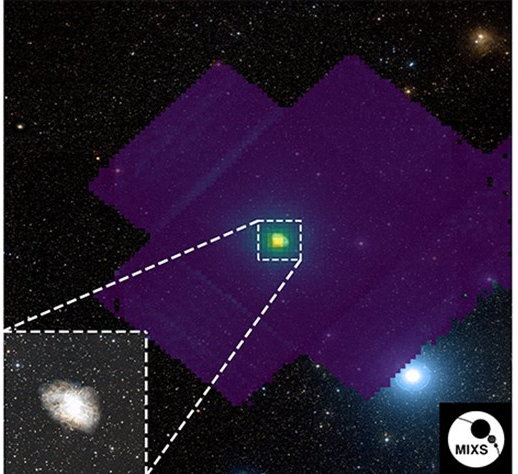 A MIXS-T image of the Crab Nebula integrated across all operations on 11-12 September, overlayed onto a visible light background. Inset shows the Crab Nebula in visible light. Background images from the Digitized Sky Survey 2 (McLean & Greene, 2000), accessed by NASA's Sky View facility (http://skyview.gsfc.nasa.gov) located at NASA Goddard Space Flight Center. Image Credit: University of Leicester
A UK-built instrument aboard the ESA/JAXA BepiColombo spacecraft has captured its first astronomical data from the inner solar system, observing one of the brightest X-ray sources in the sky on its way to Mercury.
After an eight-year voyage, verifying MIXS’s performance is essential. While engineers monitored the instrument throughout the journey, it was not until September, when the Mercury Transfer Module (MTM) separated from the joined Mercury Planetary Orbiter (MPO) and Mercury Magnetospheric Orbiter (MMO, or Mio), that MIXS gained its first unobstructed view of space, allowing the team to take calibration readings ahead of orbit insertion.
Located 6,500 light-years away, the Crab Nebula is a thoroughly studied source of X-ray radiation. Observing it marks MIXS’s first look at an astronomical X-ray source, enabling the team to evaluate how the instrument performs in space and compare those results with baseline laboratory calibrations from 2015.
The primary calibration campaign comprised 55 spacecraft slews totaling 39 hours of observation across September 11–12. By quantifying the spatial spread of the Crab Nebula’s point-spread function across the MIXS detector plane, the team characterized the instrument’s in-flight angular resolution, a key metric governing its capability to resolve fine-scale features on Mercury’s surface. Analysis confirmed that the in-orbit angular resolution slightly exceeds the baseline performance measured during ground calibration in 2015.
Professor Emma Bunce, Director of the Institute for Space at the University of Leicester, is the Principal Investigator (PI) for the MIXS instrument.
We have waited a long time to make measurements with MIXS and it is fantastic to see it operating brilliantly in space. This is testament to our engineering and technical team, and our international partners who we have worked with over many years to build this incredible instrument. 80% of the technology on MIXS is new!
Emma Bunce, Professor and Director, Institute for Space, University of Leicester
“During our calibration observations, we have determined that MIXS is generally performing fantastically well in space! We have no effects in our images that are associated with ‘stray light’ (optical photons getting in when they should not). We continue to see effects of galactic cosmic rays as we did during cruise, but we understand these and can filter them out. We see some self-fluorescence which appears when the Sun is illuminating the optic, but this won’t affect our dayside observations of Mercury’s surface. And the detector has suffered no radiation damage after 8 years in space,” said Professor Bunce.
We see some effects in the instrument that we are still studying and expect to undertake some optimization procedures during the Mercury commissioning phase to fine tune MIXS in preparation for the science phase.
Emma Bunce, Professor and Director, Institute for Space, University of Leicester
The BepiColombo mission will investigate every facet of Mercury, the smallest and least explored rocky planet in our solar system. By analyzing its findings, scientists hope to uncover how a planet forms and evolves so close to its parent star, shedding new light on the broader history of the solar system.
Flying aboard the mission’s Mercury Planetary Orbiter (MPO), MIXS was built by a Europe-wide consortium led by the University of Leicester, with backing from the UK Space Agency. As the only UK-led science instrument on BepiColombo, and the first imaging X-ray telescope ever deployed on a planetary mission, MIXS builds on Leicester’s heritage in X-ray astronomy to help generate an unprecedented global map of Mercury’s atomic surface composition.
To determine what Mercury is made of, MIXS measures fluorescent X-rays emitted by surface rocks when they are bombarded by high-energy solar radiation, working in tandem with the Solar Intensity X-ray and particle Spectrometer (SIXS). Beyond surface mapping, MIXS will also explore how Mercury’s surrounding space environment interacts with the planet itself by capturing nightside X-ray emissions triggered by magnetospheric particles.
Dr. Adrian Martindale, of the University of Leicester’s School of Physics and Astronomy, serves as the MIXS Instrument Scientist, a journey with the mission that began back in 2003 when he was an undergraduate student.
BepiColombo, and MIXS in particular, are like part of my family. I’ve been involved since I was an undergraduate and touched almost every part of the instrument before it was launched. This first data is mind-blowing to me. The last time we could see through this telescope it was in the basement under the School of Physics and Astronomy in Leicester, but after a rocket launch, eight years in space and 10 billion kilometers traveled it looks just the same. I can’t wait to see the science data it produces when we get into orbit.
Dr. Adrian Martindale, MIXS Instrument Scientist, School of Physics and Astronomy, University of Leicester
The instrument stands as a lasting tribute to the late Professor George Fraser, the original Principal Investigator prior to his passing in March 2014 and the visionary behind its novel optical design.
Professor Bunce added: “We are thinking of George as we operate MIXS fully in space for the first time and know that he would be very, very proud of the team and delighted at our first light observations.”
BepiColombo’s arrival phase kicked off on September 3 with the separation of the Mercury Transfer Module (MTM) from the spacecraft stack. Following Mercury orbit insertion on November 21, the paired Mercury Planetary Orbiter (MPO) and Mio spacecraft will separate between December 9 and 10, paving the way for the mission’s primary science phase to begin in April 2027.
MIXS was developed by a consortium of institutes and companies across Europe, including in the United Kingdom (University of Leicester, The Open University, RAL, Magna Parva); in Finland (University of Helsinki, FMI, Patria, SSF, Oxford Instruments, Beneq); in Spain (INTA, CAB, Lidax, Crisa); in Germany (MPS, MPG-HLL, MPE, PNSensor); and in France (PHOTONIS, now Exosens).
UK funding for BepiColombo MIXS is provided by the UK Space Agency (the lead funding agency), STFC, the European Space Agency, and the University of Leicester.
BepiColombo reaches Mercury: What will we discover in 2027?
Video Credit: University of Leicester