Scientists at NASA have determined that the spiral galaxy depicted in a recently captured image from the NASA/ESA Hubble Space Telescope presents a deceptively tranquil appearance, concealing a turbulent underlying reality.
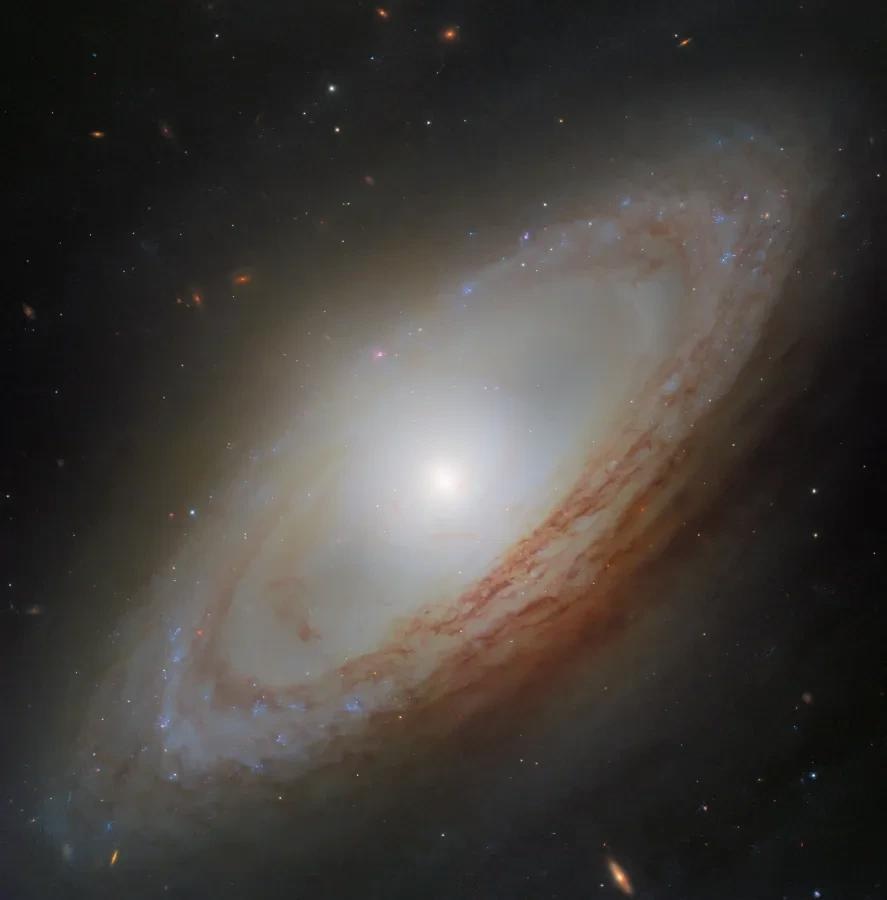 The spiral galaxy NGC 4698 shines in this image from the NASA/ESA Hubble Space Telescope. Image Credit: ESA/Hubble & NASA, D. Thilker, the MAUVE-HST Team
The galaxy is designated NGC 4698 and is situated approximately 55 million light-years distant within the constellation Virgo. It constitutes one of more than one thousand galaxies comprising the Virgo Cluster, which represents the nearest substantial assemblage of galaxies held together through gravitational forces.
As a spiral galaxy comparable to the Milky Way, NGC 4698 exhibits spiral arms that rotate around a thin disk composed of stars, gas, and dust. These arms are characterized by opaque concentrations of brown dust and interspersed with small clusters of luminous blue stars.
In contrast to numerous other spiral galaxies, such as one recently captured by the Hubble Space Telescope, NGC 4698's delicate spiral arms are predominantly visible in the outer regions of the disk; while spiral arms typically extend toward the galactic center in many galaxies, NGC 4698's spiral arms appear to recede from its luminous core. The arms instead form a ring-like configuration positioned around the galaxy's outer boundary.
The galactic center of NGC 4698 is characterized by a prominent elongated bulge. The subdued, pale luminescence emanating from this bulge originates from diminutive, ancient, and cooler stellar populations, contrasting sharply with the luminous blue stars scattered throughout the galaxy's peripheral disk.
These densely concentrated stars orbit a supermassive black hole whose mass exceeds that of the Sun by millions of times. Observational evidence indicates that this black hole is actively accreting, drawing interstellar gas inward through its powerful gravitational influence.
NGC 4698 presents itself with a flat, starry disk and a diffusely luminous center, bearing a superficial resemblance to a conventional spiral galaxy – yet this celestial object deviates significantly from the norm. NGC 4698 is one of only a handful of recognized spiral galaxies with a bulge that protrudes perpendicularly from the disk.
This distinctive elongation is subtly apparent in this Hubble photograph, where the ethereal luminescence of the stellar bulge emerges above and below the dust-laden disk. The stellar matter and gaseous material proximate to the galaxy's core exhibit rotational motion that is perpendicular to the remainder of the disk.
Astronomical research indicates that the probable source of this phenomenon originates beyond the galactic boundaries. NGC 4698 likely accumulated gas from an external source; this newly acquired gas could have formed a gaseous and stellar disk at the galaxy's core, oriented at an oblique angle to the primary disk.
Some observational data suggest this galaxy underwent a minor galactic collision in the past, as shown by a brief 'tail' of hydrogen gas extending from a lateral region of the galaxy.
The image derives from an observational initiative dedicated to examining galaxies within the Virgo Cluster. This initiative provides a magnified examination of structural features within these proximate galaxies, including discrete stellar assemblies and nebular formations.
The research team will employ these observational findings to assess the comprehensive context, thereby advancing understanding of how a galaxy's trajectory through a cluster influences its evolutionary development and capacity for stellar formation.