Researchers at TU Wien have demonstrated that by customizing the pulse shape of a photon, the success rate of transferring quantum information from one qubit to another can be significantly enhanced. The study was published in the journal Physical Review Letters.
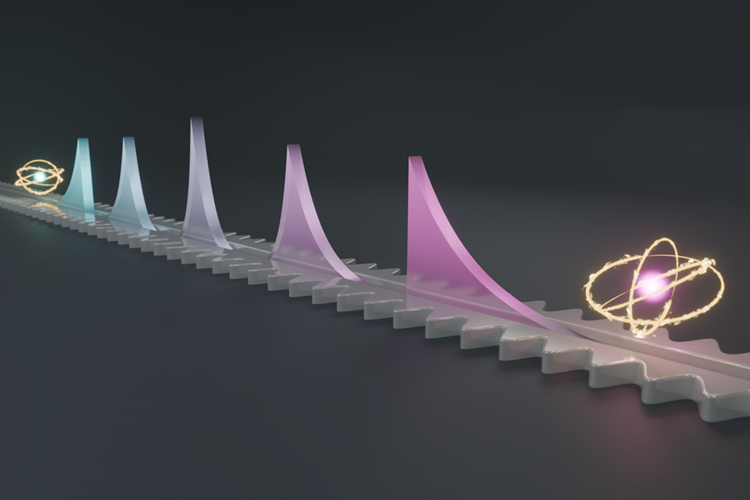 The photon changes shape during propagation. Image Credit: Oliver Diekmann / TU Wien
Photons are capable of transmitting quantum information between qubits; however, this transfer is not always successful.
The majority of contemporary quantum technologies, including quantum cryptography, the quantum internet, and quantum computing, depend on a fundamental component: the transmission of photons. In this process, two qubits (such as two atoms) communicate by having one qubit emit a photon, which is then absorbed by the other qubit.
The probability of the photon being successfully absorbed is significantly less than 100%; conventional methods yield a maximum success rate of approximately 54%, meaning that in nearly half of the instances, the photon is lost. A research team at TU Wien has proposed a solution to this issue: by reversing the shape of the photon, which can be accomplished through a relatively straightforward technique.
Quantum Particles and the Ringing of Bells
When a qubit emits a photon, you must not picture the photon as a tiny particle that is simply shot out. The photon is a wave, and a wave has a certain shape and a certain extension.
Dr. Zeyu Kuang, Institute of Theoretical Physics, TU Wien
The same principle applies to sound waves: when a bell is struck with a hammer, the sound wave is not generated solely at that precise moment; it continues to resonate for a time. At the instant of the hammer's impact, the sound wave reaches peak intensity, then gradually diminishes.
The wave generated when a photon is released from a qubit exhibits a remarkably similar profile: it is initially very pronounced and then decays exponentially. The photon's wave shape is sometimes described as resembling a "sawtooth."
This "photon sawtooth" then propagates away from the initial qubit and can be directed purposefully through a waveguide toward the second qubit, where it is intended to be absorbed. The likelihood of absorption depends on the photon's waveform.
The sawtooth configuration, strong at the outset and then tapering off, is not ideally suited to the waveform the second qubit can absorb most efficiently. A time-reversed pulse would be far more effective: it would gradually increase before peaking at the end.
Time-Reversing the Photon Pulse
This follows from time-reversal-symmetry in quantum mechanics. Under ideal conditions, quantum dynamics are reversible. If a qubit perfectly emits a photon with a particular waveform, the time-reversed process tells us which waveform that qubit can absorb perfectly.
Oliver Diekmann, TU Wien
The inquiry posed to the TU Wien team was: how can the photon’s temporal waveform be reversed? "In a vacuum, light always travels at exactly the same speed, namely the speed of light," says Prof. Stefan Rotter. "But in an optical waveguide this is not necessarily the case. Different frequency components of the wave travel faster than others – mathematically this is described by the so-called dispersion relation."
Building on this concept, the researchers suggest positioning the two qubits within a waveguide and manipulating its dispersion relation to ensure that the waveform of an emitted photon pulse perfectly reverses, thus achieving a theoretical absorption probability of 100%.
We calculated how this goal can be achieved and simulated the process on a computer. Our results indicate that the required setup should be technically feasible. This passive approach could significantly improve the absorption of photons by qubits and thereby increase the efficiency of many quantum technologies.
Carlos Gonzalez-Ballestero, Professor, TU Wien
Download the PDF of this page here
Journal Reference:
Kuang, Z., et al. (2026) Passive Quantum State Transfer in a Dispersion-Engineered Waveguide. Physical Review Letters. DOI:10.1103/m2md-rxkv. https://journals.aps.org/prl/abstract/10.1103/m2md-rxkv.