Recent research led by astronomers at the Center for Astrophysics | Harvard & Smithsonian suggests that actively growing supermassive black holes may actually boost star formation in their host galaxies rather than suppress it. Published in The Astrophysical Journal, the study analyzed nine nearby galaxies to reveal this unexpected interaction.
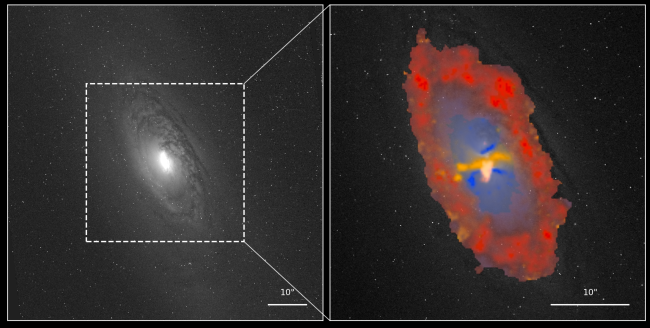 The galaxy NGC1386, shown in grayscale on the left and zoomed in to the central region on the right. The colors represent star formation in red, black-hole radiation in blue, and shocks in yellow. Image Credit: Peixin Zhu.
The research, which utilized observations from the VLT/MUSE instrument, indicates that active galactic nuclei (AGN), the luminous areas powered by material accreting onto a supermassive black hole, are linked to star-forming rings or arcs, cone-shaped regions of energized gas, and rapid "shocks" that arise when energy outflows interact with the surrounding gas.
The study provides a fresh perspective on the potential impact of AGN feedback on the growth and evolution of galaxies.
Once we resolved them, we could see that they not only accrete things, but they also eject things. The injection and accretion are linked with each other.
Peixin Zhu, Graduate Student and Astronomer, Center for Astrophysics | Harvard & Smithsonian
The research concentrated on galaxies with central black holes that are actively accreting, or drawing in, surrounding material.
We’re seeing that black holes are not just consuming material at the centers of galaxies, but they’re actively reshaping their surroundings. This work helps us understand a complex feedback cycle that plays an important role in galaxy evolution.
Lisa Kewley, Astrophysicist, Center for Astrophysics | Harvard & Smithsonian
Lisa Kewley is also the Director of the Center, and Zhu’s Advisor.
The team used a novel three-dimensional diagnostic method to distinguish among three sources: star formation, radiation from the active black hole, and shock excitation. Shock excitation takes place when high-velocity outflows from the central black hole interact with the interstellar medium.
The researchers discovered that star-forming rings or arcs were located at distances ranging from approximately 0.8 to 6 kiloparsecs from the center of the galaxy. Ionized cones of radiation from black holes were observed to extend outward from the discs of the galaxies, while the central areas, characterized by rapid shocks, frequently extended in a direction perpendicular to these bicones.
The researchers identified signs of shocks occurring in directions that are perpendicular to the AGN bicones. Zhu points out that these shocks broadly align with interactions between AGN jets and the interstellar medium, although winds from the active black hole may also play a role, especially in galaxies with lower-power jets.
“The most interesting phenomena about shocks is that they always go perpendicular to where the black hole’s injected outflows go. It is very common, and we see it consistently appearing across the whole nine galaxies,” said Peixin.
The study integrated high-resolution observations with comprehensive theoretical models. The MUSE instrument delivered spatially resolved optical data, while advanced theoretical models developed by Zhu and her colleagues, including astrophysicists Lisa Kewley from the Center for Astrophysics and Ralph Sutherland from the Australian National University, enabled a comparison between observations and predictions about black hole activity, star formation, and shocks.
Chandra X-ray observations independently corroborated the researchers' interpretations.
These results illustrate that actively accreting black holes undergo a complex cycle involving accretion, outflow, and interactions with their host galaxies. By distinguishing the impacts of black hole radiation, star formation, and shocks, the study offers a more precise understanding of this cycle and its connection to star formation.
Download the PDF of this page here
Journal Reference:
Zhu, P., et al. (2026) Common Excitation Patterns of Star Formation, Active Galactic Nuclei, and Shocks in Seyfert Galaxies. The Astrophysical Journal (2026). DOI:10.3847/1538-4357/ae9956. https://iopscience.iop.org/article/10.3847/1538-4357/ae9956.