Scientists at the University of Copenhagen have effectively regenerated the primary matter that existed moments following the Big Bang by colliding far smaller atomic nuclei than earlier deemed feasible. Generating these subatomic mini-collisions may yield fresh perspectives regarding the early Universe, while simultaneously aiding researchers in solving a core mystery within nuclear physics. These scientific results, generated through the international ALICE project, were published in Physical Review Letters.
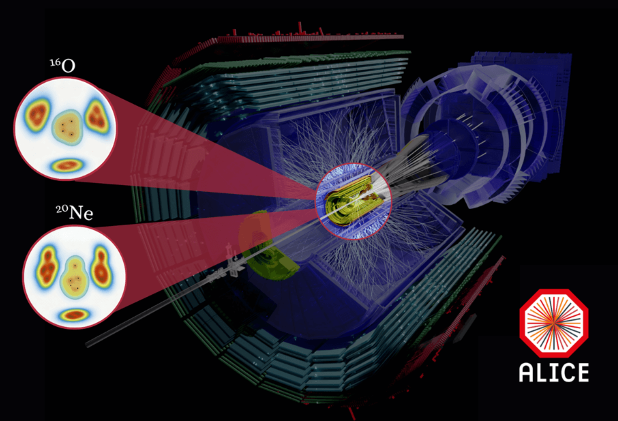 Event display of collisions between Neon-20 and Oxygen-16 at the CERN Large Hadron Collider. Image Credit: University of Copenhagen
What events unfolded during the earliest moments of the Universe, prior to the formation of the fundamental components that make up life and the current reality?
Scientists at Switzerland's CERN laboratory are trying to answer this by replicating the extreme environments present during the Universe's earliest phase. Investigators from the Niels Bohr Institute, alongside partners in the global ALICE team, have made progress toward uncovering these conditions.
Inside CERN facilities, experts accelerate atomic nuclei to nearly light speed before colliding them, producing microscopic quantities of the ultra-dense matter that dominated the Universe in its initial microsecond. Referred to as quark-gluon plasma, this matter represents what is believed to be the original physical state of matter.
For decades, experts believed that generating this state demanded impacts between massive atomic nuclei like lead. However, the Niels Bohr Institute research team has successfully produced this primordial matter by colliding significantly lighter oxygen-16 and neon-20 nuclei instead.
We have pushed the boundary for how small the atomic nuclei can be while still recreating this primordial matter - what you could call a Little Big Bang. We now know more about the fundamental conditions required for matter to transition into this extreme state.
You Zhou, Associate Professor, Niels Bohr Institute, University of Copenhagen
You Zhou adds: “Hopefully, this will help us better understand how the plasma behaved during the first moments of the Universe - and how it later evolved into the forms of matter that everything around us is made of.”
A Microscopic Big Bang Shaped Like a Bowling Pin
Upon impact, the atomic constituents melt into a minute droplet of quark-gluon plasma that exists for a tiny fraction of a second. This ultra-hot matter subsequently expands. Although scientists cannot directly view the plasma, they detect and measure the particles formed.
Here, the particle trajectory demonstrates the atomic nucleus's form. Whereas impacts between two oxygen nuclei yield a more spherical configuration, impacts involving neon result in a shape resembling a bowling pin.
“The particles from the primordial matter are directly governed by the geometric shape of the atomic nucleus. If the two nuclei we smash together are spherical, we get one pattern. If they are shaped like bowling pins, we get another. By studying how the particles move after the collision, we can gain insights into atomic nuclei that are otherwise difficult for physicists to obtain,” explains Postdoctoral Researcher Emil Gorm Dahlbæk Nielsen from the Niels Bohr Institute, who is a co-author of the study.
It is a bit like shining light on an object and seeing its shadow. You cannot see the object directly, but its shadow reveals its shape. In the same way, the movement of the particles reveals the geometric shape of the atomic nuclei that was present at the beginning of the collision.
Emil Gorm Dahlbæk Nielsen, Postdoctoral Researcher, Niels Bohr Institute, University of Copenhagen
Deep Roots at the Niels Bohr Institute
The challenge of determining the shape and structure of atomic nuclei has engaged nuclear scientists for over seven decades, carrying a rich legacy at the Niels Bohr Institute. In fact, it was Aage Bohr’s pioneering research into nuclear structure that secured him the Nobel Prize in Physics in 1975.
An atomic nucleus's shape extends beyond mere geometry. Its configuration reveals the underlying organization of protons and neutrons while offering crucial clues about the strong nuclear force, one of nature's four fundamental interactions that scientists continue to study.
Investigators have primarily probed nuclear structure under low-energy conditions, largely by analyzing how atomic nuclei rotate and vibrate.
A precise understanding of nuclear structure helps us understand the strong force. But instead of carefully investigating nuclei at low energies, we smash them together at the highest energies we can create and can now read their shape from the imprint they leave behind.
You Zhou, Associate Professor, Niels Bohr Institute, University of Copenhagen
Scientists highlight the approach's promise as a potential game-changer. With further refinement, this technique might offer an innovative means to probe atomic nuclei with poorly understood structures.
The precise conditions required to generate quark-gluon plasma remain unknown to scientists. Consequently, the next phase involves experiments using even lighter nuclei, like helium-4.
“What is fascinating is that we can use the same experiment both to learn about the structure of atomic nuclei and to gain a better understanding of what happened during the birth of the Universe. These two things turn out to be much more closely connected than one might initially think,” You Zhou concluded.
Download the PDF of this page here
Journal Reference:
Abualrob, I. J., et al. Evidence of Nuclear Geometry-Driven Anisotropic Flow in O+O and Ne+Ne Collisions at √SNN=5.36 TeV. Physical Review Letters. DOI:10.1103/gymp-vp87. https://journals.aps.org/prl/abstract/10.1103/gymp-vp87.