Recent research published in Nature Astronomy by astronomers at the University of Arizona suggests that galaxies actually began dispersing heavy elements like carbon and oxygen much earlier than previously believed.
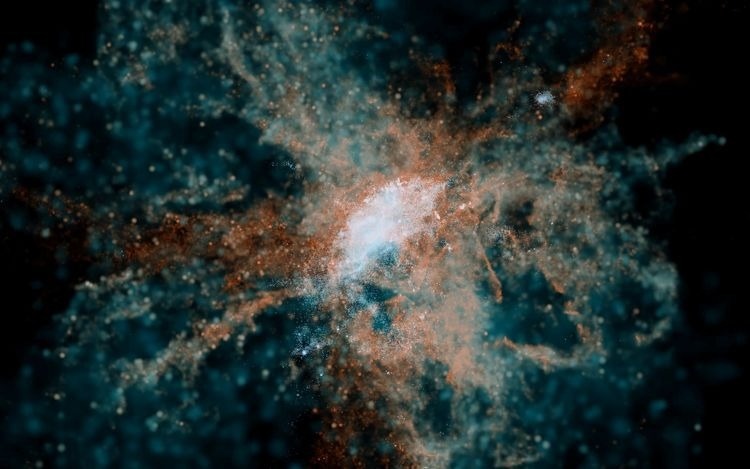 Artist's visualization of an early galaxy and its surrounding gaseous environment. The orange structures represent metal-enriched gas being expelled from the galaxy, illustrating how young galaxies began dispersing heavy elements into their surroundings within the universe's first 500 million years. The visualization is based on publicly available FIRE-2 cosmological simulation data and is not a direct telescope image. Image Credit: Yongda Zhu
When the universe was still very young, roughly 500 million years following the Big Bang, or about 3% of its present age, some of the earliest stars and galaxies had already appeared. For a long time, astronomers have assumed that much of the gas around these newly formed galaxies would have stayed largely unchanged, made primarily of hydrogen and helium, the original materials present at the beginning of the universe.
We observed that heavy elements escaped from galaxies very, very early in cosmic time. Not only were the galaxies producing these elements, but they were also dispersing them, possibly seeding other galaxies.
Yongda Zhu, Study First Author Postdoctoral Researcher, Department of Astronomy and Steward Observatory, The University of Arizona
How the Universe Got Its Elements
In the early universe, the cosmos contained mostly hydrogen and helium, the two simplest elements positioned at the top of the periodic table. Over time, gravity brought clouds of these basic elements together to create stars, and the extreme pressures and temperatures inside stars enabled nuclear fusion and other reactions that produced additional complex, heavier elements like carbon and oxygen.
When stars finished burning or ended as supernovae, they released these heavier elements into space. There, they served as foundational material for later generations of stars, planets, and eventually life. The carbon in human bodies and the oxygen one breathes also came from earlier generations of stars.
Even so, it had not been clear how and when heavier elements moved from the earliest galaxies into the surrounding universe.
Looking at Early Galaxies
Zhu’s work focused on three early galaxies. Their light has traveled for more than 13 billion years, so they are observed as they looked about 500 million years after the Big Bang, during the Epoch of Reionization. At that stage, the first generations of stars and galaxies were changing the early universe by ionizing the hydrogen gas between them. As electrons were removed from hydrogen nuclei, this process gradually ended the cosmic “dark ages” by letting ultraviolet light pass through the universe more easily.
"We used the galaxies themselves as background light sources," said Zhu. "As light from the galaxies traveled toward Earth, it passed through surrounding gas, and we were able to look at the light's absorption patterns to detect specific elements."
NASA’s James Webb Space Telescope made observations of these distant galaxies possible through its infrared capabilities. This allowed the researchers to study galaxies as they appeared about 13 billion years ago. Nearly 30 hours of exposure were enough to reveal faint absorption signatures in the spectra of these faraway galaxies.
Across one long night, Zhu searched through publicly available JWST spectra from hundreds of galaxies and identified three that showed absorption patterns consistent with heavy elements, including carbon, oxygen, and silicon. The absorption lines were “blue shifted” compared with the galaxies’ redshift, showing that the gas was moving away from the galaxies while transporting oxygen, carbon, and other heavy elements into intergalactic space.
The chemical signatures of these young galaxies closely matched those seen in galaxies billions of years later. This supports the idea that, even at cosmic dawn, galaxies were already producing and distributing heavy elements into the surrounding space.
Think of these elements, which originated from the galaxies' stars, as food dye dropped into a cup of water. The color begins to spread through the water, and, in a similar fashion, these heavy elements from early galaxies began to escape into space and 'enrich' their surroundings.
Yongda Zhu, Study First Author Postdoctoral Researcher, Department of Astronomy and Steward Observatory, The University of Arizona
Baryon Cycling
The mechanism through which galaxies move material between them is called baryon cycling. It helps explain why galaxies are not isolated systems, but connected elements within a broader galactic ecosystem. In this way, material formed by one generation of stars can be reused and redistributed across that ecosystem.
Finding evidence for early baryon cycling may also clarify why astronomers have had difficulty detecting the first generation of stars, Population III stars. These stars are expected to be the earliest formed from pristine gas made only of hydrogen and helium, before heavier elements were made and spread through the universe. If galaxies were already enriching their surroundings only 500 million years after the Big Bang, genuinely pristine gas, and the Population III stars that formed from it, may not have lasted long enough to be observed.
If you start out with pure vanilla ice cream but start mixing in sprinkles soon after, it won't be long until you can no longer find any pristine, plain, vanilla ice cream.
Yongda Zhu, Study First Author Postdoctoral Researcher, Department of Astronomy and Steward Observatory, The University of Arizona
Journal Reference:
Zhu, Y., et al. (2026). Early metal-enriched baryon cycling before the midpoint of cosmic reionization. Nature Astronomy. DOI:10.1038/s41550-026-02988-2. https://www.nature.com/articles/s41550-026-02988-2.