An international team of astronomers identified one of the faintest galaxies ever found orbiting the Andromeda Galaxy in a study published in Astronomy & Astrophysics. Researchers from the University of Surrey contributed to the discovery of a rare “cosmic fossil” that could provide fresh insights into the formation of the first galaxies.
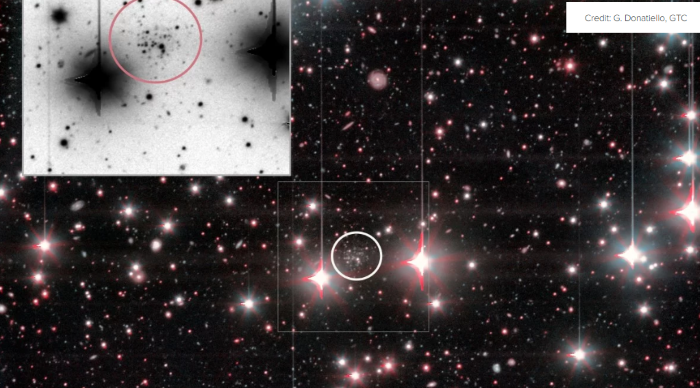 Stacked GTC OSIRIS+ image of And XXXVI. And XXVI is clearly evident in-between two bright foreground stars. In the inset we show a negative color zoom-in on And XXVI. Image Credit: G. Donatiello, GTC
The Surrey team collaborated with astronomers from the Instituto de Astrofísica de Andalucía (IAA-CSIC) to establish the presence of Andromeda XXXVI, an ultra-faint dwarf galaxy estimated to be 12.5 billion years old.
Ultra-faint dwarf galaxies are among the smallest and faintest galaxies discovered. They are regarded as fossil recordings of the first galaxies to appear after the Big Bang, having formed during the Universe's early phases. Each finding offers a distinct perspective on early galaxy formation and a means of testing dark matter models.
The Andromeda Galaxy, approximately 2.5 million light-years away from Earth, is the Milky Way's nearest massive galactic neighbor. Although current theoretical estimates indicate that it might host up to 90 satellite galaxies, only about 40 have been discovered, with just 15 categorized as ultra-faint.
Our study suggests that And XXXVI is an extremely old galaxy, around 12.5 billion years old, and remarkably poor in heavy elements. However, observations with space telescopes such as Hubble will be needed to determine its distance, age and chemical composition with greater precision.
Joanna Sakowska, Study Lead Author and Researcher, Instituto de Astrofísica de Andalucía
Sakowska added, “What is already clear is that And XXXVI is one of the faintest satellite galaxies discovered around Andromeda to date. Each new discovery, such as Andromeda XXXVI, is important because it suggests that we may still be seeing only the tip of the iceberg of a much larger population of extremely faint galaxies.”
Due to And XXXVI’s unusually low brightness, scientists were only able to identify 46 of the galaxy’s stars, making it very challenging to calculate its distance using standard techniques.
After obtaining significantly deeper pictures with the Gran Telescopio Canarias and OSIRIS+ instrument, the team compared the stars with isochrones, which are theoretical models of stellar development. These findings clearly suggested that And XXXVI is a satellite galaxy of Andromeda and that it is located at around the same distance.
The examination of the galaxy's brightness and structural characteristics was then spearheaded by Surrey researchers, who measured the galaxy's size, shape, and luminosity to better describe the recently found system.
Galaxies this faint push our analysis techniques to their limits because there are so few stars to work with. Measuring Andromeda XXXVI's structure and brightness allowed us to show that it fits the profile of an ultra-faint dwarf galaxy orbiting Andromeda, adding another important piece to the puzzle of how these tiny galaxies formed and evolved.
Michelle Collins, Professor and Associate Dean Doctoral College, University of Surrey
Astrophotographer and amateur astronomer Giuseppe Donatiello initially noticed Andromeda XXXVI while looking at publicly accessible images from the Pan-Andromeda Archaeological Survey. Professional astronomers were then informed of his results so they might be investigated further.
The discovery is the fourth dwarf galaxy in the Andromeda region found by the project in the last ten years, according to Dr. David Martínez-Delgado, an ARAID researcher at CEFCA and co-author of the study. This shows the significant contribution amateur astronomers can make when they have access to public data from major sky surveys.
Our list of possible candidates for these ‘lost galaxies’ already exceeds a dozen, and we are eager to obtain observing time on telescopes with apertures between eight and 10 meters to confirm them.
Dr. David Martínez-Delgado, Study Co-Author and ARAID Researcher, CEFCA
Discoveries like Andromeda XXXVI indicate that many more ultra-faint galaxies could still be out there, providing new insights into the early stages of the Universe’s existence as scientists continue to scan the skies for similar objects.
Download the PDF of this page here
Journal Reference:
Sakowska, J. D., et al. (2026) Andromeda XXXVI: Discovery of a new ultra-faint dwarf galaxy towards M31. Astronomy & Astrophysics. DOI:10.1051/0004-6361/202660151. https://www.aanda.org/articles/aa/full_html/2026/06/aa60151-26/aa60151-26.html.