A scientist at the University of Birmingham has constructed a "mini universe" that moves closer to providing more answers about the nature of time. The study was published in Physical Review Research.
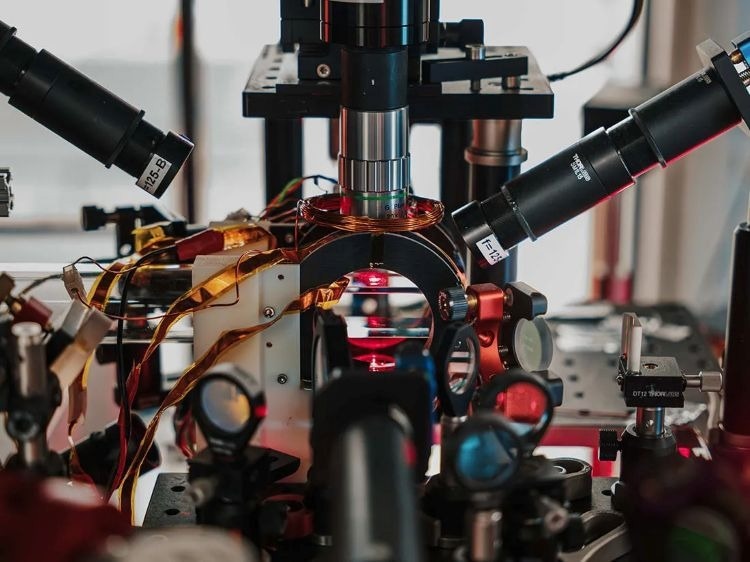 The "cloud" inside the glass cell is a magneto-optical trap of rubidium atoms at a temperature of ~0.0001 degrees above absolute zero. It is only the first step to "build" the mini-universe. Image Credit: University of Birmingham
Professor Giovanni Barontini demonstrates how time can be measured without a clock. The new results offer a scientific model in which the experiment itself gives rise to a version of time.
According to the Wheeler–DeWitt equation and related theories in physics, the cosmos can be described as a single, unchanging quantum state that exhibits both wave-like and particle-like characteristics. Without an external clock, these frameworks view the universe as a whole rather than as something evolving against a separate timeline. In this view, our experience of time must emerge from the intrinsic relationships and correlations between the universe's constituent parts.
Professor Barontini created a hermetically enclosed quantum system that resembles a basic "universe" using a cloud of 24,000 ultracold atoms, which are only a few billionths of a degree above absolute zero. To produce an observable (or "bright") and an unobserved (or "dark") zone, two laser beams of different frequencies were used to construct a thin barrier that captured and split the particles.
Similar to a Big Bang and a Big Crunch (a hypothetical situation in which the expansion of the universe finally reverses) the "bright" region periodically grows and collapses. Without using an external laboratory clock, the experiment enables the sequence of events to be recreated from within the mini-universe itself.
The experiment showed that rather than existing as an external entity that ticks away on its own, time could arise from changes taking place inside a quantum system.
The "mini universe" was used to show how the disorder or spread (entropy) of atoms and how they behaved in a system might be used to generate "time." Although atoms could travel between "bright" and "dark" areas, the system was otherwise cut off from the outside world.
Quantum Mechanics and Time
The system was "moving forward in time" when the distribution of particles in the light sector changed as atoms entered or exited. Time essentially halted while this dispersion of atoms remained unchanged.
Professor Barontini discovered that this form of time, known as "entropic time," flows in a single, steady direction, creating a distinct "arrow of time" that accurately orders events, even in a system that is growing and shrinking like a miniature universe, and that accelerates or decelerates based on the flow of entropy.
Professor Barontini said: “In some theories of the universe, especially quantum gravity, time doesn’t appear as a built-in feature. Yet in everyday life, time flows from past to future – why is this so, when most basic laws of physics work the same way forwards and backwards?”
This study provides the first controlled experimental evidence that ‘time’ can be defined by changes within a system rather than as the external ‘ticking clock’ we think of as time. It offers new insight into the nature of time in quantum gravity that could be used to describe dynamics just as effectively as conventional time.
Giovanni Barontini, Professor, Physics, University of Birmingham
The study also shows that entropic time may still be used to write a version of the fundamental equation of quantum mechanics (Schrödinger), allowing predictions of how a quantum system's "probability cloud" would evolve over time.
The experiment answers a long-standing physics question: how can one determine what comes "before" and "after" in the absence of an internal clock in some universe theories?
Professor Barontini demonstrated that the system adheres to the standard equations of quantum physics and shows that complex issues about the nature of time, which are typically only addressed in theories pertaining to the cosmos as a whole, may be investigated in carefully regulated laboratory experiments.
Concepts related to the early universe can now be scientifically evaluated in the lab thanks to the experiment, which offers a potent testbed for theories in quantum cosmology and gravity.
Researchers may be able to investigate the physics of the Big Bang and the "Big Crunch" by applying the method to more complicated systems. It might also be used to test opposing ideas regarding the emergence of time in the cosmos or to simulate black holes in a lab.