Nearly a millennium ago, scientists observed a magnificent new star blazing in the sky: a supernova so intense that it could be seen in daytime for weeks, despite being located 6,500 light years away. The Crab Nebula, its growing remnant, is still evolving. Edwin Hubble was the first to relate the nebula to historical records, and the NASA/ESA Hubble Space Telescope has subsequently examined it in fine detail, revisiting this ancient explosion to chart its continuous growth and evolution. The latest findings were reported in The Astrophysical Journal.
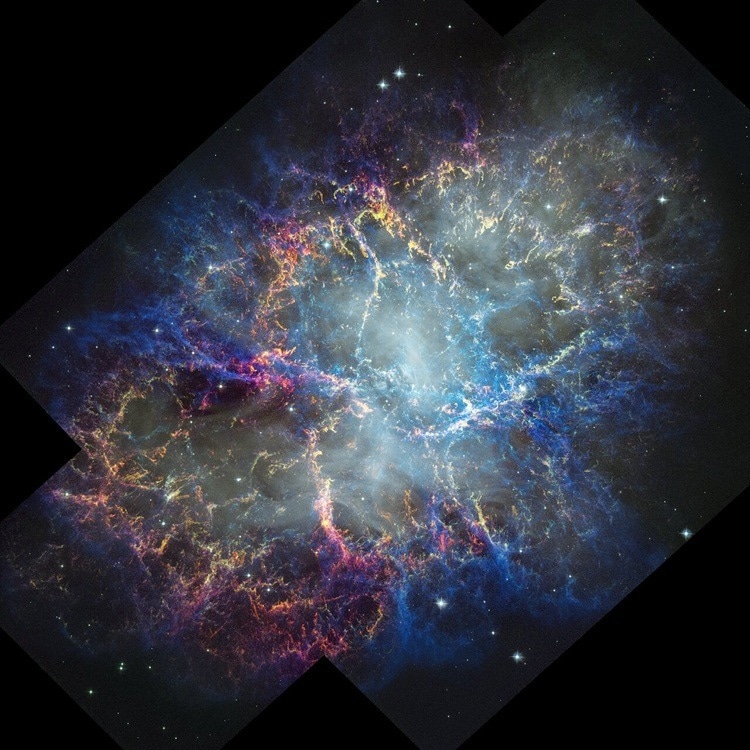 Crab Nebula (2024 Hubble image). Image Credit: NASA, ESA, STScI, W. Blair (JHU). Image Processing: J. DePasquale (STScI)
A quarter-century after its first observations of the whole Crab Nebula, the Hubble Space Telescope has returned to examine the supernova remnant once again. The Crab Nebula is the aftermath of SN 1054 and is approximately 6,500 light-years away in the constellation Taurus.
The result is an unmatched, comprehensive view of a supernova’s aftermath, showing how it has evolved over the course of Hubble’s long mission.
The supernova remnant was detected in the mid-18th century, and in the 1950s, Edwin Hubble was one of numerous astronomers who noticed a strong link between Chinese astronomical records of a supernova and the position of the Crab Nebula
The discovery that the center of the Crab contained a pulsar (a rapidly rotating neutron star driving the nebula’s expansion) helped align modern measurements with ancient records.
Hubble's latest image of the nebula captures astonishing details of its filamentary structure, as well as the significant outward movement of those filaments over 25 years, at a rate of 5.5 million kilometers per hour. Hubble is the only telescope with the lifespan and resolution required to capture these finer details.
Hubble's 1999 image of the Crab was reprocessed to make it easier to compare with the new image. Both of the Hubble images' color differences reflect variations in the gas's local temperature, density, and chemical composition.
The research team discovered that the filaments surrounding the nebula's perimeter appear to have moved more than those in the center, and instead of extending out over time, they appear to have simply moved outward.
This is due to the Crab’s nature as a pulsar wind nebula, powered by synchrotron radiation produced through the interaction between the pulsar’s magnetic field and the surrounding nebular material. In some well-known supernova remnants, the expansion is driven by shockwaves from the original explosion, which erode the surrounding shells of gas that the dying star had previously pushed forth.
The new, higher-resolution Hubble observations are also providing fresh insight into the Crab Nebula’s three-dimensional structure, something that can be difficult to interpret from a two-dimensional image. In some cases, the filaments cast visible shadows against the diffuse haze of synchrotron radiation in the nebula’s interior. Interestingly, several of the more prominent filaments in the latest Hubble images show no shadows at all, suggesting they are located on the far side of the nebula.
According to the research team, the real value of Hubble's Crab Nebula observations is still to be determined. The Hubble data can be combined with current data from other telescopes that monitor the Crab at different wavelengths of light.
A comparison of the Hubble image with other recent multiwavelength observations can assist scientists in putting together a more comprehensive picture of the supernova's ongoing aftermath, centuries after astronomers first noticed a new small star sparkling in the sky.
The Hubble Space Telescope is a joint effort of the ESA and NASA.
Sources:
Journal Reference:
Blair, W. P. et al. (2026) The Crab Nebula Revisited Using HST/WFC3. The Astrophysical Journal. DOI: 10.3847/1538-4357/ae2adc. https://iopscience.iop.org/article/10.3847/1538-4357/ae2adc.
ESA/Hubble