A new study published in Physical Review Letters by a team of researchers, including Zhifeng Ren’s group at the University of Houston and Rui He’s group at Texas Tech University, reveals an unusual quantum coherence of the vibrations, or phonons, in cubic boron arsenide, a semiconductor with excellent electronic and thermal properties.
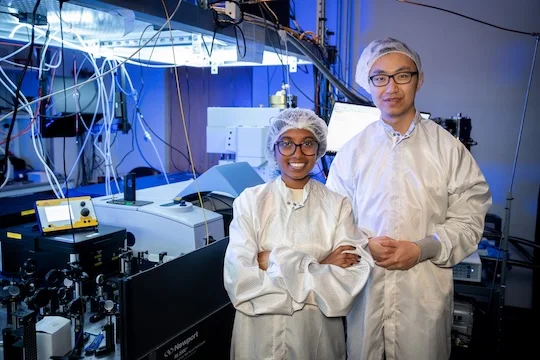 Sanjna Sukumaran and Hanyu Zhu. Image Credit: Jorge Vidal/Rice University
All solid materials produce a sound, even if it is difficult to hear. Atoms in chemical bonds are never silent. A low hum or high-energy squeak can be heard beneath the surface of any material.
When atoms vibrate in their lattices, they either move in the same direction, resulting in a low humming sound, or they move in opposite directions, resulting in an energetic vibration that registers as a bright squeak or titter.
These vibrations are crucial for both classical or quantum electronics.
Hanyu Zhu, Study Corresponding Author and Associate Professor, Materials Science and NanoEngineering, Rice University
Humming sounds, also known as acoustic phonons, are important for heat conduction. When a computer chip warms up, acoustic phonons transport heat away.
Tittering sounds, or optical phonons, control infrared thermal radiation. They can not only provide an additional route for regulating excess heat in electronics, but they can also broadcast information directly into the surrounding area. However, they usually have a shorter lifetime than acoustic phonons because, in most materials, optical phonons shift energy to acoustic phonons via friction.
Quantum mechanics dictates that this process must involve an integer number of particles, meaning at least one in and two out.
Hanyu Zhu, Study Corresponding Author and Associate Professor, Materials Science and NanoEngineering, Rice University
This mechanism is called three-phonon scattering by physicists. Contrary to expectations, the energy transfer from optical phonons to acoustic phonons can also occur by an alternative, far less likely pathway that includes splitting into three particles –, a process known as four-phonon scattering.
“In boron arsenide, an optical phonon contains more energy than any possible combination of two outgoing acoustic phonons, so the friction against one optical phonon by two acoustic phonons does not occur. This means that optical phonons in boron arsenide are especially long-lived,” Zhu added.
The group of scientists used just boron-11 isotopes to create superior crystals. They then investigated phonon scattering routes at both room temperature and cryogenic temperatures using two methods: high-resolution Raman and infrared spectroscopy.
“We found record-high coherence for phonons at low temperatures, when the vibration completed nearly a thousand cycles before fading, compared to less than a hundred in typical materials,” Zhu noted.
The analysis of coherence temperature dependency proved that in boron arsenide, four-phonon scattering outperforms three-phonon scattering. The findings further show that the remaining boron-10 isotope is the primary cause of coherence loss at the quantum ground state.
Our sample contains some puddles of structural defects, but surprisingly and gladly, they do not affect the coherence of optical phonons at all.
Sanjna Sukumaran, Study Co-Author and Doctoral Student, Rice University
“Without isotope impurity, we can extend the lifetime by another 10 times, These findings encourage further efforts of isotope engineering in boron arsenide, which offers a promising semiconductor platform for quantum phononics,” Zhu stated.
The first author of the study is Tong Lin, a Rice doctoral alumna who worked under Zhu's supervision.
The Welch Foundation (C-2128), the Air Force Office of Scientific Research (FA9550-24-1-0135), the US Department of Energy (DE-SC0020334), the National Science Foundation (2300640, 2425439), and Qorvo Inc. all provided funding for the study.
Rice researchers set record for quantum vibrations in boron arsenide
Video Credit: Rice University
Journal Reference:
Lin, T. et al. (2026) Exceptional Optical Phonon Coherence in Enriched Cubic Boron Arsenide via Suppression of Three-Phonon Scattering. Physical Review Letters. DOI: 10.1103/qysd-d6rn. https://journals.aps.org/prl/abstract/10.1103/qysd-d6rn.