Using a novel technique that examines the motion of two nearby galaxy groups within their surrounding cosmic flow, an international team led by David Benisty of the Leibniz Institute for Astrophysics Potsdam (AIP) has published two new studies in Astronomy & Astrophysics that assess the expansion of the Universe in the immediate cosmic neighborhood.
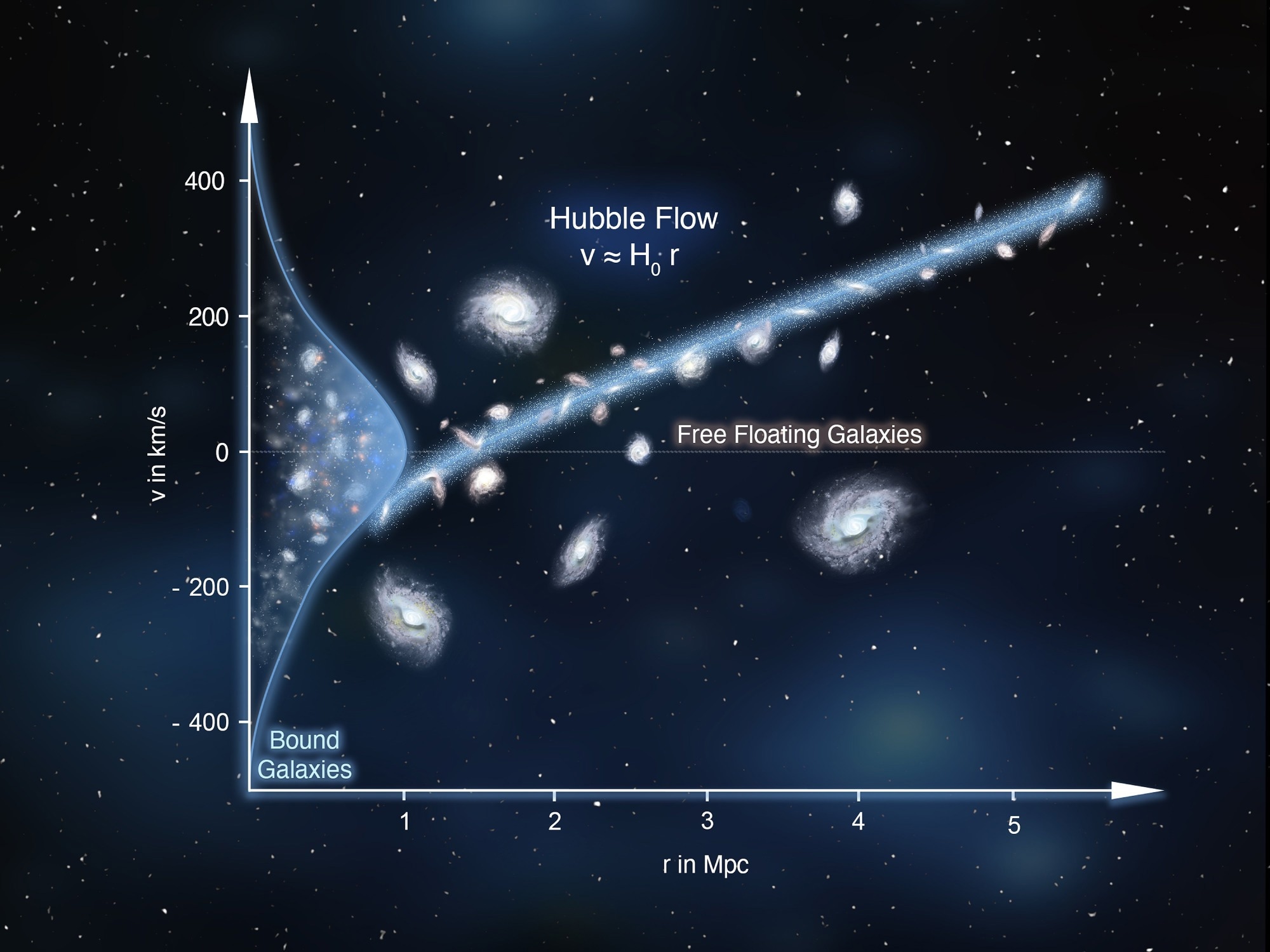 The velocities of galaxies in groups versus distance. Embedded in the expanding Universe the attractive forces of gravity cluster the groups members together and cosmic expansion tears the outer member galaxies away. This balancing act jointly constrains the mass of the gravitationally-bound group and the Hubble constant being the expanding pull. Image Credit: AIP/ D. Benisty / J. Fohlmeister
The findings show that the local Universe is growing more slowly than previously thought, bringing measurements of nearby galaxies in close alignment with observations of the early Universe. The findings also indicate that less dark matter is needed to explain the motion of galaxies in these groups than previously assumed.
Each study examines observational data from a separate neighboring galaxy group, the Centaurus A group and the M81 group, to calculate both their masses and the Hubble constant.
The Hubble constant quantifies how quickly the Universe expands, represented as a ratio of recessional velocity to a galaxy's distance from Earth. The Hubble constant is measured in km/s per Megaparsec, where 1 Megaparsec equals 3.3 million light years.
A precise measurement of the Hubble constant of 68 km/s/Mpc was derived from the first light in the early Universe, the cosmic microwave background radiation. Another highly precise measurement of the Hubble constant could come from our late, local Universe by measuring distances between stars in receding galaxies. That measurement, however, gives a value of 73 km/s/Mpc.
The Hubble tension refers to the discrepancy between the expansion rates measured for the early Universe and those observed in the late Universe. Over the past several decades, increasingly precise observations have turned this discrepancy into one of the central issues in modern cosmology. It now poses a significant challenge to our understanding of cosmology and the underlying laws of fundamental physics.
Need a refresher on the Hubble Tension?
The new research offer insight on this tension from a more comprehensive perspective, as opposed to the approach centered on stellar explosions. While the stellar-explosion approach seeks to directly trace cosmic expansion, the new research examines the motion of galaxies in groups nested inside the expanding Universe. Gravitational forces draw the groupings together, whereas cosmic expansion separates the individual galaxies.
This balancing act constrains the mass of the gravitationally bound group, while the Hubble constant represents the expanding pull. Surprisingly, David Benisty of AIP and his team determined a Hubble constant of around 64 km/s/Mpc. The findings show that at least some of the Hubble tension may stem from the measurements and methods used to calculate the Hubble constant.
The researchers focused on two galaxy groups: the Centaurus A group is one of the closest galaxy groupings other than the Milky Way's own Local Group. It is thought to be dominated by the massive elliptical galaxy Centaurus A and has hundreds of smaller satellite galaxies. The new investigation revealed that the Centaurus A group is not focused on Centaurus A, but rather forms a binary with the M83 galaxy. As a result, the researchers obtained the first binary value of the Hubble constant from this group, as well as a more precise mass estimate.
The M81 Group is known to include two dominant galaxies at its core: M81 and M82. The expanded dataset shows that the surrounding member galaxies continue to form a planar structure, consistent with earlier findings.
Analysis of the system’s chaotic dynamics also reveals that this arrangement remains surprisingly well ordered. The inner planar region, extending to less than one million light-years from the center, is tilted by roughly 34 degrees relative to the larger-scale environment. Farther out, at distances of around ten million light-years, the orientation gradually shifts to align with the broader sheet-like structure that stretches toward the Centaurus A group.
Most intriguingly, the two galaxy groups do not just share a comparable environment. They also share the fact that the masses of the most luminous member galaxies account for virtually all of the total group mass, and that the movements of all galaxies in their neighborhood are equally well represented by the interaction of the galaxies' gravitational attraction and cosmic pull.
As a result, unlike simulated galaxy groups, which are invariably immersed in a larger dark-matter halo, the observations of both galaxy groups can be explained without the additional dark mass.
The team will utilize this strategy to gain a thorough knowledge of structures in our cosmic vicinity and apply it to a bigger cosmic expanse. With new observations at greater distances, such as those from the 4-metre Multi-Object Spectroscopic Telescope (4MOST), future data releases may not only resolve the Hubble tension but also provide a more precise census of how much of this perplexing dark matter exists in the Universe.
This research was conducted in collaboration with David Benisty (AIP Potsdam), Jenny Wagner (Academia Sinica, Institute of Astronomy and Astrophysics, and University of Helsinki), Adrian Faucher (École Polytechnique), David Mota (University of Oslo), and Igor Karachentsev (Special Astrophysical Observatory, Russian Academy of Sciences).
Keep the PDF of this article here
Sources:
Journal References:
Faucher, A. et al. (2025) Hubble-constant and -mass determination of Centaurus A and M83 from tip-of-red-giant-branch distances. Astronomy & Astrophysics. DOI: 10.1051/0004-6361/202556283. https://doi.org/aanda.org/articles/aa/full_html/2026/01/aa56283-25/aa56283-25.html.
Wagner, J. et al. (2025) The binary ballet: Mapping local expansion around M 81 and M 82. Astronomy & Astrophysics. DOI: 10.1051/0004-6361/202557876. https://www.aanda.org/articles/aa/full_html/2026/02/aa57876-25/aa57876-25.html.
Leibniz Institute for Astrophysics Potsdam