The "Champagne Cluster," discovered on New Year's Eve 2020, is a merging galaxy cluster captured in a new image from NASA's Chandra X-ray Observatory and optical telescopes. Astronomers are studying the Champagne Cluster to understand how dark matter behaves during high-speed collisions, with two possible collision scenarios being investigated. The study was published in The Astrophysical Journal.
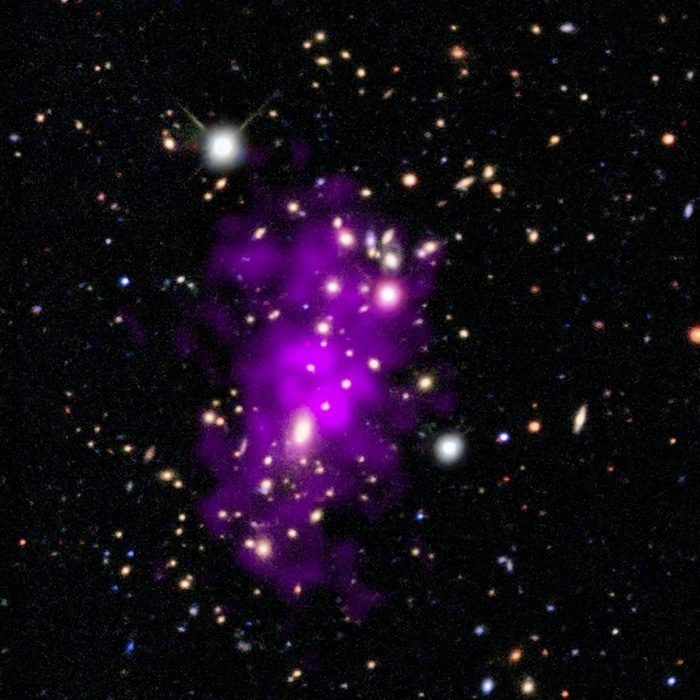 X-ray: NASA/CXC/UCDavis/F. Bouhrik et al.; Optical:Legacy Survey/DECaLS/BASS/MzLS; Image Processing: NASA/CXC/SAO/P. Edmonds and L. Frattare. Image Credit: NASA
The timing, along with the bubble-like look of the galaxies and superheated gas observed in Chandra data, led researchers to nickname the galaxy cluster the Champagne Cluster, a far easier-to-remember title than its formal designation of RM J130558.9+263048.4 object.
The newly released composite image reveals that the Champagne Cluster isn't a single galaxy cluster, but rather two distinct clusters in the process of merging to form a larger one.
Typically, gas heated to millions of degrees in galaxy clusters appears as a roughly circular or slightly oval shape in images. But in the Champagne Cluster, the gas is stretched vertically, a telltale sign of two clusters colliding. Supporting this, there are two visible concentrations of individual galaxies, one near the top and one near the bottom of the image center, marking the locations of the merging clusters.
The hot gas is heavier than the combined mass of all the hundred-plus individual galaxies in the newly forming cluster. The clusters also contain even larger amounts of unseen dark matter, the mysterious substance that fills the universe.
Besides the Chandra data, this new image includes optical data from the Legacy Surveys (red, green, and blue), which is made up of three separate and complementary surveys from different telescopes in Arizona and Chile.
The Champagne Cluster belongs to a rare class of merging clusters, which includes the well-known Bullet Cluster, where the hot gas in each cluster has collided and slowed, and there is a clear separation between the hot gas and the most massive galaxy in each cluster.
By comparing the data to computer simulations, astronomers proposed two potential histories for the Champagne Cluster. One possibility is that the two clusters collided over two billion years ago.
Following the collision, the clusters moved outward, then gravity pulled them back, and they are now approaching a second collision. The other idea suggests a single collision roughly 400 million years ago, and the two clusters are now moving away from each other after that collision.
Journal Reference:
Bouhrik, F., et al. (2025). Discovery and Multiwavelength Analysis of a New Dissociative Galaxy Cluster Merger: The Champagne Cluster. The Astrophysical Journal. DOI:10.3847/1538-4357/ade67c. https://iopscience.iop.org/article/10.3847/1538-4357/ade67c.