The intense winds of giant stars, which carry the essential elements for life throughout the galaxy, are not solely driven by starlight and stardust, according to a recent study from Chalmers University of Technology, Sweden, focusing on the red giant star R Doradus. The findings contradict a long-standing theory about how the fundamental components of life are dispersed. The study was published in Astronomy & Astrophysics.
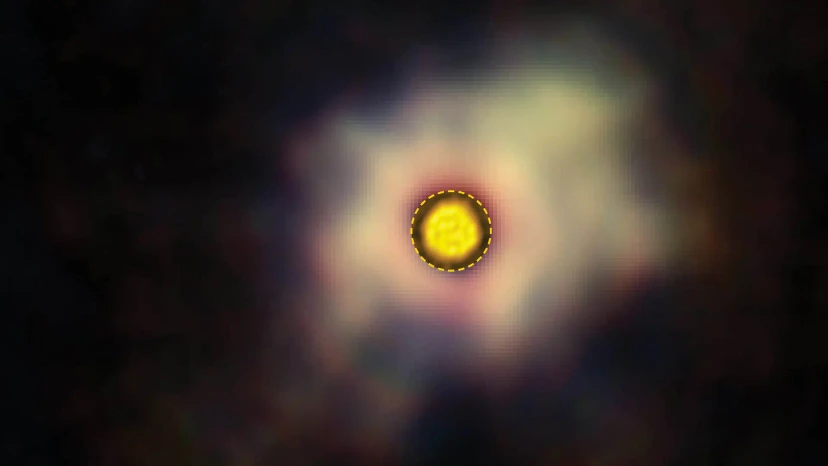 Dust clouds reflect starlight around the star R Doradus. This image combines polarised visible light taken with the Very Large Telescope in Chile, and an image of the star’s surface taken with Alma. Image Credit: ESO/T. Schirmer/T. Khouri; ALMA (ESO/NAOJ/NRAO)
We thought we had a good idea of how the process worked. It turns out we were wrong. For us as scientists, that’s the most exciting result.
Theo Khouri, Astronomer, Chalmers University of Technology
To comprehend the beginnings of life on Earth, astronomers must understand how giant stars generate their winds. For many years, scientists have thought that winds from red giant stars (which distribute carbon, oxygen, nitrogen, and other vital elements for life throughout the galaxy) are powered by starlight pushing against newly formed dust particles. The new observations of R Doradus dispute this established view.
Red giant stars are the Sun's older, cooler counterparts. As they age, they shed significant amounts of material via stellar winds, thereby enriching the space between stars with the basic components for future planets and life. Despite their significance, the physical process that powers these winds has remained unclear.
Astronomers studying the nearby red giant star R Doradus have discovered that the minuscule grains of stardust around the star are too small to be propelled outward by starlight with enough force to escape into interstellar space.
Combining Observation and Simulations
Using the world’s best telescopes, we can now make detailed observations of the closest giant stars. R Doradus is a favourite target of ours: it’s bright, nearby, and typical of the most common type of red giant.
Theo Khouri, Astronomer, Chalmers University of Technology
The team studied R Doradus using the Sphere instrument on ESO’s Very Large Telescope, gauging light reflected by dust particles in an area about the size of the Solar System. By analyzing polarized light at various wavelengths, the researchers identified the size and makeup of the particles, discovering they matched typical types of stardust like silicates and alumina.
The observations were then integrated with sophisticated computer simulations that model how starlight interacts with dust.
For the first time, we were able to carry out stringent tests of whether these dust grains can feel a strong enough push from the star’s light.
Thiébaut Schirmer, Chalmers University of Technology
The team was surprised to discover that starlight's pressure is not sufficient. The grains around R Doradus are usually only about one ten-thousandth of a millimeter wide, which is too small for starlight to propel the star's wind into space.
“Dust is definitely present, and it is illuminated by the star,” says Thiébaut Schirmer. “But it simply doesn’t provide enough force to explain what we see.”
The results suggest that other, more complicated processes are significant. The team previously used the ALMA telescope to take images of huge bubbles ascending and descending on R Doradus's surface.
Even though the simplest explanation doesn’t work, there are exciting alternatives to explore. Giant convective bubbles, stellar pulsations, or dramatic episodes of dust formation could all help explain how these winds are launched.
Wouter Vlemmings, Study Co-Author and Professor, Chalmers University of Technology
Journal Reference:
Schirmer, T., et al. (2025). An empirical view of the extended atmosphere and inner envelope of the asymptotic giant branch star R Doradus. Astronomy and Astrophysics. DOI: 10.1051/0004-6361/202556884. https://www.aanda.org/articles/aa/full_html/2025/12/aa56884-25/aa56884-25.html.