Scientists from the University of the Witwatersrand in South Africa, working with Huzhou University, have found that the entanglement method used in most quantum optics labs can have hidden topologies, reporting the highest ever seen in any system: 48 dimensions with over 17,000 topological signatures, a huge alphabet for encoding strong quantum information. The research was published in the journal Nature Communications.
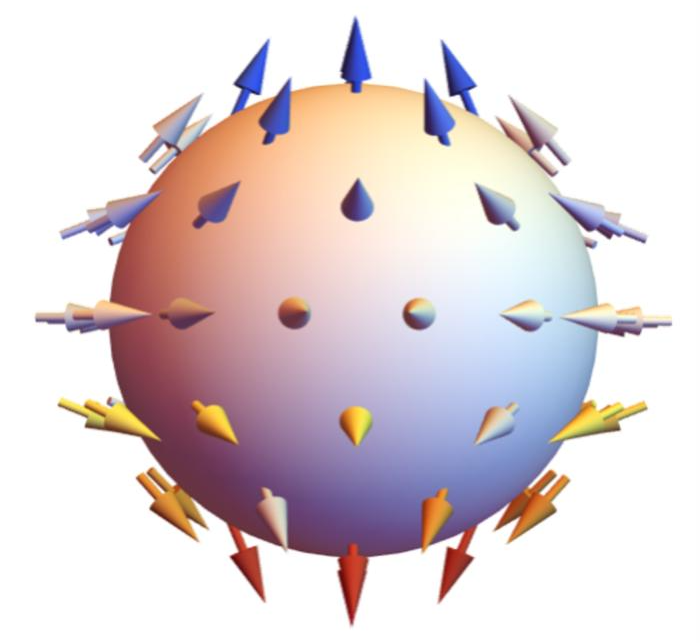 Examples of quantum topologies, shown as vectorial textures on a sphere. Image Credit: Wits University
Quantum optics labs typically generate entangled photons via spontaneous parametric down-conversion (SPDC). This process inherently creates entanglement in “space,” the spatial degrees of freedom of light.
Researchers have discovered high-dimensional topologies within this space, presenting new models for information encoding and enhancing quantum information's resilience to noise. The topology was demonstrated using the orbital angular momentum (OAM) of light, spanning from two dimensions to very high dimensions.
The team demonstrated that measuring the OAM of two entangled photons reveals a topology: a fundamental characteristic of the entanglement. Because OAM can have an infinite number of values, the topology also can.
We report a major advance in this work: we only need one property of light (OAM) to make a topology, whereas previously it was assumed that at least two properties would be needed, usually OAM and polarization. The consequence is that since OAM is high-dimensional, so too is the topology, and this let us report the highest topologies ever observed.
Andrew Forbes, Professor, School of Physics, University of the Witwatersrand
The team demonstrated that when the topology goes beyond two dimensions, multiple topological numbers are required instead of a single one, unlike what is observed in typical optical topologies.
A key advantage of this finding is that the necessary equipment is standard in most quantum optics labs and does not require a specialized "quantum engineer."
Pedro Ornelas details, “You get the topology for free, from the entanglement in space. It was always there; it just had to be found.”
In high dimensions, it is not so obvious where to look for the topology. We used abstract notions from quantum field theory to predict where to look and what to look for, and found it in the experiment!
Robert de Mello Koch, Professor and Study Lead Author, Huzhou University
Orbital angular momentum entanglement has been researched and applied in numerous quantum systems, though it has previously been fragile. The team now believes that OAM entanglement can be re-examined through the lens of its underlying topology, which could create new opportunities for its use in practical quantum systems.
Journal Reference:
de Mello Koch, R., et al. (2025). Revealing the topological nature of entangled orbital angular momentum states of light. Nature Communications. DOI:10.1038/s41467-025-66066-3. https://www.nature.com/articles/s41467-025-66066-3.