Scientists from Australia and other countries have, for the first time, fully mapped how errors develop over time within a quantum computer. This discovery could significantly boost the reliability of future quantum machines. The study was published in Quantum.
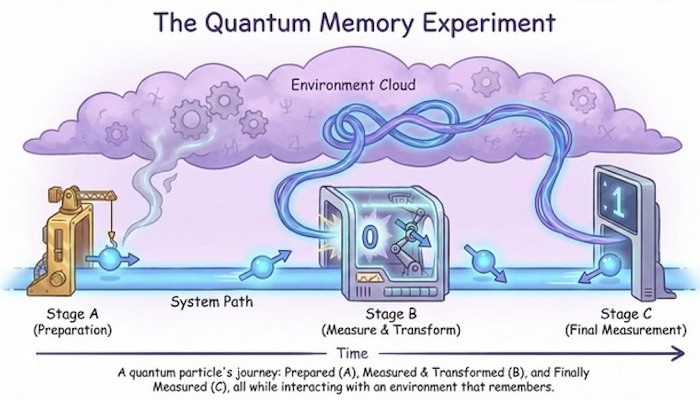 Quantum memory experiment: demonstrates how errors in quantum computers can persist over time. Image Credit: Christina Giarmatzi
Led by Dr. Christina Giarmatzi from Macquarie University, the team discovered that the small errors affecting quantum computers are not random. They can persist, change, and connect with each other across different points in time.
We can think of it as quantum computers retaining memory of the errors, which can be classical or quantum, depending on the way these errors are linked. A lot of quantum protocols assume quantum computers have no such memory (known as Markovian), but that’s simply not true.
Dr. Christina Giarmatzi, Macquarie University
A major hurdle in constructing functional, extensive quantum computers is this kind of behavior.
“We’ve been able to reconstruct the entire evolution of a quantum process across multiple points in time, something that hasn’t been done before. It lets us see not only when noise happens, but how it carries through time,” Dr Giarmatzi says.
This advancement paves the way for improved methods of modeling, forecasting, and rectifying errors in quantum devices, encompassing superconducting chips, trapped ions, and spin qubits.
We’ve opened a new window into how quantum systems behave over time, when their errors are correlated. That’s essential if we want quantum computers to become truly useful and error-free.
Dr. Christina Giarmatzi, Macquarie University
To accomplish this, the team conducted a series of experiments on advanced superconducting quantum processors, some in the lab at the University of Queensland and others accessed via IBM’s cloud-based quantum computers.
Prior efforts to map the behavior of quantum systems over time all encountered the same obstacle: after measuring a quantum system mid-experiment, scientists could not freely reconfigure it for the subsequent step, because the setup depends on whether the measurement result was 0 or 1.
The new method addresses this by incorporating a clever approach, assuming that 50 % of the time, the outcome was 1, and the rest of the time, the outcome was 0. Then, the researchers used software to analyze the data in reverse, to determine its initial state.
The hardware could do it. What we figured out was how to actually prepare the system after a mid-circuit measurement.
Dr. Fabio Costa, Study Co-Author, Nordita
Their findings indicate that even the most advanced quantum computers currently available exhibit nuanced, yet significant, time-correlated noise behaviors. This includes quantum noise originating from neighboring qubits on the same microchip.
They discovered that even current top-performing quantum machines exhibit subtle but significant time-correlated noise patterns, including noise that is quantum in origin and originates from nearby qubits on the same chip.
“It’s rewarding when theoretical models can be brought to life on real hardware, and especially so when they can help develop the hardware itself,” notes Tyler Jones, who worked on the project as a PhD student at the University of Queensland. “Robust characterisation of time correlations in quantum systems is needed on the path to building powerful quantum machines.”
The group has made its experimental data and code publicly available.
Journal Reference:
Giarmatzi, C., et al. (2025). Multi-time quantum process tomography on a superconducting qubit. Quantum. DOI:10.22331/q-2025-12-18-1952. https://quantum-journal.org/papers/q-2025-12-18-1952/.