A team of computational astrophysicists from the Institute for Advanced Study and the Flatiron Institute's Center for Computational Astrophysics has reached a significant milestone, creating the most comprehensive model to date of luminous black hole accretion. The study was published in The Astrophysical Journal.
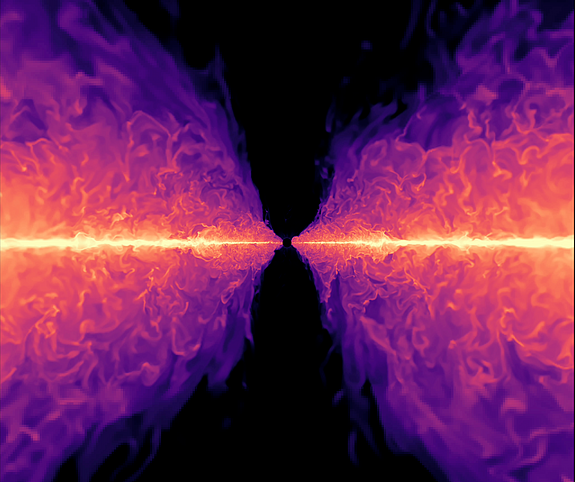 This image shows the gas density in a two-dimensional cross-section of an accreting black hole. Brighter areas represent regions of higher density. Near the black hole, the accretion flow forms a dense, thin thermal disk embedded within a magnetically dominated envelope that helps stabilize the system. Although the flow is radiation-dominated and highly turbulent, the thermal disk structure remains remarkably stable. Image Credit: Zhang et al. (2025)
This achievement was made possible thanks to the world's most powerful supercomputers. The researchers have successfully calculated the flow of matter into black holes under the conditions of full general relativity and in the radiation-dominated regime, entirely without the use of simplifying approximations.
The study marks the initial release in a series of papers that will detail the team's innovative computational methodology and its applications to various types of black hole systems.
This is the first time we’ve been able to see what happens when the most important physical processes in black hole accretion are included accurately. These systems are extremely nonlinear – any over-simplifying assumption can completely change the outcome. What’s most exciting is that our simulations now reproduce remarkably consistent behaviors across black hole systems seen in the sky, from ultraluminous X-ray sources to X-ray binaries. In a sense, we’ve managed to ‘observe’ these systems not through a telescope, but through a computer.
Lizhong Zhang, Study Lead Author, Institute for Advanced Study
Zhang holds a joint postdoctoral research fellowship, splitting his time between the Institute for Advanced Study’s School of Natural Sciences and the Flatiron Institute’s Center for Computational Astrophysics. He began this project during his first year at IAS (2023–24) and has continued it at Flatiron.
A comprehensive model of black holes must include Einstein's theory of general relativity due to their immense gravity, which explains how massive objects warp spacetime. Accurately simulating the movement and interaction of radiation with surrounding gas as matter accretes onto a black hole is essential.
The prior simulations have been unable to fully address these complex mathematical requirements. Similar to how physics students use simplified or “toy” models to grasp concepts, earlier simulations of radiation around black holes employed simplifications to make the problem more manageable.
“Previous methods used approximations that treat radiation as a sort of fluid, which does not reflect its actual behavior,” explained Zhang.
The full equations are extremely complex and computationally demanding, necessitating previous approximations. However, by combining insights gained over decades of work, the team developed new algorithms that directly solve these equations without approximations.
Ours is the only algorithm that exists at the moment that provides a solution by treating radiation as it really is in general relativity.
Lizhong Zhang, Study Lead Author, Institute for Advanced Study
The study focuses on accretion onto stellar mass black holes, which are roughly ten times the mass of the Sun. These are considerably less massive than Sgr A*, the supermassive black hole at the center of the galaxy. Simulations are indispensable for comprehending these black holes. Unlike supermassive black holes, which can be imaged in high resolution, stellar mass black holes appear only as points of light and cannot be observed in the same manner.
The researchers need to convert the light into a spectrum in order to collect data that maps the energy distribution around a black hole. Stellar mass black holes undergo changes on timescales of minutes to hours, in contrast to the years or centuries required for supermassive black holes to evolve, making them ideal for real-time study of system evolution.
The scholars' simulations depicted the behavior of matter as it spirals towards stellar mass black holes, forming turbulent, radiation-dominated disks, expelling powerful winds, and occasionally generating potent jets. The team observed a strong correlation between their model and the spectrum derived from observational data. This congruence between simulation and observation is vital, enabling more robust interpretations of the limited data available for these remote objects.
The Institute for Advanced Study has a long-standing history of pioneering computer modeling for complex systems, which has significantly contributed to the advancement of human knowledge. An early illustration of this is the Institute’s Electronic Computer Project, directed by founding Professor (1933–55) John von Neumann, which provided insights into diverse fields such as fluid dynamics, climate science, and nuclear physics.
Building upon this heritage, Zhang and his research team were granted access to two of the world's most powerful supercomputers, Frontier and Aurora, located at Oak Ridge National Laboratory and Argonne National Laboratory, respectively, to model black hole accretion. These "exascale" computers, capable of performing a quintillion operations per second, can span thousands of square feet, reminiscent of the room-sized early computers.
The team required sophisticated mathematics and code to harness the capabilities of these immense computing resources. The team's success in this area was facilitated by Christopher White of the Flatiron Institute and Princeton University, who spearheaded the design of the radiation transport algorithm, and Patrick Mullen, a Member (2021–22) in the School of Natural Sciences, now at Los Alamos National Laboratory, who led the implementation of the algorithm within the AthenaK code, which is optimized for exascale computing.
The team intends to investigate the applicability of their model to all types of black holes. Beyond stellar mass black holes, their simulations may deepen the understanding of supermassive black holes, which play a role in galaxy evolution. The team will continue to refine its methodology to account for the varied interactions of radiation with matter across a broad spectrum of temperatures and densities.
What makes this project unique is, on the one hand, the time and effort it has taken to develop the applied mathematics and software capable of modeling these complex systems, and, on the other hand, having a very large allocation on the world’s largest supercomputers to perform these calculations. Now the task is to understand all the science that is coming out of it.
James Stone, Study Co-Author and Professor, School of Natural Sciences, Institute for Advanced Study
Journal Reference:
Zhang, L., et al. (2025) Radiation GRMHD Models of Accretion onto Stellar-mass Black Holes. I. Survey of Eddington Ratios. The Astrophysical Journal. DOI 10.3847/1538-4357/ae0f91. https://iopscience.iop.org/article/10.3847/1538-4357/ae0f91.