Quantum computing job postings surged by 58% in 2026, reflecting rising investment, expanding technical teams and growing demand for cross-disciplinary talent. Coresignal Product Director Karolis Didziulis explains what this hiring activity reveals about the industry’s maturity, leading employers, emerging talent hubs and the skills shortages shaping its future.
What factors do you think triggered the 58% surge in quantum computing job postings in 2026?
Investment was most likely the deciding factor, along with greater visibility of the topic. PitchBook and Quantum Consortium (QED-C) reports show that 2025 set the record for annual venture capital investment in quantum, at almost $4 billion. Beyond the private sector, government funding commitments rose 310% in 2025 compared with 2024. This matches our data, which shows a significant increase in quantum hiring in 2025 compared with previous years. At the same time, the topic gained visibility when the UN declared 2025 the International Year of Quantum Science and Technology. Together, investment, hiring and publicity carried the momentum into 2026. Quantum suddenly became very real in the eyes of potential investors and employers.
What does the dominance of mid-senior and early-career roles reveal about the maturity of the quantum industry?
The dominance of mid-senior, entry-level and internship roles in the job postings shows clear demand for people who build and run the technology. Leadership positions are likely already filled or will be filled later; for now, the focus is on builders. This points to an industry that is still building its bench and expanding rather than consolidating.
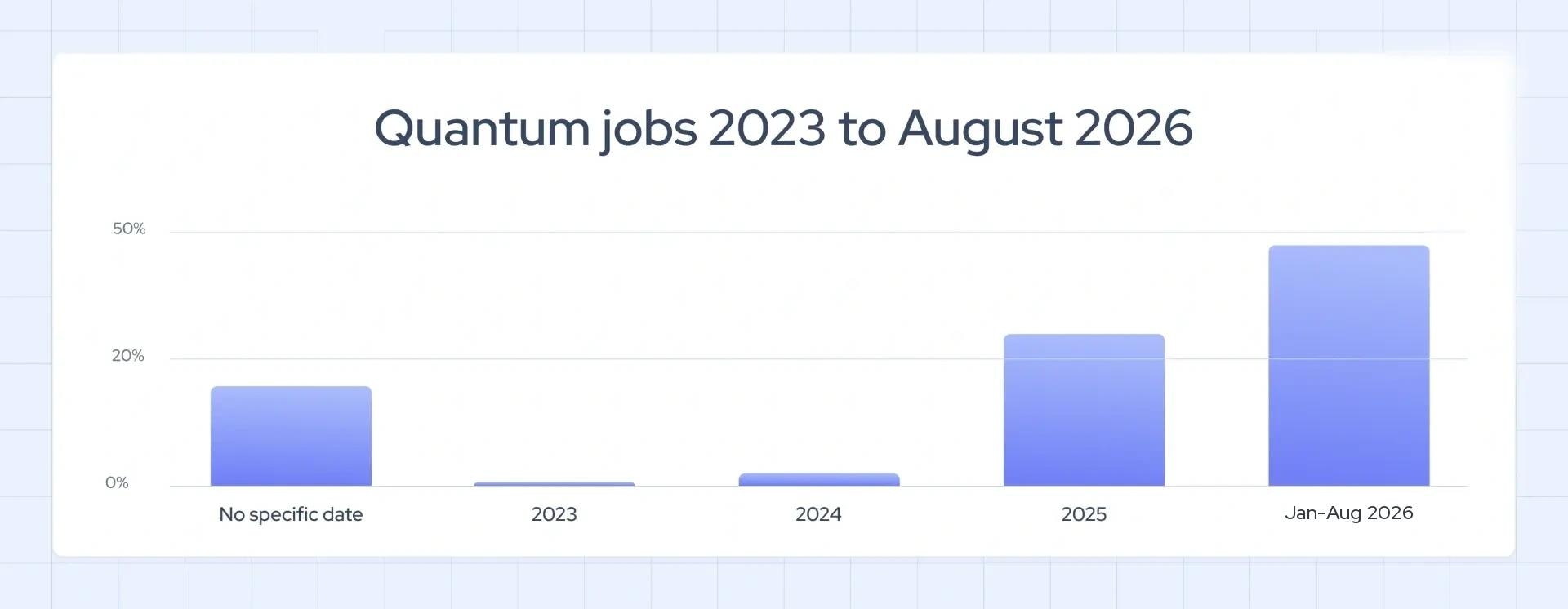
Image Credit: Coresignal
How do hiring patterns and role types differ among leaders like Google, IBM, AWS, Infleqtion, IonQ, NVIDIA, and Microsoft?
We’re essentially comparing two types of employers: established players running quantum divisions alongside their core business, and quantum-native companies. Google (leader in postings) and IBM both build superconducting qubits. AWS develops its own “cat qubit” hardware, and Microsoft is pursuing topological qubits. NVIDIA is the outlier: it builds the software and GPU infrastructure that connects quantum processors to classical computing, not the processors themselves. Among quantum natives, Infleqtion works with neutral atoms and IonQ with trapped ions. That these much smaller companies out-hire NVIDIA and Microsoft shows genuine progress in quantum development.
What does the balance between software and hardware hiring tell us about today’s main technical challenges in quantum?
The quantum field needs both people who build physical qubits and systems, and people who write the software and algorithms that make them useful. Software Development is currently the largest industry category in quantum job postings. This could signal either a follow-up to hardware progress that has already been made, or a shortage of talent that can bridge disciplines, such as quantum physics plus engineering, or quantum plus software development.
Download the PDF of this interview here
How would you describe the emerging global map of quantum talent based on the U.S. clusters and cities like Goleta, London, and Paris?
Quantum talent is highly concentrated in a handful of hubs in the U.S. and Europe. In Europe, London and Paris lead. Both are among the continent’s largest cities and major technology hubs. Goleta, California, is a more specialized cluster. It’s the single top city for quantum job ads, mainly thanks to a notable cluster of photonics and quantum-sensing companies. In a way, specialized clusters are not surprising: the U.S. already has a government and defence corridor in DC, Virginia and Maryland, and tech and research hubs in the Bay Area and Boston/Cambridge. But Goleta stands out because a small city outranks the likes of New York and London. This shows that quantum hiring follows specific labs and companies rather than population centres.
What were the main challenges in filtering 25,000 “quantum” job ads down to 9,500 truly quantum development roles?
The main challenge we faced was semantics. The word “quantum” has long meant more than just quantum computing or quantum technology. For example, a job ad might mention a company’s “quantum leap” without the company having anything to do with quantum computing. Or a posting might offer tutoring in quantum mechanics, which isn’t the kind of quantum-building job we were looking for either. We had to filter the data with a precise definition of “quantum” and decide which job postings were truly relevant. Thankfully, our systems are highly capable of transforming a natural language search into wanted results.

Image Credit: ZinetroN/Shutterstock.com
How should we interpret the absence of companies like Meta or Apple from your rankings despite their broader tech investments?
I wouldn’t assume that Meta or Apple are falling behind in quantum hiring. There could be several reasons why their quantum job postings don’t appear in our data, from listing semantics and already having the specialists they need to recruiting quantum hardware and software developers only through their own career pages. The presence of three of the Big 5 companies, Google, Amazon and Microsoft, already shows big tech’s interest in quantum technology.
Where do you see the biggest talent shortages in quantum today, and which skills will be most in demand over the next few years?
The talent shortage is widely recognized across the industry. In January 2026, a NIST lab director told U.S. lawmakers that they are in a workforce shortage. I’d say the biggest gap is in profiles that combine disciplines: physicists who can engineer, or software developers who understand quantum hardware. That kind of talent has always been hard to find. However, the strong share of entry-level and internship postings in our data suggests companies are already investing in growing that talent themselves.
Keep a PDF of this interview - Download here
About the Speaker

Karolis Didziulis is Product Director at Coresignal, a provider of public web data solutions. He focuses on driving business growth and developing data products that help organizations access and utilize large-scale datasets. His expertise spans data analytics, product development, artificial intelligence, and data-driven business strategies. Karolis also shares insights into web data collection, data optimization, and the role of structured datasets in supporting business intelligence and AI applications.
Disclaimer: The views expressed here are those of the interviewee and do not necessarily represent the views of AZoM.com Limited (T/A) AZoNetwork, the owner and operator of this website. This disclaimer forms part of the Terms and Conditions of use of this website.