Io, the innermost of Jupiter's four Galilean moons, is only slightly larger than Earth's own Moon, yet it behaves nothing like it. Its surface is patterned with sulphur deposits in yellow, orange and red, dotted with lava lakes, and reshaped constantly by eruptions. Several hundred active volcanic centers have now been catalogued on Io, making it the most volcanically active body known in the Solar System.1, 2
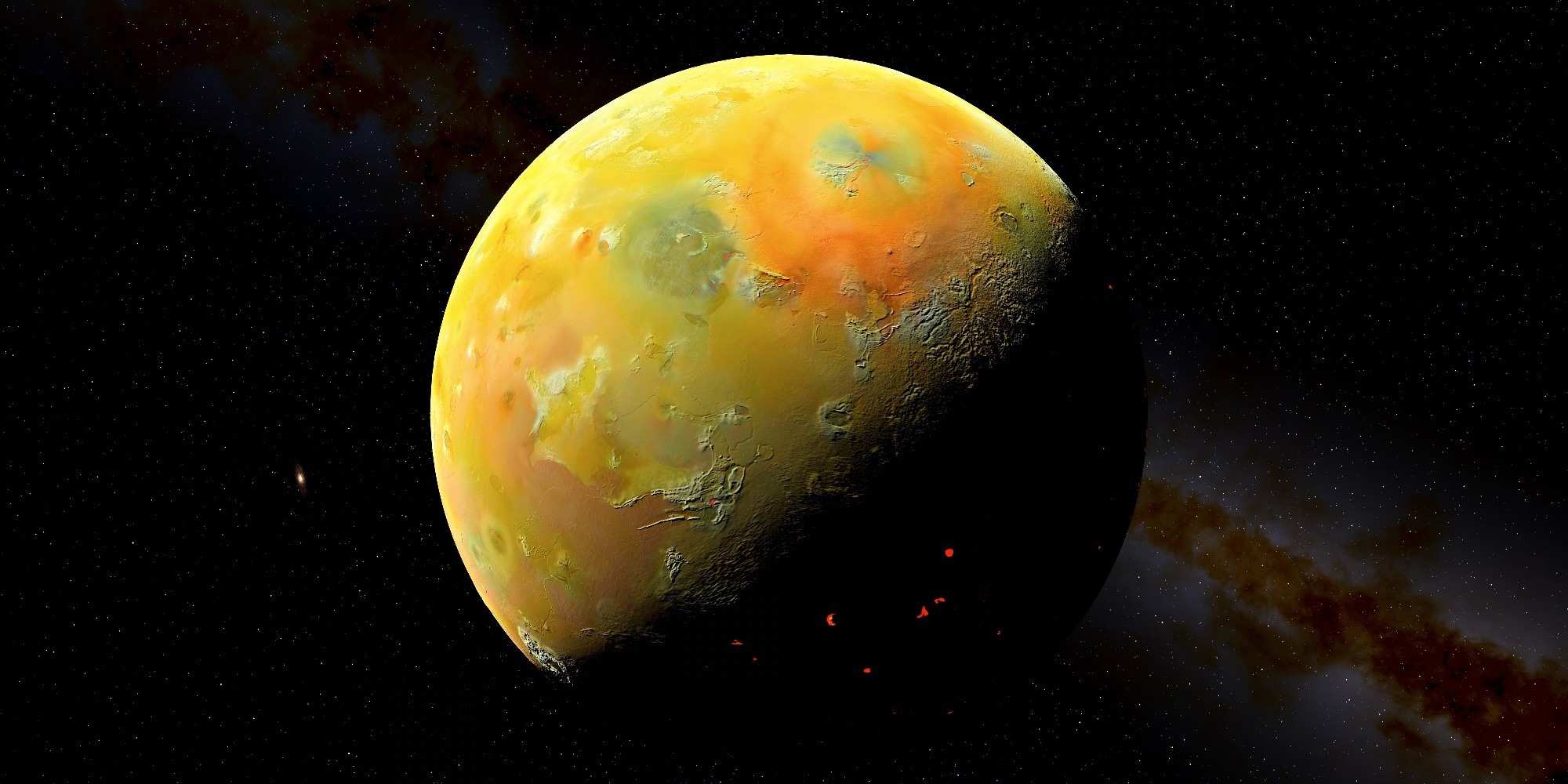
Image Credit: Catmando/Shutterstock.com
Since 2016, NASA's Juno spacecraft has carried out a series of close flybys of Io as part of its extended mission, using infrared and imaging instruments to build the most detailed record yet of the moon's volcanic behavior. A string of results published between 2024 and 2026 has revised long-standing ideas about how Io's interior is structured and how its heat reaches the surface.1, 3
Keep the PDF of this page here
Why Is Io So Volcanically Active?
Io's heat does not come mainly from radioactive decay, as on Earth, but from tidal heating. Io, Europa and Ganymede orbit Jupiter in a stable ratio close to 4:2:1, known as the Laplace resonance, which keeps their orbits slightly eccentric. Jupiter's gravity flexes Io's interior as the moon moves along this eccentric path, and the resulting friction generates far more internal heat, relative to Io's size, than Earth produces from all its own internal heat sources combined.
This continuous flexing keeps much of Io resurfaced with fresh lava within a matter of years, erasing impact craters almost as fast as they could form. Where Earth's volcanism is concentrated along narrow zones such as subduction margins and mid-ocean ridges, Io's eruptions are scattered across the globe. Researchers have compared the distribution of Io's volcanic heat output directly against tidal heat-flow models and found that, while output at the poles is generally lower than at the equator, no single existing model matches the observed pattern well, suggesting the internal heating process is more complex than early models assumed.4
What Have Recent Missions Discovered?
The clearest evidence yet for how Io's interior plumbing is organized came from a Juno flyby on 27 December 2024. The spacecraft's Jovian Infrared Auroral Mapper (JIRAM) recorded a hotspot event in Io's southern hemisphere covering roughly 65,000 square kilometers, an area larger than Lake Superior. The signal was intense enough to saturate JIRAM's detector, and the mission team concluded it likely represented several closely spaced volcanic features erupting together rather than a single vent. The event is estimated to have released on the order of 140–260 terawatts, well above the previous record eruption observed on Io, at the volcano Surt in 2001. The synchronized nature of the eruptions points to an interconnected network of magma reservoirs beneath the surface, rather than separate feed systems for each volcano.1
Separately, JIRAM observations gathered across 25 Juno flybys between March 2017 and October 2023 catalogued 325 individual hotspots, extending activity records for long-lived volcanoes such as Loki Patera, Pele and Prometheus back more than four decades.3 A companion global map, combining Galileo, ground-based and Juno data, identified 343 distinct thermal sources and found that heat output differs measurably between Io's Jupiter-facing and opposite-facing hemispheres, a pattern current tidal heating models do not fully explain.2 Juno's cameras have also captured visible surface change between successive flybys near Io's south pole, direct evidence of how quickly lava resurfaces the moon.1
How Are Scientists Mapping Io's Surface?
Three instruments underpin this work. JunoCam, Juno's visible-light camera, captures wide-field images during close approaches, revealing color changes and new lava flow fronts. JIRAM measures infrared and thermal emission, letting scientists estimate eruption temperatures and areas even where visible light is limited.1, 3 Ground-based adaptive optics systems, at facilities such as Keck and Gemini, supplement the spacecraft record with regular monitoring between flybys, extending the observational baseline back to the 1990s.2 More recently, infrared observations from Earth-orbiting telescopes have added further coverage of Io's largest lava lakes, complementing Juno's closer but more sporadic passes; combining these datasets helps researchers separate short eruptive outbursts from steadier, ring-shaped emission patterns seen around some of Io's biggest lava lakes.5
What do These Discoveries Tell Us?
Io is the clearest working example of tidal heating anywhere in the Solar System, a process also thought to sustain subsurface oceans on Europa and Ganymede. A 2026 study using Juno's Microwave Radiometer measured subsurface temperatures on Io for the first time, rather than relying only on surface-skin infrared readings, giving a more direct picture of how internal heat moves toward the surface.6 Understanding how that heat is generated and transported has implications beyond Jupiter's moons: tidal heating is expected to influence the interiors of rocky exoplanets on eccentric orbits around low-mass stars, potentially keeping some of them geologically active independent of their distance from a star.6
Technology Driving Future Exploration
Two upcoming missions, NASA's Europa Clipper and ESA's Jupiter Icy Moons Explorer (JUICE), due to arrive at Jupiter in 2030 and 2031 respectively, will add further observations of the Jovian system, though their equatorial orbits mean Juno's polar vantage point on Io will remain unique for some time.3 The growing volume of imaging and infrared data already returned is encouraging greater use of automated and AI-assisted techniques to identify hotspots and track surface change across thousands of images, work that also carries commercial relevance for developers of imaging sensors, infrared instrumentation, spacecraft electronics and planetary science software.
Future Developments
Open questions remain about Io's interior, including whether a global magma ocean exists beneath the crust and how heat is redistributed between the moon's poles and equator.2 Some researchers have proposed dedicated future missions focused on volcanic and tidally heated worlds, able to fly closer and more frequently than Juno's current trajectory allows. In the meantime, continued monitoring during Juno's extended mission, alongside ground- and space-based telescopes, will be needed to determine whether the record-breaking 2024 event was an isolated occurrence or a sign of longer-term change in Io's volcanic behavior.1
In a recent interview, we also explored how to analyze all the data we have on Mars' craters
References and Further Reading
- Mura, A., Lopes, R., Nimmo, F., Bolton, S., Ermakov, A., Keane, J. T., et al. (2026). Synchronized Eruptions on Io: Possible Evidence of Interconnected Subsurface Magma Reservoirs. Journal of Geophysical Research: Planets, 131, e2025JE009047. https://doi.org/10.1029/2025JE009047
- Davies, A. G., Perry, J. E., Williams, D. A., Veeder, G. J., & Nelson, D. M. (2024). New Global Map of Io's Volcanic Thermal Emission and Discovery of Hemispherical Dichotomies. The Planetary Science Journal, 5(5), 121. https://doi.org/10.3847/PSJ/ad4346
- Davies, A. G., et al. (2025). Hot Spot Detections and Volcanic Changes on Io during the Juno Epoch: Orbits PJ5 to PJ55. The Planetary Science Journal. https://doi.org/10.3847/PSJ/adbae3
- Pettine, M., et al. (2024). JIRAM Observations of Volcanic Flux on Io: Distribution and Comparison to Tidal Heat Flow Models. Geophysical Research Letters. https://doi.org/10.1029/2023GL105782
- Mura, A., Tosi, F., Zambon, F., Lopes, R. M. C., Mouginis-Mark, P. J., Radebaugh, J., et al. (2025). Widespread Occurrence of Lava Lakes on Io Observed from Juno. Journal of Geophysical Research: Planets, 130, e2024JE008723. https://doi.org/10.1029/2024JE008723
- Brown, S., et al. (2026). Io Sub-Surface Temperature Profile Observed by the Juno Microwave Radiometer. Journal of Geophysical Research: Planets. https://doi.org/10.1029/2025JE009622
Disclaimer: The views expressed here are those of the author expressed in their private capacity and do not necessarily represent the views of AZoM.com Limited T/A AZoNetwork the owner and operator of this website. This disclaimer forms part of the Terms and conditions of use of this website.