NASA's Nancy Grace Roman Space Telescope lifted off on August 30, 2026, aboard a SpaceX Falcon Heavy rocket from Launch Complex 39A at Kennedy Space Center in Florida, beginning a roughly three-month, one-million-mile journey to its operating orbit.1
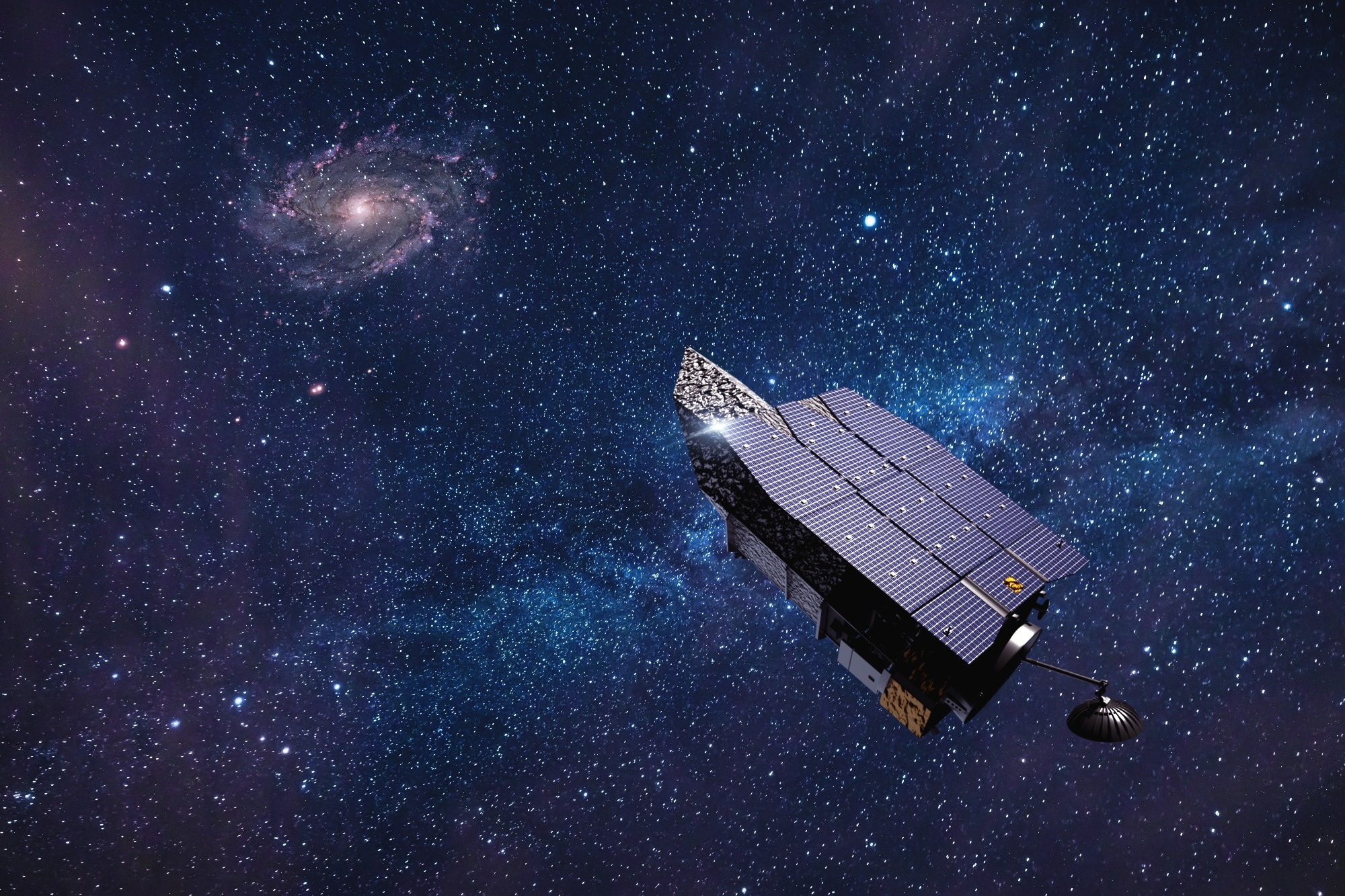
Image Credit: Elliptic Studio/Shutterstock.com
The Nancy Grace Roman Space Telescope Begins Its Mission
Named after Nancy Grace Roman, NASA's first chief astronomer and a key figure behind the Hubble Space Telescope, the observatory is widely regarded as NASA's next flagship astrophysics mission, following Hubble and the James Webb Space Telescope.2
Over its operating lifetime, Roman is expected to address questions across four broad areas: the nature of dark energy and cosmic expansion, the distribution of dark matter, the demographics of exoplanets across the galaxy, and a wide range of infrared astrophysics enabled by its unusually large field of view.2
Download the PDF of this article here
What Makes the Roman Space Telescope Different?
Roman carries a 2.4-metre primary mirror, the same aperture as Hubble's, feeding two science instruments: the Wide Field Instrument, a 300-megapixel near-infrared camera, and the Coronagraph Instrument, a high-contrast imaging system flying as a technology demonstration.3
Roman's central advantage lies in scale rather than sharpness. Hubble's narrow field forces astronomers to stitch together large areas of sky from many separate exposures, whereas Roman's Wide Field Instrument covers a single patch at least 100 times larger while matching Hubble's image quality, so a single Roman exposure can capture roughly the same detail as around 100 Hubble images.4
Roman is not intended to replace Hubble or Webb. Webb specializes in deep, detailed observations of individual targets, and Hubble continues to observe largely at visible wavelengths, while Roman is built for speed and breadth, running the wide, repeated surveys needed to study statistics of galaxies, stars and planets rather than single objects in isolation.2
What to Expect From Launch and Early Operations
After launch, Roman is travelling toward the second Sun-Earth Lagrange point, L2, a gravitationally stable location about 930,000 miles from Earth, after which a longer checkout period begins.1, 5
Over the following months, engineers will activate and calibrate the Wide Field Instrument and test the spacecraft's systems; NASA anticipates releasing Roman's first images in early 2027, once commissioning is complete.1
Roman has a nominal five-year mission with a goal of ten years of operation. Its core science will be carried out through three large Community Surveys: the High Latitude Wide Area Survey and High Latitude Time Domain Survey, both built around dark energy and cosmology, and the Galactic Bulge Time Domain Survey, dedicated largely to exoplanet microlensing.5, 6
Mapping Dark Matter and Dark Energy
The High Latitude surveys will map the positions, shapes and distances of hundreds of millions of galaxies across roughly a sixth of the sky, tracing how galaxies cluster and how that clustering has changed as the universe has expanded over billions of years.3
Dark energy is the name given to whatever is driving the universe's accelerating expansion, while dark matter is an invisible form of matter whose gravity shapes how galaxies and galaxy clusters form; together the two make up most of the universe's total mass and energy.3,6
Rather than settling these questions outright, Roman's surveys are designed to sharpen constraints on how dark energy has behaved over cosmic history and to map dark matter's distribution in far greater detail than earlier surveys, giving cosmologists a much larger dataset against which to test competing theories.6
What Could Roman Reveal About Exoplanets?
Roman's Galactic Bulge Time Domain Survey is expected to detect on the order of 100,000 exoplanet and transiting-planet candidates over the course of the mission, substantially expanding the statistical sample of known worlds.7
Most of these detections will come through gravitational microlensing, a technique that watches for the brief brightening of a background star's light as its gravity is bent by a foreground star, and any orbiting planets, passing nearly in front of it; because it depends on chance alignments rather than a planet's own light, microlensing can find colder, more distant planets that transit and radial-velocity surveys generally miss.7, 8
Combined with results from missions such as Kepler and TESS, Roman's survey is intended to fill in a part of the exoplanet population, roughly Mars-to-Jupiter-mass worlds a few astronomical units from their stars, that has so far been difficult to sample, building a fuller statistical picture of how planetary systems form and evolve.7
Testing the Future of Direct Exoplanet Imaging
The Coronagraph Instrument works by suppressing a star's light so that far fainter objects nearby, such as orbiting planets or debris disks, can be seen directly; it does so using deformable mirrors that actively correct for tiny imperfections in the telescope's optics, a first for a space-based coronagraph.8
NASA classifies the Coronagraph as a technology demonstration rather than a core science instrument, meaning its main purpose is to prove that these starlight-suppression techniques can work reliably in space, with any observations of nearby planets and disks treated as a valuable bonus.8, 3
Lessons learned from the Coronagraph are expected to directly inform the design of future missions aiming to image Earth-sized, potentially habitable planets around nearby stars, including NASA's planned Habitable Worlds Observatory, recommended by the 2020 astrophysics decadal survey.8
What Could Roman Mean for the Future of Astronomy?
Roman is expected to collect around 4 petabytes of data annually, roughly the volume Hubble has gathered across its entire three-decade mission, in a single year, all of it released openly to the astronomical community.3
Because its surveys will repeatedly image huge areas of sky, researchers expect Roman's data to support work well beyond its primary goals, including studies of stellar populations, black holes and neutron stars detected through microlensing, small bodies in the outer solar system, and the structure of the Milky Way.6, 7
Once Roman is fully operating, astronomers will be watching its early calibration images and first survey data closely for signs of how well its models of galaxy clustering and planet detection hold up in practice. If the mission performs as designed, it should set a template, wide, fast and richly documented, that future observatories are likely to follow.2, 8
We explored how nanomaterials can be used in space tech here
References & Further Reading
- NASA. "NASA's Dark Universe-Seeking Nancy Grace Roman Space Telescope Launches." NASA News Release, August 30, 2026. https://www.nasa.gov/news-release/nasas-dark-universe-seeking-nancy-grace-roman-space-telescope-launches/
- NASA Science. "Nancy Grace Roman Space Telescope." NASA Science Mission Overview. https://science.nasa.gov/mission/roman-space-telescope/
- Space Telescope Science Institute (STScI). "Nancy Grace Roman Space Telescope: Science and Technical Overview." https://www.stsci.edu/files/live/sites/www/files/home/roman/_documents/roman-science-and-technical-overview.pdf
- NASA Science. "Introducing the Roman Space Telescope." https://science.nasa.gov/mission/roman-space-telescope/introducing-the-roman-space-telescope/
- NASA Science. "Roman Observatory." https://science.nasa.gov/mission/roman-space-telescope/roman-observatory/
- Space Telescope Science Institute (STScI). "Surveys and Programs." https://www.stsci.edu/roman/surveys-and-programs
- Penny, M. T., Gaudi, B. S., Kerins, E., Rattenbury, N. J., Mao, S., Robin, A. C., & Calchi Novati, S. (2019). Predictions of the WFIRST Microlensing Survey. I. Bound Planet Detection Rates. The Astrophysical Journal Supplement Series, 241(1), 3. https://doi.org/10.3847/1538-4365/aafb69
- NASA Jet Propulsion Laboratory (JPL). "The Roman Coronagraph Instrument." https://www.jpl.nasa.gov/missions/the-roman-coronagraph-instrument/
Disclaimer: The views expressed here are those of the author expressed in their private capacity and do not necessarily represent the views of AZoM.com Limited T/A AZoNetwork the owner and operator of this website. This disclaimer forms part of the Terms and conditions of use of this website.