The Science
Laser plasma accelerators (LPAs) use powerful laser pulses to create waves inside a plasma. In just a few centimeters, these waves can push electrons to very high energies. In contrast, traditional particle accelerators need metallic structures that are several kilometers long to reach the same energy levels. But laser plasma accelerators are hard to control. This has made it difficult to produce stable, high-quality electron beams. Recently, scientists made an important advance. They showed that these compact accelerators can produce electron beams good enough to reliably power a highly demanding tool called a free-electron laser.
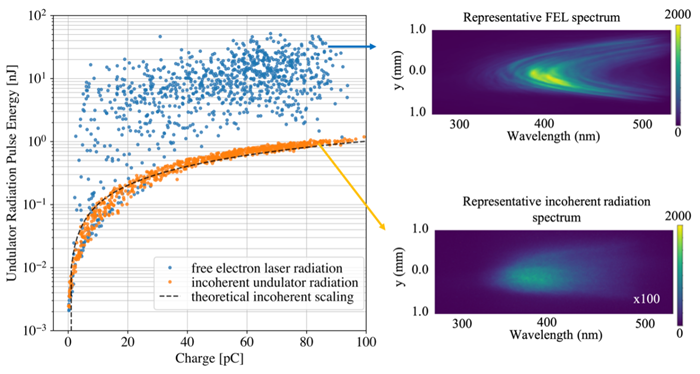 This graphic illustrates a measurement of the increase in pulse energy from the free-electron laser mechanism. Image Credit: Department of Energy's Lawrence Berkeley National Laboratory
The Impact
Particle accelerators are key tools in many areas of science. X-ray free-electron lasers rely on them to study matter at the atomic scale. These machines produce pulses of X-rays that take ultrafast snapshots of atoms and molecules. However, particle accelerator facilities often require kilometer-scale accelerators. This constraint limits their availability. This result shows that laser plasma accelerators can provide the energy and brightness needed for free-electron lasers. This finding makes them a promising alternative for building compact machines and upgrading existing facilities. This breakthrough opens the door to smaller, more accessible tools for advanced research in physics, chemistry, and materials science.
Summary
Laser plasma accelerators are an emerging technology that offer huge potential for the field of particle accelerators. They enable acceleration of particles nearly one thousand times faster than is possible in conventional accelerators. They can also be used to produce extremely dense electron beams. These two attributes make them desirable for many advanced and demanding applications, like free-electron lasers and future particle colliders. This technology can potentially be used to shrink these machines, reducing their financial impact and broadening their accessibility. In addition, it may enable entirely new capabilities.
Harnessing laser plasma accelerators remains a primary challenge. Reliably generating dense electron beams with the same energy from one shot to the next has been an elusive capability. With this new result, researchers have made significant strides in addressing these challenges by demonstrating free-electron lasing on more than 90 percent of consecutive shots over the period of an hour. This firmly establishes their viability as drivers for future particle accelerator applications that have demanding requirements for particle beams.
Funding
This work was supported by the U.S. Department of Energy (DOE), Office of Science, the Office of Basic Energy Sciences, and the Office of High Energy Physics, through a CRADA with Tau Systems. It was also supported by the Gordon and Betty Moore Foundation.