Cosmic microwave background measurements by Planck satellite show no evidence of stupendously large black holes formed shortly after Big Bang to contain significant amounts of dark matter.
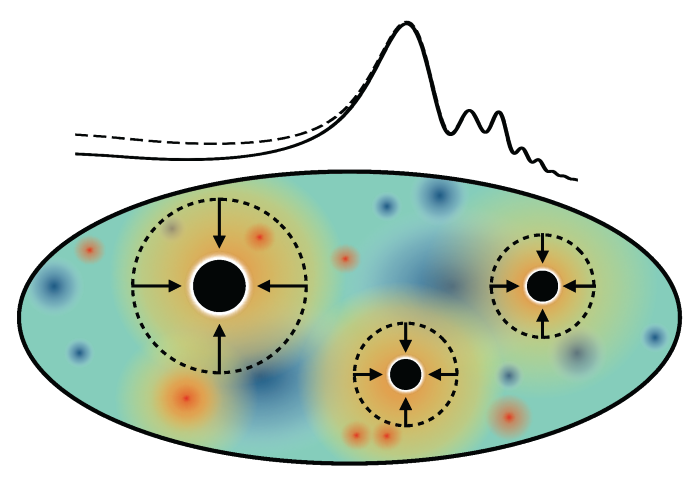 The collapse of matter overdensities to primordial black holes in the early universe changes the spectrum of cosmic microwave background fluctuations. Image Credit: Christopher Gerlach
While physicists today know that dark matter must exist, there are still many unanswered questions surrounding it – such as what it is made of. For the latter question, a team of researchers at Johannes Gutenberg University Mainz (JGU) has now narrowed down the list of possible answers by analyzing measurements of the cosmic microwave background taken by the Planck satellite. In an article published in Physical Review Letters, they detail how their findings rule out one theory of how dark matter might have behaved after the Big Bang.
“A possible solution to the puzzle of dark matter was that it might have collected shortly after the Big Bang in giant black holes with masses ranging from 100 million to 10 billion billion times that of the sun”, said Christopher Gerlach, theoretical physicist at JGU and PRISMA++ Cluster of Excellence. However, this accumulation should have had a distinct impact on the young universe – so distinct that it would still be visible in the cosmic microwave background, or CMB, even to this day.
Looking for Something Invisible
The CMB is the light released when the universe was just 380,000 years old. To measure it, one must bring highly specialized equipment and leave the Earth’s atmosphere. ESA’s Planck space observatory did just that, conducting uniquely detailed measurements of the “echo of the Big Bang” in four and a half years of operation before its final shutdown in October 2013.
“That we are still generating new insights into the universe’s evolution and structure 13 years after it was shut down only emphasizes how important the Planck satellite was and is to physicists”, explained Christopher Gerlach. Its measurements allow more precise calculations of the universe’s visible and dark matter contents. Analysis of primordial black holes, which were formed shortly after the Big Bang, has already shown that they are unlikely to have contained all dark matter in the universe. The JGU research team concentrated their efforts on the subset of so-called stupendously large black holes (SLABs), which were candidates if not for containing all dark matter, then at least a significant part of it.
Nicholas Leister, another JGU physicist in the research team: “If these SLABs had existed in large numbers and contained significant amounts of dark matter, they would have left a characteristic imprint on the CMB through their unique perturbations, or, in a word, making it grainy.” The physicists modeled how this imprint should look and compared it to the actual measurements. Not enough graininess was found, ruling out the possibility of SLABs as significant parts of dark matter.
Questions About the Early Universe Remain
Stupendously large black holes were candidates for explaining several other phenomena in the early universe. One of them is the nano-Hertz gravitational-wave background, or “hum” detected in Pulsar Timing Arrays, another are the surprisingly large early galaxies observed by the James Webb telescope. “These questions are also unlikely to be answered by SLABs, since our findings show that they didn’t exist in large numbers”, said Nicholas Leister. “The early universe still has many puzzles waiting to be solved.”