In a recent study published in Optica, researchers from the National Institute of Standards and Technology (NIST) revealed a breakthrough in superconducting nanowire single-photon detectors (SNSPDs). Their work demonstrates the feasibility of expanding superconducting wires to a tenth of a millimeter, a size over 100 times greater than conventional SNSPDs. This innovation streamlines the photon detector's design and manufacturing process, leveraging a novel technique to fully realize the material's inherent performance capabilities.
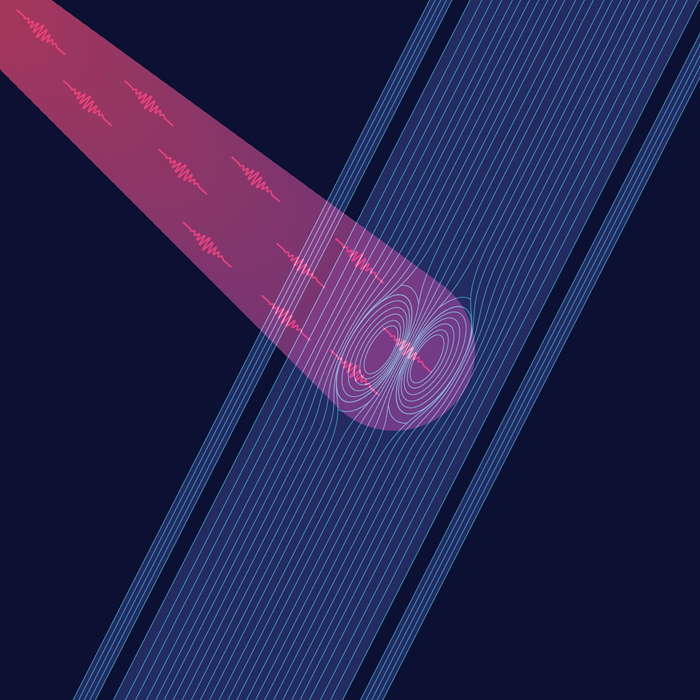 In this illustration, photons hit a strip of superconducting wire, disrupting the electric current and registering an electric pulse. Each pulse tells researchers about the light that has hit the detector, which is beneficial for applications like biomedical imaging and astronomy. Image Credit: NIST
In advanced technological fields, ranging from quantum computing to deep-tissue imaging, the precise detection of individual photons is critically important.
Photons carry information. Whenever a photon comes into your measurement system, you need to be able to detect it.
Kristen Parzuchowski, Postdoctoral Researcher, National Institute of Standards and Technology
The transmission of data through quantum networks and deep-space communication links can be achieved using photons. Capturing and analyzing photons also enables scientists to construct biomedical images and explore the universe for evidence of dark matter.
For these applications, superconducting nanowire single-photon detectors (SNSPDs) offer an optimal way to capture photons. As their name suggests, these devices harness superconductivity, a state in which electrical current flows without resistance, to detect individual photons.
When individual light particles strike, they generate minute disturbances in the electric current, interrupting the superconducting state and initiating a quantifiable electrical signal. Over time, NIST has substantially refined these devices, achieving a detection efficiency of 98% for incoming photons.
Nevertheless, SNSPDs are not without limitations. Their production generally necessitates highly specialized fabrication methods at the nanometer scale. A primary concern is that the performance of superconducting detectors is constrained by their edges. While detectors capable of handling higher current are known for superior performance, manufacturing imperfections limit maximum current flow.
The researchers at NIST opted for a more expansive approach.
Parzuchowski noted, “Conventionally, the focus has been on producing progressively smaller wires, which consequently escalates the difficulty of fabrication.”
A typical SNSPD incorporates a 100-nanometer-wide wire, composed of superconducting material, linked to a readout circuit. Electrical current traverses this wire in a manner analogous to water flowing in a river. When a photon hits it, like a rock disturbing the river, a localized hot spot forms and interrupts the current. This hot spot then generates a voltage pulse, which the readout electronics detect.
Eli Mueller, a postdoctoral researcher at NIST, highlighted the prevailing scientific belief that superconducting wires within SNSPDs had to be nanoscale to optimize the minimal "splash" effect of a photon across the wire.
Your photon energy needs to break superconductivity over the entire width of the wire. It's very difficult to have your device in a regime where the photon could break superconductivity over 100 microns wide, so devices needed to be on the order of hundreds of nanometers wide.
Eli Mueller, Postdoctoral Researcher, National Institute of Standards and Technology
The nanoscale dimensions of SNSPDs mandate their operation at reduced currents. Consequently, lower-energy photons produce a less pronounced "splash," making them more difficult to detect, and resulting in weaker readout signals. Furthermore, the electric current behaves imperfectly, failing to distribute uniformly across the wire. Parzuchowski further noted that imperfections can cause current to accumulate along the edges, like whirlpools or eddies in a river, generating spurious signals known as dark counts.
Mueller elaborated, “If we can get the middle of our device to flow more current than what was previously accessible, then we can generate a hot spot over an arbitrarily wide wire. And that hot spot is what's giving you the pulse out. If you're operating even closer to that transition between the superconducting state and the normal state, then you're still sensitive to the very low energy photons.”
The solution to this challenge is to introduce rails.
These superconducting rails are positioned alongside the main wire, directing current in an identical path, which in turn creates a magnetic field. The magnetic field from these rails interacts with that of the central wire, collectively redistributing the current flow and eliminating current accumulation at the edges.
This equalization of current flow allowed the team to maximize the superconducting wire's current capacity and increase its physical dimensions. Furthermore, these enlarged SNSPDs are polarization-insensitive; the detector can register photons regardless of the orientation of their electric-field oscillation. Consequently, each photon now generates a more distinct "splash" that the team can readily interpret.
For many years, researchers have endeavored to approach the optimal performance of these detectors, yet the extent to which a user could push these limits remained uncertain. We have now demonstrated that a user can indeed attain the intrinsic performance threshold.
Kristen Parzuchowski, Postdoctoral Researcher, National Institute of Standards and Technology
Marty Stevens, the group's leader and an electronics engineer, mentioned that the team successfully enlarged their wire to a tenth of a millimeter, with potential for even greater widths.
Stevens noted that it remains uncertain whether wide SNSPDs can achieve the same 98% efficiency demonstrated by their nanoscale counterparts, and further evaluation is needed. Nevertheless, the team set a new benchmark with these devices, achieving a billion-fold reduction in dark counts.
The novel architecture simplifies fabrication, thereby facilitating the production of significantly larger detectors. The enhanced dimensions and sensitivity enable the detector to capture a greater number of photons, a feature particularly advantageous in scenarios involving extremely weak and less regulated light sources.
This capability is particularly beneficial for medical imaging techniques such as diffuse correlation spectroscopy, which involves directing a beam of light through human tissue and collecting the scattered light to measure blood flow. It is also valuable in astronomy, where detecting faint, low-energy light is essential for studying signals from distant galaxies.
“There are many applications where you’re working with handfuls of photons. Ideally, you need to detect all of them,” Parzuchowski concluded.
Partial funding for this research was provided by the Defense Advanced Research Projects Agency (DARPA) via the Synthetic Quantum Nanostructures (SynQuaNon) initiative.
Journal Reference
Parzuchowski, K. M., et al. (2026) Reaching the intrinsic performance limits of superconducting nanowire single-photon detectors up to 0.1 mm wide. Optica. DOI: 10.1364/OPTICA.599984. https://opg.optica.org/optica/fulltext.cfm?uri=optica-13-8-1649.