BQP, a leader in quantum-accelerated simulation software, and Modovolo, an innovative drone manufacturer developing high-performance drones at radically-reduced cost, today announced a major commercial milestone demonstrating how quantum-inspired computing is radically disrupting heavy engineering and the Aerospace & Defense (A&D) sector.
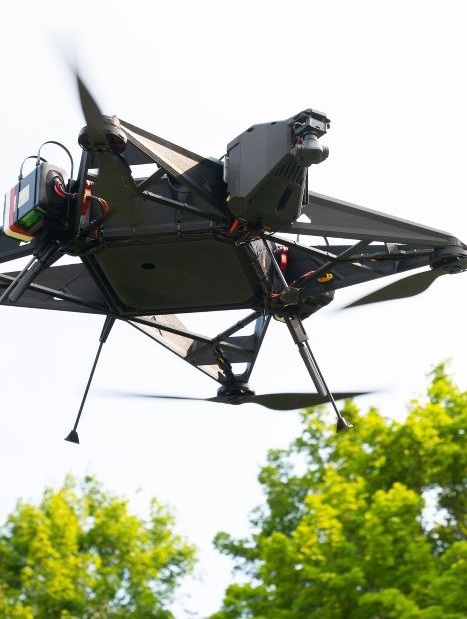 Modovolo, a drone manufacturer in the GENIUS NY program. Image Credit: BQP
By integrating BQP’s flagship software platform, BQPhy, into Modovolo’s advanced engineering pipeline, the companies have bypassed the traditional trial-and-error bottlenecks that plague heavy engineering, delivering a blueprint for high-speed hardware innovation.
The partnership has yielded an immediate, high-stakes victory: Modovolo has achieved state-of-the-art performance metrics for its next-generation UAV systems in a fraction of the traditional development window. More importantly, it establishes a highly scalable framework that allows Modovolo to seamlessly apply these advanced computational workflows to increasingly complex drone designs moving forward.
The Reality of Aerospace & Defense Long and Expensive Design Cycles
In the heavy-engineering and Aerospace & Defense (A&D) sectors, the primary barrier to market entry isn't the speed of a single simulation; it is the exhausting, capital-intensive trial-and-error process. Traditional computational fluid dynamics (CFD) and structural optimization tools limit engineers to testing just a handful of design variations due to compute constraints, often forcing teams to settle for a functional but unoptimized design.
BQPhy alters this paradigm. Powered by the QuantumNOW solver engine, which leverages advanced quantum-inspired algorithms on existing high-performance computing (HPC) and GPU infrastructure, BQPhy allows engineering teams to compress tens of thousands of design simulations into the same timeframe and compute footprint typically required for a fraction of that workload.
“This isn't about making a single simulation marginally faster; it’s about total design-space exploration,” said Abhishek Chopra, Founder and CEO of BQP. “By running thousands of simulations simultaneously, BQPhy eliminates the traditional trial-and-error bottleneck. It gives forward-thinking manufacturers like Modovolo the power to discover radically optimized geometries that were previously computationally invisible, moving from software output to physical testing at a pace the industry hasn't seen before.”
The Case Study: Mapping the "Infinite Variables" of Drone Design
For New York-based Modovolo, this computational throughput has translated into an immediate commercial advantage. Modovolo’s drone platform was built around a more unique yet practical question: what if aircraft could be configured around the mission, repaired closer to the field, and produced at a radically lower cost without sacrificing performance?
Modovolo answers this question through its "performance-to-cost" philosophy: maximizing flight-time and payload performance while radically reducing cost and eliminating complexity.
"We have developed our own genetic algorithms for propeller optimization, which has produced some very high-efficiency designs," explains Justin Call, Co-Founder and CEO of Modovolo. "But relying on traditional optimization methods was incredibly time-intensive, due to the extremely large number of potential three-dimensional geometries for the propeller. Not only in terms of the number of man-hours but also in terms of compute, running them on our local servers would take many days to get to a single design, and more often than not, that design made no sense as calculations would get trapped in a 'local minima.' This would force us to re-run everything, and that could take weeks of work."
So when the two companies partnered to optimize Modovolo’s new, patent-pending line of 3D-printed propellers, Modovolo utilized BQPhy's quantum-inspired optimization to push the drone's performance advantage for flight time and payload capabilities even further beyond competition.
“Propeller design is particularly difficult with existing tools because, in addition to being an error-prone, lengthy process, these existing tools only consider a small number of variables. But a propeller blade has an infinite number of variables. At each point on the blade there are different stress points, aerodynamic considerations, performance changes. In order to truly increase performance, you need to contemplate all of these variables,” explains Arion Mangio, Co-Founder and Chief Technology Officer of Modovolo.“BQPhy enabled us with the computational muscle, to explore an unprecedented number of design variables at once, solving our immediate performance bottlenecks and giving us a scalable engine to tackle our next generation of complex UAV systems”
Call added: “We had developed a proprietary process for 3D printing highly affordable propellers, but maximizing their performance through traditional tools was a slow, uphill battle. BQPhy acted as a true force multiplier, giving us a massive competitive leap in UAV market. With the BQP-developed propellers were are seeing large increases in flight time and payload lift capacity.”
Macro Shift: Deep Tech Entering the Physical Supply Chain
The joint breakthrough arrives at a critical macroeconomic inflection point for the tech and defense ecosystems. According to McKinsey’s 2026 Quantum Technology Monitor, global investment in quantum tech startups has surged to $12.6 billion, with the market increasingly demanding immediate, "quantum-ready" software solutions that run on today's hardware. Concurrently, Deloitte’s 2026 Aerospace & Defense Industry Outlook projects U.S. A&D spending on advanced computational tools and AI to reach $5.8 billion by 2029, driven by intense pressure to shorten hardware deployment timelines. As fellow portfolio companies of NY Ventures (the venture capital investment arm of New York State), BQP and Modovolo exemplify a broader shift: deep-tech innovation is no longer clustered exclusively in Silicon Valley, but is actively reshaping the physical manufacturing landscape of New York State.
For BQP, the collaboration with Modovolo offers something unusually valuable: a physical proving ground where advanced algorithmic design choices can be instantly manufactured, mounted, and flight-tested against real-world constraints. By demonstrating a pipeline where quantum-inspired design outputs are instantly 3D-printed, mounted, and flown, BQP and Modovolo have delivered a definitive case study for the Wall Street and Silicon Valley tech sectors alike: the first meaningful impacts of the quantum era are happening today, directly on the physical factory floor.
The implications of this breakthrough extend far beyond drones and aircraft. For high-stakes industries like defense, robotics, energy, and semiconductors, the broader market takeaway is clear: the first meaningful ROI of the quantum era will not come from waiting for future, universal quantum hardware. Instead, it is happening right now by applying quantum-inspired computational throughput to today's heavy engineering bottlenecks.