Scientists utilized NASA's IXPE (Imaging X-ray Polarimetry Explorer) to analyze the magnetic fields of PSR J1101−6101, a pulsar in the Lighthouse Nebula. The findings shed fresh light on the structure of some of the most extreme things in the universe, as NASA strives to uncover the mysteries of how the world works. The Astrophysical Journal published a study that described the results.
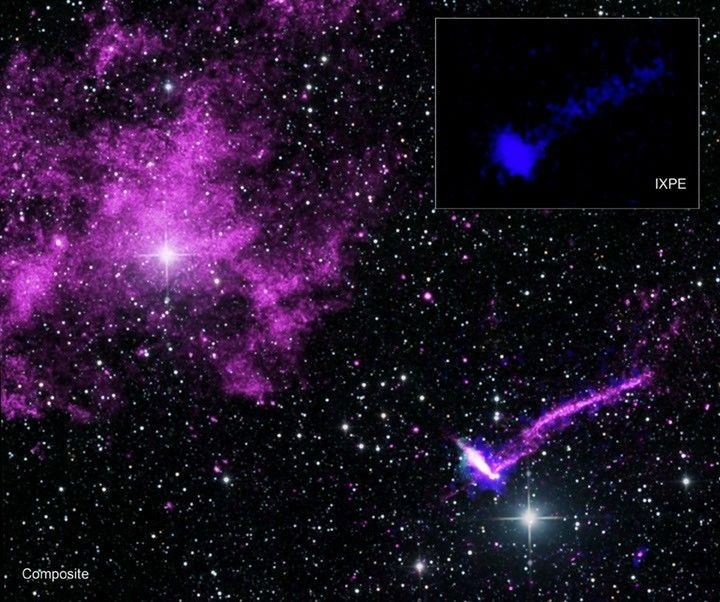 This composite image contains X-ray data from IXPE in blue (highlighted in the inset), the Chandra X-ray Observatory in purple, and radio data from CSIRO in green. The starfield is optical data from the 2MASS optical survey. X-ray: Chandra: NASA/CXC/Stanford Univ./J.T. Dinsmore et al.; IXPE: NASA/MSFC/J.T. Dinsmore et al., Radio: CSIRO/ATNF/ATCA; Optical: 2MASS/UMass/IPAC-Caltech/NASA/NSF; Image processing: NASA/CXC/SAO/L. Frattare. Image Credit: NASA
In June 2025, IXPE spent over 18 days observing the Lighthouse Nebula.
Astronomers analyzed two thin X-ray offshoots extending from the pulsar to better understand how electrons traveling at nearly the speed of light interact with this highly energetic system. The larger branch is known as the “filament,” while the shorter one is called the “trail.”
As high-energy particles emitted by the pulsar collide with interstellar gas, they generate a bow shock, much like the bow wave that forms at the front of a speeding boat. Most of these particles become trapped behind the bow shock, creating a turbulent trail that follows the pulsar.
Since 2008, researchers have proposed that the most energetic particles escape through the bow shock into interstellar space, where they follow the galaxy's magnetic field lines and create the nebula's long, narrow filament.
We wanted to test that theory. The ‘smoking gun’ would come by measuring the polarization of the light, which indicates the magnetic field direction. If the magnetic field points along the filament, that confirms that the filament’s particles are flowing along the field.
Jack Dinsmore, Study Lead and Undergraduate Student, Stanford University
One issue with these observations is that the Lighthouse Nebula is rather faint. To solve this, IXPE scientists created sophisticated analysis methods that make use of all available data, rather than simplifying stages that might limit information.
The science team was able to successfully quantify the filament’s polarization using these new tools and new Lighthouse observations. These approaches also provided polarization measurements for the trail and the pulsar’s emission signal.
With over 99% certainty, their study verified that the magnetic field did, in fact, line up with the particle movement.
The polarization degree was high enough to raise fresh concerns, even if the parallel direction supports models for the particle’s motion.
Many of the models for filaments assume strong magnetic turbulence. The high polarization degree we measured indicates lower turbulence than such models require.
Roger Romani, Study Co-Author and Professor, Stanford University
The IXPE observations also revealed that the magnetic field responsible for X-ray emission must be parallel to the trail. However, the authors gathered radio frequency observations that revealed a magnetic field that was almost precisely perpendicular.
The striking divergence in magnetic field orientations observed between radio and X-ray wavelengths provides compelling evidence for the highly structured nature of these objects. This marks the first clear indication that particles of different energies occupy distinct regions within the system, hinting at the presence of multiple, and potentially very different, acceleration mechanisms at work.
Niccolò Bucciantini, Study Co-Author, Italian National Institute for Astrophysics
Journal Reference:
Dinsmore, J. T., et al. (2026) IXPE Polarizations of the Lighthouse Pulsar, Trail, and Filament. The Astrophysical Journal. DOI: 10.3847/1538-4357/ae64f3. https://iopscience.iop.org/article/10.3847/1538-4357/ae64f3.