Qubic, a quantum technology company developing low-noise cryogenic amplifiers for quantum computing and applications in sensing and defence, today announces it has closed an oversubscribed round of venture capital financing in the amount of $2.5 million USD ($3.5 million CAD). The investment was led by Two Small Fish Ventures, with participation from UC Investments, Quantacet and UCeed. The financing will be deployed to accelerate the development and commercialization of the technology, build out greater manufacturing capability, and bring to market an RF quantum sensing platform.
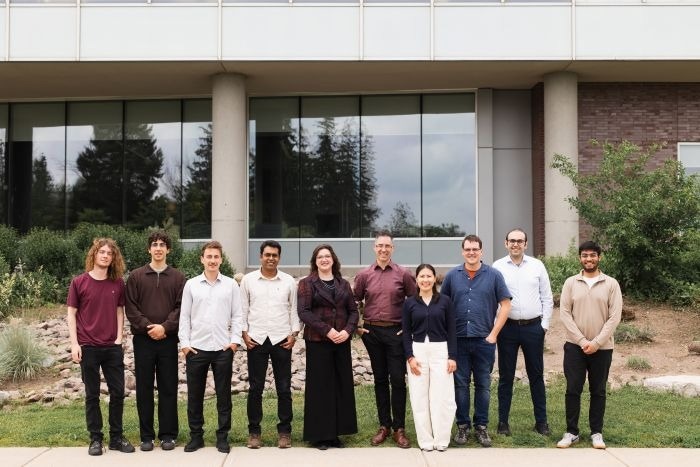 Image Credit: Qubic
The advanced amplifiers developed by Qubic represent a major step forward for this type of device. Heat dissipation is expected to be cut to under 0.1 mW per amplifier, which is a significant milestone, especially for quantum computing. Many quantum systems use standard semiconductor amplifiers in cryogenic environments, consuming nearly half the thermal budget of their dilution refrigerators. This restricts cooling capacity and has been a substantial roadblock preventing these machines from scaling. It is therefore vital to overcome this key obstacle to unlocking the full potential of quantum computing.
“We have seen an increasing appetite in the market for the technologies Qubic is developing. The recent purchase of our devices by Quantum Machines is evidence of this,” said Jérôme Bourassa, CEO and Co-Founder at Qubic. “This group of investors was very impressed by our momentum and decided that now was the right time for them to back us. They understand, as others do, that our technology will be a key component in enabling quantum computers to scale and attain the full potential of those systems. Beyond that, other applications in defence and communications are also within reach, giving us a significant total addressable market which our team is very excited about.”
Proceeds from the seed round will be deployed across three priorities. First, completing development of Qubic's amplifier MVP. Second, scaling manufacturing capacity to meet growing demand from quantum computing and defence customers. Third, building a Radio Frequency quantum sensing platform with the amplifier at its core, for advanced sensing and communication applications such as threat detection or covert operations. The company plans to grow its team three-fold in order to achieve these milestones.
In May, Qubic announced the first sale of its amplifiers to Quantum Machines, a global leader in hybrid control systems for quantum computing. Together, the companies will examine integrating Qubic's cryogenic amplifiers into the technology stack to optimize performance enhancements for quantum computers.
“Qubic’s technology is addressing one of the most critical bottlenecks in quantum and advanced sensing infrastructure, which is preserving signal fidelity in extremely low-noise environments. We believe this technology represents a significant step forward, and we are proud to lead this round as the company moves toward expanded commercial scales,” added Allen Lau, Co-founder and Operating Partner at Two Small Fish Ventures.
Chloé Archambault, Partner at Quantacet added "Qubic has developed a unique radio-frequency quantum signal processing platform that not only addresses critical needs in the quantum computing industry, but also lays the foundation for future uses such as remote sensing and stealth communications. We are pleased to support the team at this critical stage of development."
Kinetic Inductance Traveling Wave Parametric Amplifiers (KI-TWPAs) are ultra-low-noise, wide-bandwidth microwave amplifiers capable of boosting signal amplitude. Purpose-built for reading out superconducting qubits in quantum computers, Qubic’s KI-TWPAs are also compatible with other qubit modalities. Unlike conventional designs that rely on Josephson junctions, which are notoriously challenging to scale, Qubic's KI-TWPAs derive their nonlinear inductance directly from the transmission line material itself. The result is a more robust device that operates near the quantum limit and supports multiplexed qubit readout.