Qunova Computing, a world leader in quantum computations for advanced chemistry, today announces that its HI-VQE algorithm has become the first quantum algorithm to reach chemical accuracy (a level of precision required for practical use) at 80 qubits. It did so while simulating the 4Fe-4S iron-sulfur cubane cluster in a quantum / classical super compute workflow using an IBM Quantum System Two quantum computer at RIKEN, along with RIKEN’s classical supercomputer Fugaku. This result represents the most accurate quantum computation of the molecule to date.
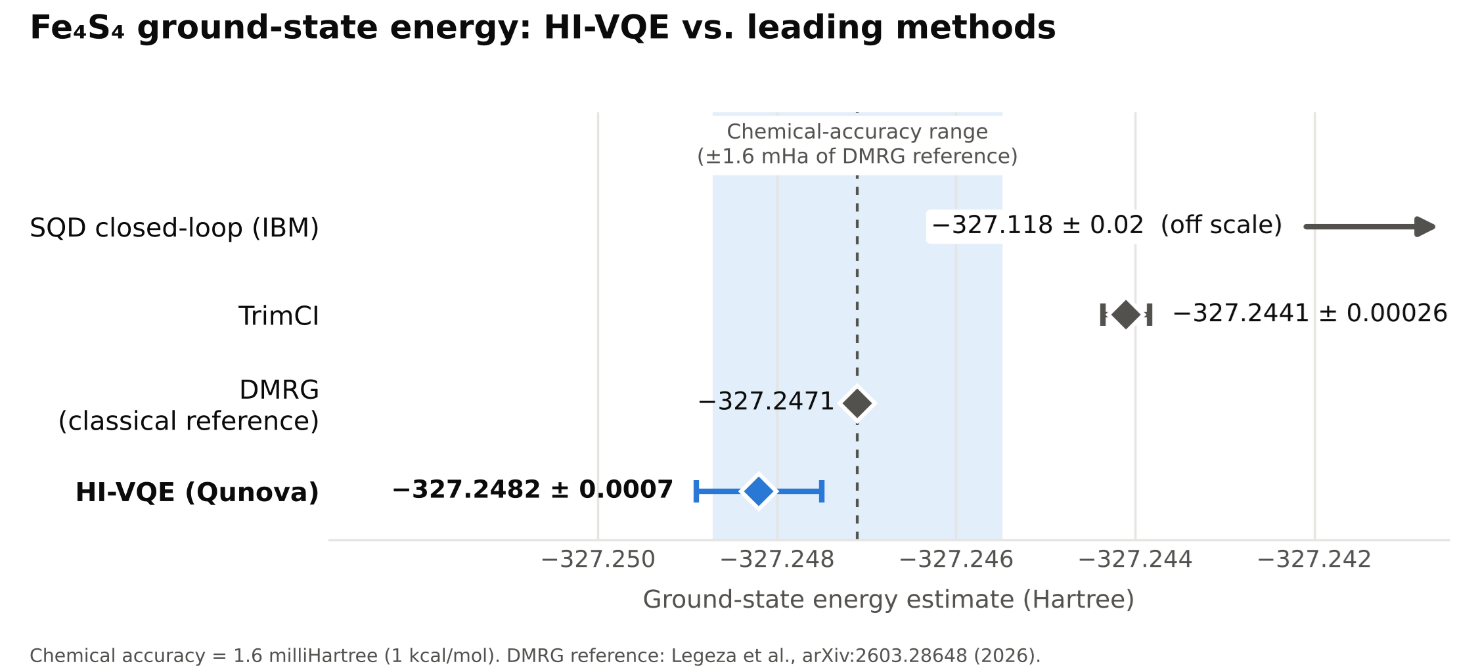 Image Credit: Qunova Computing
Qunova’s extrapolation of the cluster’s ground-state energy, −327.2482 ± 0.0007 Hartree, is consistent within chemical accuracy regarding the leading classical reference calculated using the Density Matrix Renormalization Group (DMRG) method (−327.2471 Hartree). This result is more accurate than the latest extrapolated Trimmed Configuration Interaction (TrimCI) results. This places a quantum-based approach on equal footing, in terms of accuracy, with the strongest classical methods available today for one of the most demanding problems in chemistry.
“4Fe-4S has long been a proving ground where only the very best classical methods could compete, and today a quantum algorithm has reached that standard,” said Kevin Rhee, CEO and founder of Qunova Computing. “Our ground-state energy estimate is within chemical accuracy with respect to the classical benchmark DMRG, making HI-VQE the first quantum approach to achieve this type of result at this scale. We are also very encouraged that our method points to a slightly lower estimate of the ground state energy estimate of the true ground state. Our next goal is to identify additional industrial use cases where HI-VQE consistently delivers better results than the best classical methods. We believe this result shows we are on the right path.
For chemical, pharmaceutical, and materials companies, the significance is confidence. For the first time, a quantum-based workflow has produced results for an industrially relevant molecule that stand alongside the best that classical computing can offer. Reaching this level of accuracy, reproducibly, is the prerequisite for quantum-enhanced chemistry to move from a capability demonstrated by a handful of institutions toward one which industrial users can apply to real design questions.
The result marks a significant step forward among quantum approaches. Compared with previously published sample-based quantum diagonalization (SQD) result for 4Fe-4S, HI-VQE reached a lower ground-state energy of −326.9821 Ha by the second iteration using only 2,518 Fugaku node-hours, which represents a ~300x reduction in computational cost.
Mitsuhisa Sato, Division Director of Quantum-HPC Hybrid Platform Division from RIKEN Center for Computational Science, said “One of the principal reasons we have built our world-class JHPC-quantum QC-HPC hybrid computing platform is so that we can enable forward thinking innovators to test and prove their theories in practice for advanced QC-HPC hybrid applications. We are therefore pleased to see that Qunova’s HI-VQE is delivering highly accurate results to complex problems far faster than alternative approaches. It is important in this way that we can continue to enhance the value that quantum computing brings to industrial users around the world.”
Fe4S4 ground-state energy: HI-VQE vs. leading methods. Source: Qunova Computing
| Method |
Ground-state energy estimate (Hartree) |
Difference from DMRG reference |
Within chemical accuracy? (±1.6 mHa) |
| HI-VQE (Qunova) |
−327.2482 ± 0.0007 |
1.1 mHa lower based on extrapolated results |
Yes |
| DMRG (classical reference) |
−327.2471 |
Reference |
Reference |
| TrimCI |
−327.2441 ± 0.00026 |
3.0 mHa higher |
No |
| SQD closed-loop (IBM) |
−327.118 ± 0.02 |
129 mHa higher |
No |
Chemical accuracy = 1.6 milliHartree (1 kcal/mol). DMRG reference: Legeza et al., arXiv:2603.28648 (2026). SQD ref: https://arxiv.org/html/2511.00224v1
The result shows how HI-VQE is directly relevant to industrial users working in chemicals, pharmaceuticals, and materials science. Iron-sulfur clusters serve as the catalytic and electron-transfer cores of a large class of metalloproteins, including ferredoxins, hydrogenases, nitrogenase, and numerous respiratory and photosynthetic enzymes. Computing their electronic structure correctly underpins the understanding of biological nitrogen fixation, hydrogen production, and electron transport. The molecule is also among the most computationally demanding systems known in chemistry, beyond exact solution by any method, and a recognized proving ground for new approaches.
“Qunova has demonstrated an impressive ‘quantum plus HPC’ workflow on a highly challenging chemistry problem, using IBM quantum computers and Fugaku, which has shown promising efficiency compared with selected-CI approaches,” said Jay Gambetta, Director, IBM Research and IBM Fellow.
Qunova’s findings also indicate that even better results may be possible, and processing between 500 million and 3 billion unique states puts the next accuracy milestone within reach. Additional functionalities such as orbital rotation and orbital optimization will be added to HI-VQE over the coming months to unlock this added performance, and Qunova is now working to identify the systems where HI VQE consistently outperforms other methods. Furthermore, because HI-VQE assumes neither linearity nor locality, the same solver applies to catalysts, electrode materials, and drug targets. This represents a crucial area where HI-VQE delivers the accuracy required to create value for industrial users of quantum computing.