New observations of stellar motion show that interactions with the Large Magellanic Cloud are causing the Small Magellanic Cloud to expand and fall out of equilibrium. According to a recent study published in Astronomy & Astrophysics, the nearby dwarf galaxy is being stretched and disturbed, even in its inner regions, by gravitational interactions with its larger neighbor. The study provides the most comprehensive picture of the Small Magellanic Cloud’s stellar motions to date.
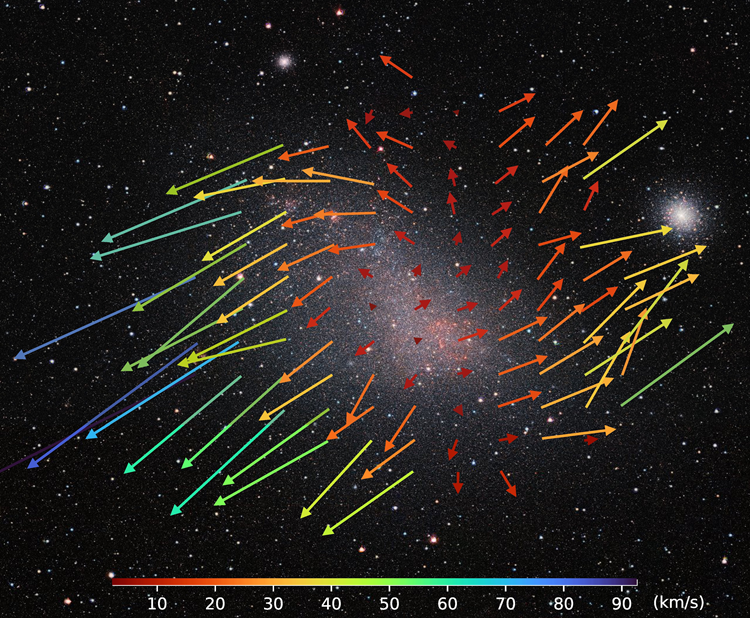 Small Magellanic Cloud observed with the VISTA Telescope. The arrows show the motion of stars away from the center of the galaxy, revealing a large-scale expansion pattern. The color scale indicates the velocities of the stars. Image Credit: ESO/VISTA VMC/ AIP/ S. Vijayasree
Researchers at AIP were able to quantify the movements of millions of stars throughout the Small Magellanic Cloud with previously unheard-of accuracy using over ten years of observations from the VISTA Survey of the Magellanic Clouds (VMC). The recent study offers concrete evidence that the Small Magellanic Cloud's encounter with the Large Magellanic Cloud caused a tidal disruption that affected the entire galaxy.
Stars across the Small Magellanic Cloud exhibit large-scale outward motion rather than the coherent rotation typical of stable galaxies, suggesting that the structure is dynamically perturbed even in the interior regions.
The results reveal large-scale tidal expansion throughout the Small Magellanic Cloud galaxy and challenge long-standing assumptions that the Small Magellanic Cloud behaves like a rotating disk. The study shows that the internal motions of stars in the Small Magellanic Cloud are dominated not by orderly rotation, but by gravitational disturbances caused by repeated encounters with the LMC over billions of years.
Sreepriya Vijayasree, Doctoral Student, Leibniz Institute for Astrophysics Potsdam (AIP)
Approximately 200,000 light-years away from Earth, the Small Magellanic Cloud is one of the Milky Way's nearest galactic neighbors. From the Southern Hemisphere, it creates two interacting satellite galaxies with the Large Magellanic Cloud. The Magellanic Clouds' proximity gives scientists a rare chance to examine how galaxies change as a result of gravity.
Interactions between the two galaxies have caused star formation bursts, warped their forms over time, and drawn streams of gas and stars into intergalactic space. These encounters are recorded by the movements of stars. Astronomers can recreate the galaxy's dynamical past by observing stars' "proper motions," or movements across the sky.
“The new study used observations from the VMC survey, an extensive near-infrared imaging program conducted with the VISTA telescope at the European Southern Observatory’s Paranal Observatory in Chile,” explains AIP researcher and principal investigator of the survey Prof. Dr. Maria-Rosa Cioni.
The VMC survey was designed to map the Magellanic Clouds in unprecedented detail in infrared light, allowing astronomers to peer through dust and study stellar populations spanning a wide range of ages. The latest VMC data release extends the observational time baseline to as much as 11 years, enabling much more precise measurements of stellar motions than earlier studies.
Dr. Maria-Rosa Cioni, Leibniz Institute for Astrophysics Potsdam (AIP)
Dr. Florian Niederhofer, co-author of the study and postdoctoral researcher at AIP, adds: “When I saw the results for the first time, I was really amazed by the quality of the measured stellar motions. By combining observations that have been taken over a time baseline of more than a decade, we were able to map the internal kinematics of the Small Magellanic Cloud with a level of detail that is outstanding for observations from the ground.”
In comparison to earlier VMC-based measurements, the team's analysis of this long-time baseline resulted in a threefold increase in proper-motion precision. The resulting motion maps show that stars in the Small Magellanic Cloud are traveling outward along a southeast-northwest axis, which is compatible with tidal stretching brought on by the Large Magellanic Cloud's gravitational pull.
The researchers discovered that stars in the Small Magellanic Cloud are expanding at an average rate of roughly 17 km/s. Over a few hundred million years, stars can shift by several thousand light-years at this rate, which would drastically alter the structure of the galaxy.
Surprisingly, the expansion may be seen deep within the galaxy's center regions as well as on its periphery. After taking tidal influences into consideration, the researchers discovered no proof of coherent rotating motion. Rather, the observed star motions are primarily radial, suggesting that the dynamical state of the Small Magellanic Cloud is significantly disrupted.
The results imply that popular rotating-disk models oversimplify the actual intricacy of the interior dynamics of the galaxy. The study claims that these models are capable of misinterpreting tidal streaming motions as rotation. Additionally, the study discovered a clear northward stellar motion that is unique to older red giant stars.
The trace of an interaction that took place more than two billion years ago might be preserved by this property. Younger and intermediate-aged stars exhibit stronger and more consistent outward motions in response to the tidal forces. This population-dependent behavior suggests that the star populations in the Small Magellanic Cloud still remember various phases of the galaxy's interaction history.
Journal Reference:
Vijayasree, S., et al. (2026) The VMC survey. LV. The coherent expansion of the SMC. Astronomy & Astrophysics. DOI: 10.1051/0004-6361/202659431. https://www.aanda.org/component/article?access=doi&doi=10.1051/0004-6361/202659431.