A dense dead star observed drawing material from a companion star has helped astronomers solve one of the universe’s most enduring mysteries, with researchers from UNC-Chapel Hill playing a key role in the discovery. The findings, published in the journal Nature Astronomy, provide some of the strongest evidence to date about the origin of these unusual radio wave bursts. Since their discovery, the bursts have puzzled scientists because they can repeat over timescales ranging from minutes to hours
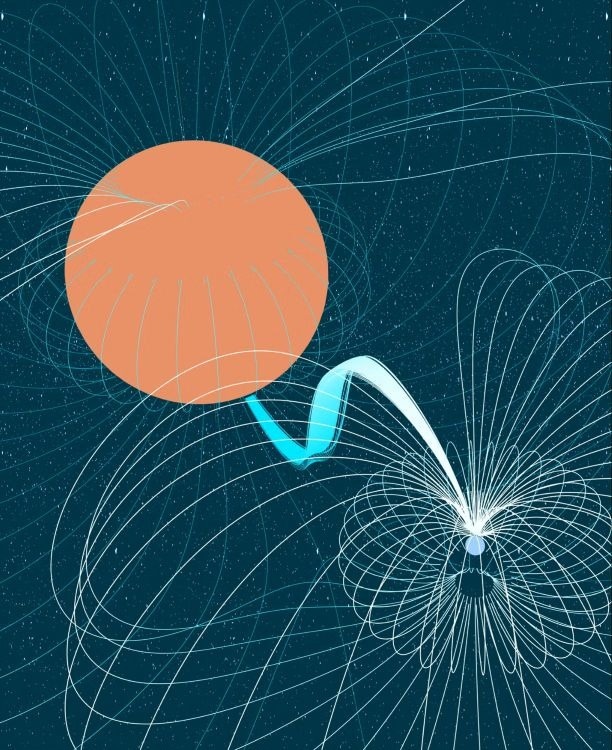 Artist’s impression of the white dwarf binary ASKAP J1745-5051. The smaller, dense white dwarf star is accreting material from the larger, but less dense red dwarf star. The interaction of their magnetic fields and the heat from the material accretion creates signals in radio and X-ray light frequencies. Image Credit: Carl Knox (OzGrav/Swinburne) and Dr. Joshua Preston Pritchard (CSIRO).
The source of a mystery class of cosmic signals known as long-period radio transients was identified by Carolina astronomers Dr. Igor Andreoni, Dr. Brad Barlow, and PhD candidate Jonathan Carney as part of a worldwide cooperation.
The discovery started when researchers at the University of Sydney, under the direction of graduate student Kovi Rose, utilized the Australian Square Kilometre Array Pathfinder (ASKAP) radio telescope to identify strong radio wave bursts that repeated every 1.4 hours. Multiple telescope observations revealed that the signals originated from a binary star system that had a low-mass red dwarf companion, a compact stellar remnant around the size of Earth but with a mass similar to the Sun, and a white dwarf.
The Carolina team swiftly obtained observing time on the 4.1-meter Southern Astrophysical Research (SOAR) Telescope in Chile to test the concept.
“The SOAR observations were essential to the success of this project,” said Andreoni, Assistant Professor in the Department of Physics and Astronomy at UNC-Chapel Hill.
Our data revealed that we were looking at two stars orbiting each other and we could measure the rotation period.
Dr. Igor Andreoni, Department of Physics and Astronomy, The University of North Carolina at Chapel Hill
The presence of a magnetic cataclysmic variable (a binary system in which a white dwarf extracts material from a companion star) was verified by Andreoni, Barlow, and Carney's late-night measurements of the system's brightness. That material warms to extremely high temperatures as it spirals toward the white dwarf, resulting in characteristic X-ray and optical emissions.
The atmosphere in the observing room that night was electric. As soon as the spectrum came up on the screen, those unmistakable emission lines told us we had something special on our hands. It’s not often you get to play a role in discoveries of this magnitude.
Dr. Brad Barlow, Associate Professor, Department of Physics and Astronomy, The University of North Carolina at Chapel Hill
The system, known as ASKAP J1745−5051, is made up of a red dwarf star and a white dwarf with a mass of roughly one-tenth that of the Sun. The stars are so close to one another that it takes them slightly more than an hour to complete one orbit. The strong magnetic fields of the stars combine to produce regular radio bursts that may be seen over great distances in space as material is removed from the red dwarf and gathered onto the white dwarf.
The resolution and sensitivity of the SOAR telescope instrumentation were key. The observations were made possible in part by the Goodman spectrograph, a Carolina-designed instrument mounted on the SOAR Telescope in Chile. UNC originally initiated the SOAR Telescope project in 1987 to expand access to the southern sky for students and researchers.
Jonathan Carney, Graduate Student, Department of Physics and Astronomy, The University of North Carolina at Chapel Hill
The discovery could ultimately explain the cause of some long-period radio transients. Many scientists believed that these signals were from pulsars, which are neutron stars that spin very slowly. According to current theory, such emissions should not be produced by neutron stars rotating this slowly. The new results support a different theory that some of these enigmatic signals are produced by interacting white dwarf binary star systems.
ASKAP J1745−5051, according to researchers, may be an important reference for understanding new findings. This system could give astronomers a benchmark for figuring out if recently found long-period radio transients come from pulsars, white dwarf binaries, or other unusual objects, much like the Rosetta Stone assisted researchers in deciphering ancient Egyptian hieroglyphics.
In addition to resolving a long-standing astronomical conundrum, the system gives researchers a unique chance to examine high-energy plasma, severe magnetic fields, and the behavior of matter under circumstances that cannot be replicated in labs.
Journal Reference:
Rose, K., et al. (2026). Periodic radio and X-ray emission from an accreting white dwarf binary. Nature Astronomy. DOI: 10.1038/s41550-026-02882-x. https://www.nature.com/articles/s41550-026-02882-x.