Magnons are promising components for hybrid quantum systems and quantum metrology, but their very short lifetimes have limited their use. A research team from the University of Vienna has extended magnon lifetimes up to 18 microseconds, about 100 times longer than before. The study was recently published in the journal Science Advances.
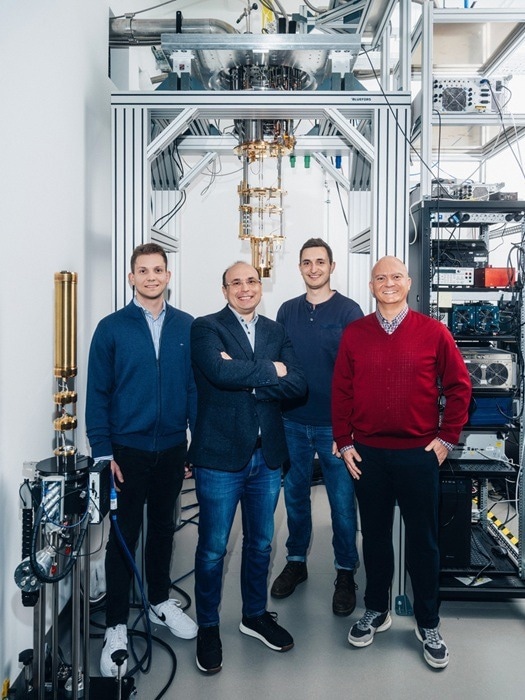 From right to left, Rostyslav Serha, Andrii Chumak, David Schmoll, and Sebastian Knauer are standing in front of a cryostat. This device is used to generate and stabilize extremely low temperatures, thereby enabling the controlled excitation and precise detection of magnons. Image Credit: ©Ian Ehm
Magnons are minuscule waves in magnetization. A barrier has been their excessively brief lifetime of only a few hundred nanoseconds. This lifetime has now been extended a hundredfold to up to 18 microseconds by an international team of physicists led by Andrii Chumak from the University of Vienna, opening the door for a quantum computer the size of a one-cent coin.
Additionally, the scientists have achieved the important discovery that the lifetime of magnons is determined by materials rather than a basic law of physics.
Similar to the ripples that appear when a stone is tossed into a pond, magnons are minuscule waves in magnetization that move through solid magnetic objects. In contrast to photons, which move via optical fibers or empty space, magnons move inside a magnetic solid.
Magnonic circuits might theoretically fit onto a chip no bigger than those present in modern smartphones since their wavelengths can be lowered to the nanometer range. A magnon is a perfect building block for hybrid quantum systems and quantum metrology because, being an excitation of a solid, it naturally relates to many other fundamental quasi-particles, such as phonons and photons.
Until now, magnons’ extremely short lifespan has been a major barrier. Their lifespan (the length of time they can reliably transmit quantum information) was, at most, only a few hundred nanoseconds, far too brief for practical quantum computation. Wiener’s team has now made a major advance, measuring magnon lifetimes of up to 18 microseconds, roughly 100 times longer than any previously recorded value.
Similar to the superconducting qubits used in today's top quantum processors, magnons in this state transform from transient signals into dependable, long-lasting carriers of quantum information.
The breakthrough came from combining two key ideas. First, the team excited short-wavelength magnons, which are naturally less sensitive to surface defects in the crystal, the very imperfections that had limited lifetimes in earlier experiments, rather than relying on traditional uniform magnons.
Second, using a mixed-phase cryostat, the researchers cooled ultra-pure spheres of yttrium iron garnet (YIG) to just 30 millikelvin, roughly a degree above absolute zero. At this temperature, the thermal processes that typically disrupt magnons are effectively frozen out, allowing them to persist far longer than previously possible.
Importantly, the team was able to demonstrate that minute trace impurities in the crystal, rather than a basic law of nature, dictate the remaining restriction on the magnon lifespan. The outcome of testing three spheres with different levels of purity was evident: the longer the magnon lasts, the purer the substance.
All prior records were exceeded by even the least pure sample. This indicates that there is a lot of room for advancement and that it will depend on materials science rather than the discovery of novel physics.
What This Means for Quantum Technology
Magnons change from lossy intermediate links to reliable quantum memory and low-loss communication links on a semiconductor with lifetimes of 18 microseconds. A long-awaited "quantum bus" that would be a necessary component for scalable quantum computers might be created by connecting hundreds of qubits over a common channel.
Magnons could act as universal translators in hybrid quantum architectures, connecting technologies that would not otherwise be able to communicate with one another because they are solid-state particles that couple to a variety of quantum systems.
Journal Reference:
Serha, O. R., et al. (2026) Ultralong-living magnons in the quantum limit. Science Advances. DOI: 10.1126/sciadv.aee2344. https://www.science.org/doi/10.1126/sciadv.aee2344.