Astronomers analyzing data from the Hobby-Eberly Telescope Dark Energy Experiment (HETDEX) identified tens of thousands of massive hydrogen gas halos, known as “Lyman-alpha nebulae,” that surrounded galaxies 10 billion to 12 billion years ago. The Astrophysical Journal reported the findings.
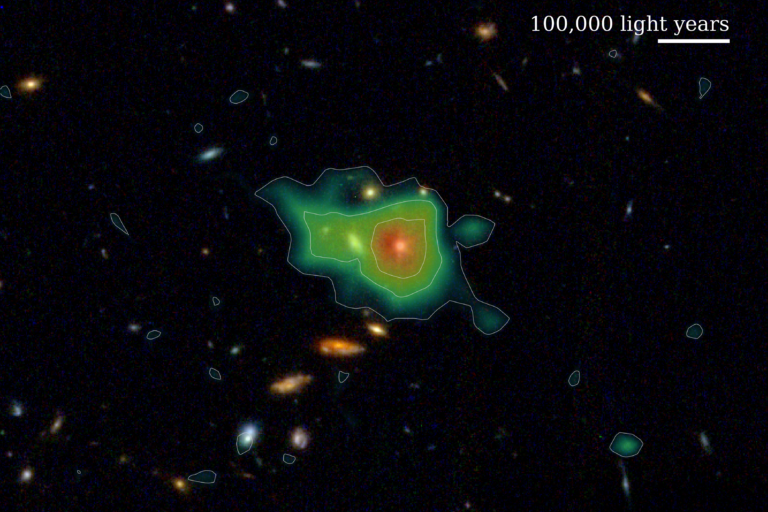 An enormous halo of hydrogen gas found in Hobby-Eberly Telescope Dark Energy Experiment (HETDEX) data and superimposed over its location as seen in deep imaging from the James Webb Space Telescope (JWST). Present 11.3 billion years ago, this system glows from the combined light of many galaxies within it, with the brightest region represented in red. Using data from HETDEX, astronomers have increased the known number of these haloes by more than a factor of ten – from roughly 3,000 to over 33,000. Image Credit: Erin Mentuch Cooper (HETDEX), JWST image: NASA, ESA, CSA, STScI
Cosmic Noon is a time in the early universe when galaxies were developing at their fastest. To power this expansion, they would have required access to massive quantities of hydrogen gas, a critical building element for stars. However, until recently, astronomers had only discovered a few of these critical structures.
The new study has raised the known number of hydrogen gas halos by a factor of 10, from around 3,000 to more than 33,000. This validates assumptions that they are not uncommon oddities. The finding also broadens the range of known sizes, giving astronomers a more representative sample to explore as they continue to investigate the genesis and evolution of the earliest galaxies.
We’ve been analyzing the same handful of objects for the past 20 or so years. HETDEX is letting us find many more of these halos and measure their shapes and sizes. It has really allowed us to create an amazing statistical catalogue.
Erin Mentuch Cooper, Study Lead Author and Data Manager, Hobby–Eberly Telescope Dark Energy Experiment
Hydrogen gas is notoriously difficult to detect because it does not emit visible light on its own. However, when it is near an energetic source, such as a galaxy or a group of galaxies with UV-emitting stars, the hydrogen can begin to glow. Detecting this signal requires significant observing time with highly precise instruments, which are typically in high demand.
Previous astronomical surveys have identified some of these halos, but their instruments were only sensitive enough to capture the brightest and most extreme examples. In addition, targeted observations of early galaxies are often so tightly zoomed in that anything beyond the smallest halos is missed. As a result, the full range between the smallest structures and the largest, most prominent halos has remained largely unexplored.
Observations from HETDEX are beginning to close this gap. By using the Hobby-Eberly Telescope at McDonald Observatory, the project is mapping the positions of more than one million galaxies to better understand dark energy.
We’ve captured nearly half a petabyte of data on not only these galaxies but the regions in between. Our observations cover a region of the sky measuring over 2,000 full Moons. The scope is enormous and unprecedented.
Karl Gebhardt, Study Co-Author and Principal Investigator, Hobby–Eberly Telescope Dark Energy Experiment
Gebhardt is also the chair of The University of Texas at Austin’s astronomy department.
“The Hobby-Eberly Telescope is one of the largest in the world. And the instrument HETDEX uses produces 100,000 spectra in each observation. So, we have huge amounts of data and there are all kinds of neat, fun, weird things waiting for us to find,” added Dustin Davis, a postdoctoral fellow at UT Austin, a HETDEX scientist, and co-author on the study.
The newly discovered halos span a wide range of sizes, from tens to hundreds of thousands of light-years across. Some are relatively simple, resembling football-shaped clouds surrounding a single galaxy. Others are vast, irregular structures that encompass multiple galaxies within a single, diffuse halo.
Those are the fun ones. They look like giant amoebas with tendrils extending into space.
Mentuch Cooper, Data Manager, Hobby–Eberly Telescope Dark Energy Experiment
To identify these structures, the researchers selected the 70,000 brightest galaxies from the more than 1.6 million early galaxies identified so far by HETDEX. They then used supercomputers at the Texas Advanced Computing Center to analyze how many of these galaxies were surrounded by a halo (a dense central region of hydrogen with a more diffuse cloud extending outward).
Nearly half of the galaxies met this criterion. As Erin Mentuch Cooper noted, however, this proportion is likely an underestimate.
Almost half did. Furthermore, Mentuch Cooper noted that this proportion is most likely an underestimate.
Cooper added, “We suspect the faintest systems simply aren’t bright enough to fully reveal how large they are.”
The team believes that their discovery will aid future research into the early universe, including how its structures developed, matter distribution, object movement, and other topics. With 33,000 halos to investigate, the question will no longer be where to discover them, but which one to select.
There are various models for galaxies in this epoch that largely work and seem to make sense, but there are gaps and holes. Now we can focus in on individual halos and see at a greater detail the physics and mechanics of what’s going on. And then we can fix or throw out the models and try again.
Dustin Davis, Study Co-Author and Postdoctoral Fellow at University of Texas, Austin
Journal Reference:
Cooper, E. M. et al. (2026) Lyα Nebulae in HETDEX: The Largest Statistical Census Bridging Lyα Halos and Blobs across Cosmic Noon. The Astrophysical Journal. DOI: 10.3847/1538-4357/ae44f3. https://iopscience.iop.org/article/10.3847/1538-4357/ae44f3.