According to a new study published as an Editor’s Suggestion in Physical Review D, researchers from The University of Tokyo Kavli Institute for the Physics and Mathematics of the Universe discovered that a change in a critical cosmic measurement in the early universe might be a statistical artifact.
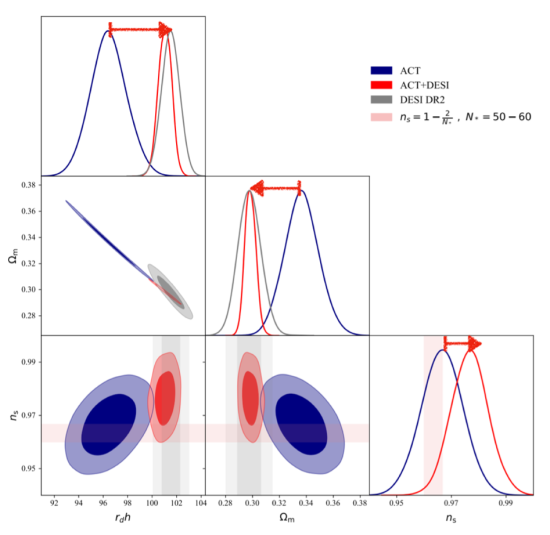 Comparison of the constraints from ACT (blue), DESI BAO (grey), and ACT+DESI (red) on the BAO parameters and the spectral index,. The pink band shows the values favored by the preferred post-Planck inflation models. A shift in the preferred parameter values is visible between ACT and DESI, as well as ACT+DESI, highlighting the BAO–CMB tension. This shift also pushes away from the pink band. Image Credit: Ferreira et al.
For decades, researchers have been investigating what the universe looked like in its earliest seconds. It is widely recognized that the universe expanded exponentially in the first fraction of a second following the Big Bang.
Researchers utilize the scalar spectral index, , to determine how primordial density variations were spread over different length scales in the early universe. The value of ns is an important observable in inflationary cosmology since different inflationary scenarios predict different values for this quantity, making it a powerful model discriminator.
Observations from the Planck satellite placed tight constraints on , significantly narrowing the range of viable inflationary models. As measurements of became increasingly precise, attention shifted toward other observables, such as the tensor-to-scalar ratio and primordial non-Gaussianities, as the next key discriminants of inflationary physics.
This was true until 2025, when two groups of researchers used diverse astrophysical datasets to produce a value for that called into question some of the most well-known inflation models.
However, a team of researchers led by Project Assistant Professor Elisa Ferreira of the University of Tokyo's Kavli Institute for the Physics and Mathematics of the Universe (Kavli IPMU, WPI) has now demonstrated that this disparity results from a subtle statistical interaction between measurements of the cosmic microwave background (CMB) and baryon acoustic oscillations (BAO), underscoring the significance of dataset consistency in the estimated value of .
In the study, the team examined how the estimated value of the scalar spectral index is affected when BAO data and CMB observations are combined. They demonstrated how a mild tension between these datasets, known as the “BAO–CMB tension,” causes the change in and spreads into the inflationary parameter restrictions. The evidence against conventional inflationary models becomes much weaker when this impact is appropriately taken into consideration.
Particularly, the authors show that changes in late-time cosmological characteristics like the matter density are connected to the shift in . This implies that the outcome mostly reflects internal dataset consistency rather than novel insights into the mechanics of inflation. The study emphasizes how crucial it is to thoroughly evaluate cross-dataset conflicts prior to making firm conclusions on basic early-universe theories.
As a result, the inferred value of is not unique in the presence of BAO-CMB tension. Different combinations of cosmic datasets produce statistically significant changes. Current inflation limitations are therefore susceptible to how late-time data are integrated.
Until the origin of this tension is identified, it is uncertain whether the value of should be considered the most dependable. The shift might be attributed to unknown systematics, analytical decisions, or perhaps new physics.
Before making conclusions on inflationary models and the physics of the early universe, this issue must be resolved.
Sources:
Journal Reference:
Ferreira, E. G. M. et al. (2026) BAO-CMB tension and implications for inflation. Physical Review D. DOI: 10.1103/lq71-b84v. https://journals.aps.org/prd/abstract/10.1103/lq71-b84v.
The University of Tokyo Kavli Institute for the Physics and Mathematics of the Universe