New optical modules have now been added to the IceCube Observatory, allowing it to measure lower-energy neutrinos as well. This extension was made possible in large part by researchers at the Karlsruhe Institute of Technology (KIT).
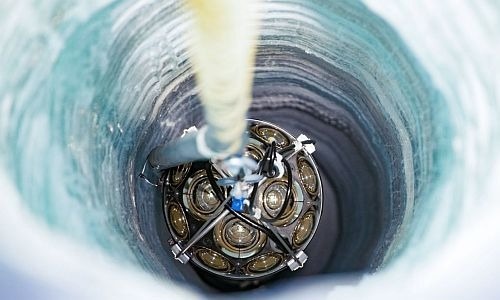 The chains with instruments are lowered into shafts drilled into the Antarctic ice. Image Credit: Yuya Makino, IceCube/NSF
The Amundsen-Scott South Pole Station’s IceCube Observatory has been providing ground-breaking measurements of high-energy cosmic neutrinos since 2010. It is made up of several detectors set into a roughly one cubic kilometer amount of Antarctic ice.
Because neutrinos do not emit detectable signals, researchers instead monitor the paths of muons and other secondary particles. When a neutrino interacts with ice, it can occasionally produce a muon, an elementary particle that leaves a measurable track as it moves. Unlike neutrinos, muons carry an electric charge, which makes their trajectories possible to detect and analyze
Highly sensitive detectors capture the distinctive cone of light these particles generate as they travel through the ice. Building on this capability, 51 scientists from around the world have expanded the IceCube Collaboration experiment to better monitor low-energy neutrinos. The upgrade includes six additional strings of advanced sensors, installed as deep as 2,400 meters beneath the Antarctic ice, further extending the detector’s reach into this frozen environment .
New Optical Sensors Amplify Even Weak Light Signals
The novelty of the optical sensors in the upgrade is that they are equipped with photoelectron multipliers in all directions, allowing a 360-degree view into the ice. This enables us to observe neutrino interactions at lower energies and thus determine the properties of neutrinos, complementing the KATRIN experiment at KIT.
Dr. Andreas Haungs, Scientific Director, IceCube Working Group, Institute for Astroparticle Physics, Karlsruhe Institute of Technology
He added, “In addition, we can better investigate the properties of ice in a large volume, thereby improving measurement accuracy. In combination with the new surface instrumentation, the upgrade also offers new possibilities for measuring high-energy cosmic rays.”
The weak light signal from the interaction of neutrinos during their very infrequent reactions in the transparent ice is amplified by the photosensors. Along with other sensors, these light amplifiers are mounted in 40 cm football-shaped containers called mDOMs (multi-PMT digital optical modules).
These mDOMs and other measurement devices are connected by cable harnesses to create a 1,500-meter-long pearl necklace. After being dropped into tunnels that are 2,400 meters deep, these chains are melted into the ice in two days by a hot-water drill. This produced six shafts that, once the instruments are in place, freeze once more.
The IceCube Neutrino Observatory is being upgraded in Germany through a collaboration led by the DESY and the Karlsruhe Institute of Technology, alongside researchers from RWTH Aachen University, Ruhr University Bochum, TU Dortmund University, Friedrich-Alexander-Universität Erlangen-Nürnberg, Johannes Gutenberg University Mainz, Technical University of Munich, University of Münster, Humboldt University of Berlin, and University of Wuppertal.
The approximately 10,000 mDOM photosensors installed in IceCube were developed and produced by KIT researchers. The team is also responsible for expanding the experiment’s instrumentation, including radio antennas and scintillators that they designed and built to enhance the observatory’s detection capabilities.
Looking to the Future: IceCube Gen2
The upgrade will extend neutrino astronomy to lower energies. This not only opens a new window onto the universe, but also serves as a meaningful technology and practical test for the proposed expansion to IceCube-Gen2. Gen2 will then enable neutrino astronomy at the highest energies. The result will be a globally unique observatory capable of measuring neutrinos over an energy range of ten orders of magnitude.
Ralph Engel, Professor and Head, Institute for Astroparticle Physics, Karlsruhe Institute of Technology
IceCube-Gen2 is planned as IceCube's next expansion stage, and it is expected to raise the experiment's measuring volume to 8 cubic kilometers. It is a chosen project from the German National Roadmap for Research Infrastructures. The Helmholtz Association's full application, to be submitted in Berlin at the end of February, envisions the two Helmholtz centers, Deutsche Elektronen-Synchrotron DESY and KIT, as equal supporting institutions with a total expenditure of 55 million euros.