An international collaboration led by the Fritz Haber Institute (FHI) has successfully mapped Electron-Transfer-Mediated Decay (ETMD), a critical mechanism in radiation-induced biological damage. By tracking atomic rearrangement in real-time, the team visualized how an excited atom 'solicits' an electron from a neighbor, triggering the ionization of a third nearby atom. The study provides the most detailed real-space depiction of the electronic decay processes that lead to biomolecular destruction and was published in the Journal of the American Chemical Society (JACS).
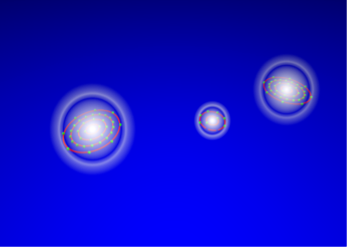 The three atoms of the excited NeKr2 trimer keep roaming around each other for up to one picosecond. Image Credit: FHI
High-energy radiation, such as that found in the X-ray spectrum, can inflict damage on human cells. This occurs because energetic radiation can excite atoms and molecules, which frequently undergo decay, resulting in the destruction of biomolecules and the impairment of larger biological structures. There are many different types of decay mechanisms, and studying them is essential for improving our understanding of (and ability to prevent) radiation-induced damage .
Sophisticated Combination of Experiment and Theory
The research team investigated a straightforward prototype system composed of a single neon atom loosely associated with two krypton atoms (NeKr2 trimer). Following the ionization of the neon core using soft X-rays, the researchers monitored the system for a duration of up to a picosecond, a significant period on the atomic timescale, until it ultimately decayed by transferring an electron between adjacent atoms and releasing a low-energy electron.
Utilizing a cutting-edge COLTRIMS reaction microscope at the synchrotron light sources BESSY II in Berlin and the PETRA III beamline P04 at DESY, the team reconstructed the molecular geometry precisely at the moment the decay took place. To analyze the measurements, comprehensive dimensional ab initio simulations were performed, tracking thousands of nuclear trajectories and assessing the decay probability along each trajectory.
Taking a Movie of the Non-Local Electronic Decay
The team's findings were remarkable: the atoms do not stay static in their original arrangement. Rather, they exhibit significant roaming-like movement, perpetually altering the molecular structure and greatly affecting the timing and manner of the decay process.
We can literally watch how the atoms move before the decay happens. The decay is not just an electronic process – it is steered by nuclear motion in a very direct and intuitive way.
Florian Trinter, Study Lead Author, FHI
The findings suggest that ETMD doesn’t arise from a single “preferred” structure. Instead, different molecular geometries dominate at different points in the process. Initially, the decay occurs near the ground-state geometry. As it progresses, one krypton atom moves closer to the neon atom while the other shifts farther away, forming a configuration well-suited for electron donation and long-range energy transfer.
In the later stages, the system investigates nearly linear and significantly distorted configurations, which illustrate a pendular, roaming-like motion of the atoms. This dynamic reconfiguration results in decay rates that are strongly dependent on time, fluctuating by nearly an order of magnitude based on the geometry.
The atoms explore large regions of configuration space before the decay finally takes place. This shows that nuclear motion is not a minor correction – it fundamentally controls the efficiency of non-local electronic decay.
Till Jahnke, Study Senior Author, European XFEL
Why it Matters
ETMD has garnered increasing interest due to its ability to efficiently generate low-energy electrons, which are recognized for causing chemical damage in both liquids and biological materials. Therefore, comprehending the relationship between ETMD and molecular structure and motion is essential for accurately modeling radiation damage in aqueous and biomolecular contexts, as well as for analyzing ultrafast X-ray experiments. The current results are instrumental in the development of multiscale theoretical frameworks that incorporate precise decay rates into extensive, intricate systems.
By establishing a comprehensive benchmark for the smallest system that facilitates ETMD with three atoms, this study provides a foundation for expanding these concepts to liquids, solvated ions, and biological settings.
“This work shows how non-local electronic decay can be used as a powerful probe of molecular motion. It opens the door to imaging ultrafast dynamics in weakly bound matter with unprecedented detail,” concluded the authors.
Sources:
Journal Reference:
Trinter, F., et al. (2026) Tracking the Complex Dynamics of Electron-Transfer-Mediated Decay in Real Space and Time. Journal of the American Chemical Society (JACS). DOI: 10.1021/jacs.5c15510. https://pubs.acs.org/doi/10.1021/jacs.5c15510
Deutsches Elektronen-Synchrotron (DESY)