A researcher at Tohoku University's Department of Physics discovered an unexpected quantum phenomenon concealed inside regular crystals: the intensity of electron-lattice vibration interactions, known as phonons, is quantized rather than continuous. The study was published in the journal Chemical Physics Impact.
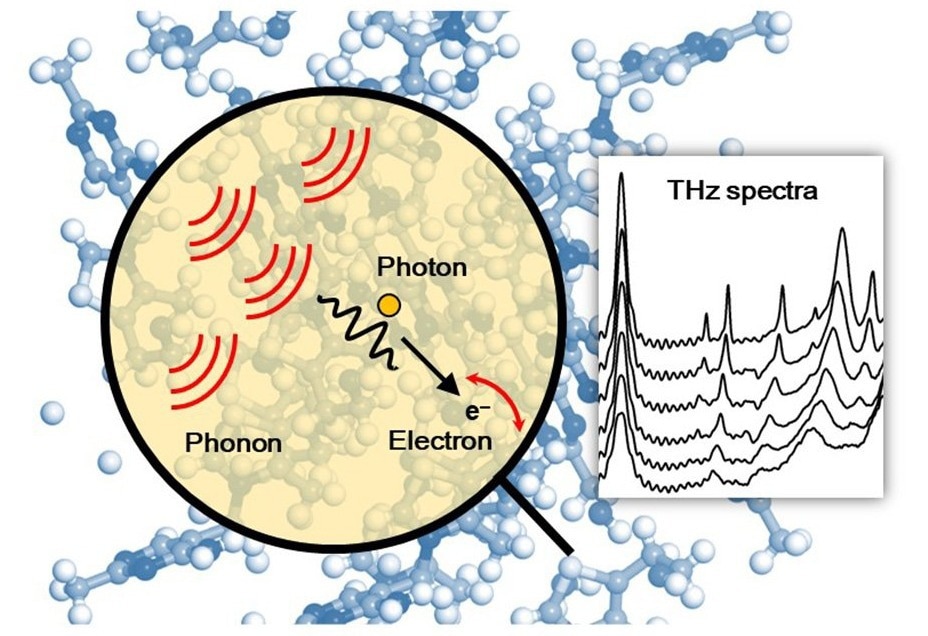 The light (photons) emitted from phonons interact with vibrating electrons in the crystal, and this can be observed in the terahertz spectrum on the right. Image Credit: Masae Takahashi
Even more surprisingly, its power is inextricably tied to one of physics' most recognizable numbers: the fine-structure constant.
The fine-structure constant (α ≈ 1/137) is a dimensionless number known for characterizing electromagnetic interactions independently of any unit system. Think of it like this: if one pencil is twice as long as another, that ratio stays the same whether you measure in inches, centimeters, or feet. The same kind of consistency applies here.
In a recent study led by Masae Takahashi at Tohoku University, researchers discovered that the strength of electron-phonon coupling consistently appears as an integer multiple of a fundamental unit, specifically, the fine-structure constant multiplied by the Boltzmann constant. Put simply, in each interaction, about one part in 137 of the phonon’s energy is transferred.
Electron-phonon coupling was detected with unparalleled accuracy using sophisticated terahertz spectroscopy, which investigates vibrations in the infrared to microwave frequency range. This discovery shows that a basic constant that governs electromagnetic forces also applies to the tiny "dialogue" between electrons and crystals.
Why is this happening? Takahashi traced the origin back to a process similar to Compton scattering, in which electrons clash with photons generated by phonons rather than phonons themselves.
This understanding explains why energy transmission scales with α to the first power, not α², as in spin-orbit interactions. Overall, this study identifies a general quantum rule guiding electron interactions with lattice vibrations within crystals.
This new finding was exciting, as it's the first time in quite a while that we can add new information to well-established quantum mechanics.
Masae Takahashi, Study Head, Tohoku University
By measuring these interactions and regulations, scientists can generate materials with specific qualities for faster electronics and more efficient energy systems. For example, electron-phonon interactions influence the performance of semiconductors, superconductors, and next-generation quantum devices.
Terahertz waves can also influence cell division, meaning that this discovery may have an impact on future breakthroughs not just in daily electronics like cellphones and computers, but also in life sciences.
This work shows that even the whispers between electrons and crystals follow the universal language of quantum constants.
Masae Takahashi, Study Head, Tohoku University
Journal Reference:
Takahashi, M., (2025) Electron–phonon coupling strength in hydrogen-bonded network crystals in the THz frequency range. Chemical Physics Impact. DOI:10.1016/j.chphi.2025.100977. https://www.sciencedirect.com/science/article/