Researchers from Kyoto University and Meiji University have led the quest to understand the origins of elements and the fundamental question of humanity to investigate supernova remnants. The study utilizing data from the X-Ray Imaging and Spectroscopy Mission (XRISM) satellite has provided new insights into the creation of chlorine and potassium, elements crucial for life and planet formation. The study was published in Nature Astronomy.
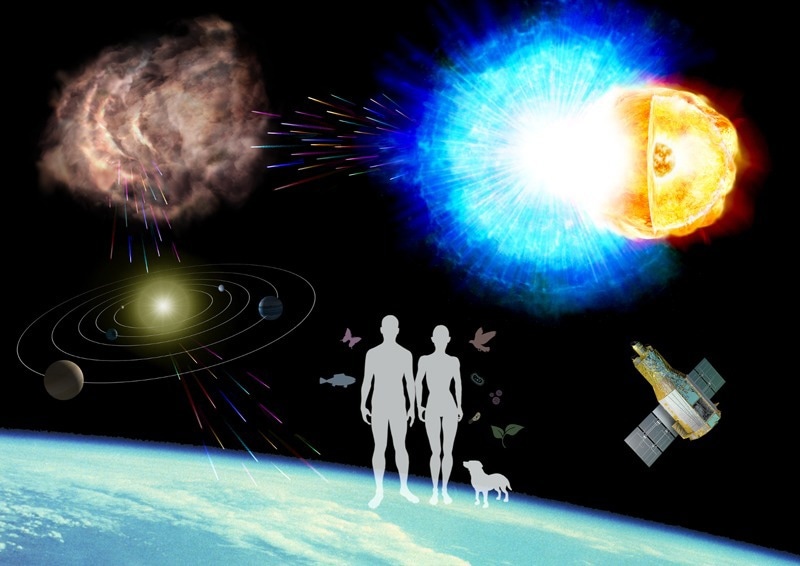 The chlorine and potassium needed to support planet formation and sustain life come from exploding stars. Image Credit: JAXA
The formation of elements is a crucial aspect in addressing the question of existence. Elements are created in stars and supernovae. These then cast them out into the universe. However, the origins of some key elements have remained a mystery.
Chlorine and potassium are essential for life and planet formation. Both are odd-Z elements, possessing an odd number of protons. Current theoretical models suggest that stars produce only about one-tenth of the amount of these elements observed in the universe. This has puzzled astrophysicists for a long time.
This prompted researchers at Kyoto University and Meiji University to examine supernova remnants for traces of these elements. They used XRISM, an X-ray satellite launched by JAXA in 2023. The team performed high-resolution X-ray spectroscopic observations of the Cassiopeia A supernova remnant within the Milky Way.
The scientists utilized the Resolve microcalorimeter on the XRISM satellite, which offers high energy resolution an order of magnitude better than previous X-ray detectors. This capability allowed them to successfully detect faint emission lines from rare elements. Following this, the researchers analyzed the X-ray spectrum from Cassiopeia A, specifically comparing the observed abundances of chlorine and potassium against several established supernova nucleosynthetic models.
The team definitively discovered clear X-ray emission lines for both chlorine and potassium. Their measured abundances were far higher than predicted by standard supernova models, providing the first observational evidence that a supernova is capable of creating sufficient amounts of these elements. The team suggests that strong mixing deep inside massive stars could be responsible for this enhanced production, with possible drivers including fast rotation, binary interaction, or shell-merger events.
When we saw the Resolve data for the first time, we detected elements I never expected to see before the launch. Making such a discovery with a satellite we developed is a true joy as a researcher.
Toshiki Sato, Study Corresponding Author, Kyoto University
The results demonstrate that the vital elements for life were created in extreme environments, deep inside stars, which are drastically different from the conditions necessary for life's emergence. The research also proves the effectiveness of high-precision X-ray spectroscopy in probing the origins of elements and understanding the physical processes located deep within stars.
I am delighted that we have been able, even if only slightly, to begin to understand what is happening inside exploding stars.
Hiroyuki Uchida, Study Corresponding Author, Kyoto University
Utilizing XRISM, the team's next step is to observe other supernova remnants. This effort is aimed at determining if the boosted production of chlorine and potassium is a common characteristic of massive stars or if it is specific to Cassiopeia A, thereby helping to uncover whether these internal mixing processes represent a universal aspect of stellar evolution.
How Earth and life came into existence is an eternal question that everyone has pondered at least once. Our study reveals only a small part of that vast story, but I feel truly honored to have contributed to it.
Kai Matsunaga, Study Corresponding Author, Kyoto University
Journal Reference:
Matsunag, K., et al. (2025) Chlorine and potassium enrichment in the Cassiopeia A supernova remnant. Nature Astronomy. DOI: 10.1038/s41550-025-02714-4. https://www.nature.com/articles/s41550-025-02714-4