The SpeQtre initiative, a joint effort involving the UK's Science and Technology Facilities Council (STFC) RAL Space and Singapore's SpeQtral, achieved a successful launch from California as part of the SpaceX Transporter-15 rideshare mission.
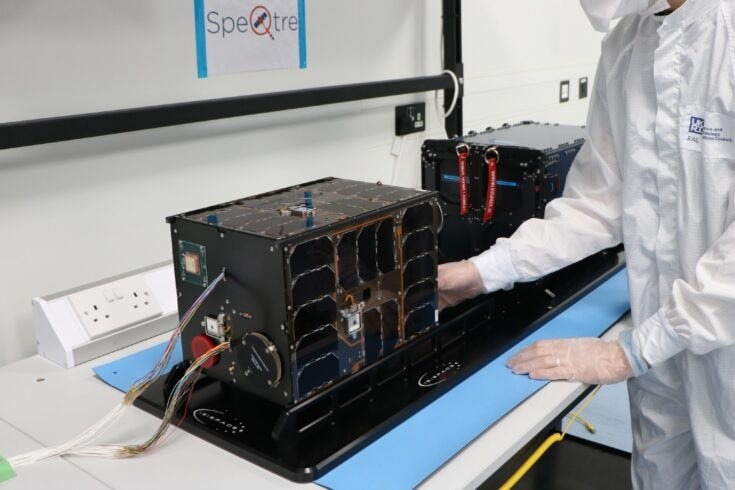
Image Credit: UK Research and Innovation
The primary objective of the SpeQtre satellite's deployment is to demonstrate the potential of ultra-secure quantum communication technology originating from orbit to render cyber-attacks impossible.
Although quantum computing offers significant advancements across various sectors, including healthcare and financial services, it simultaneously poses a risk to the cryptographic safeguards presently securing sensitive information, ranging from online financial transactions to national defense.
With financial backing of £7 million from the UK government, the recently launched SpeQtre satellite is set to evaluate quantum communication technologies from space, which possess such a high level of security that any unauthorized interception attempt is immediately identifiable.
SpeQtre will investigate how this particular technology, leveraging the distinct characteristics of quantum particles to generate encryption keys impervious to undetected interception, could protect data against future cyber-attacks perpetrated by advanced quantum computers.
Drawing on the Power of Quantum Technology
With cyber threats growing more sophisticated, there has never been a more important time to drive forward technologies that can keep us one step ahead of those threatening to wreak havoc. By drawing on the power of quantum technologies to keep data secure, this satellite demonstrates the value of British ingenuity in keeping our country safe from cyber threats while further building on our reputation as a world leader in quantum technology.
Liz Kendall, Science and Technology Secretary, UK Research and Innovation
How Quantum Communication by Satellite Works
For classical encryption, users exchange sequences of random numbers, known as encryption keys, to both encode and decode their communications.
Although this method generally maintains information security, it possesses a weakness: should the key be intercepted during its transfer, the entirety of the communication risks compromise.
Quantum communication employs a fundamentally distinct methodology, embedding encryption keys within the inherent quantum attributes of particles.
Altering a quantum system's state occurs with any interference, implying that any effort to intercept information is immediately apparent.
This principle, a foundational law of physics, theoretically renders quantum communication impervious to all recognized hacking methods, including those potentially executed by potent quantum computers.
Reducing Cost and Accessibility
Creating quantum communication connections from orbital platforms presents an exceptionally intricate challenge, yet it is vital for facilitating secure, global long-range communication.
SpeQtre introduces a significantly more demanding technical hurdle: showcasing the transfer of quantum information from a nanosatellite, approximately the dimensions of a microwave oven.
Through scaling down this sophisticated technology, the mission seeks to enhance the affordability and availability of future quantum communication systems, thereby establishing Britain as a global frontrunner in this nascent domain.
An Ambitious Approach
Furthermore, the SpeQtre mission has adopted an entirely novel strategy compared to conventional space projects, integrating readily available components with advanced technology via an experimental development process.
This approach has allowed SpeQtre to transition from its conceptual stage to orbital deployment with greater speed and reduced expenditure compared to similar missions.
SpeQtre is the first satellite developed through our agile mission facility, and a credit to the teams who have worked hard to deliver the payload for launch. By approaching this mission with speed and creativity, they have already paved the way for more ambitious missions ahead, including future UK demonstrators. But for now, for SpeQtre, the real fun begins as we look forward to the beginning of our quantum experiments in space.
Andy Vick, Disruptive Technology Lead, RAL Space
Vick is also the UK Principal Investigator for SpeQtre.
International Collaboration
The UK's involvement in SpeQtre, financed by UK Research and Innovation (UKRI) via the National Quantum Technologies Programme, is spearheaded by STFC’s RAL Space, which serves as the national space laboratory for the UK.
RAL Space holds responsibility for supervising the mission's space-based elements and for constructing the apparatus designed to transmit quantum signals towards Earth.
SpeQtral, a quantum communications firm based in Singapore, is supplying the quantum hardware, and ISISPACE is furnishing the satellite platform.
The launch of SpeQtre represents a significant milestone in the Singapore-UK collaboration on space technologies, showcasing Singapore’s leadership in space-based quantum communications. Through the Space Technology Development Programme, OSTIn has supported SpeQtral’s developments in quantum key distribution technologies, which is vital to ensure quantum-secure communications in an increasingly interconnected world.
Jonathan Hong, Executive Director of Office, Space Technology & Industry, Singapore
He added, “This mission reinforces the value of strategic international partnerships in driving innovation and advancing critical technologies.”
Next Steps
Subsequent to its successful launch, the satellite is now transitioning into a commissioning phase, during which personnel from RAL Space and SpeQtral will confirm the anticipated functionality of their systems.
The commencement of quantum communication experiments is slated for early 2026.
SpeQtre intends to showcase its technological capabilities by facilitating the exchange of quantum information between a RAL Space ground station situated at the Chilbolton Observatory in Hampshire and a reciprocal ground station located in Singapore.
This will offer crucial proof of concept for secure quantum communication from space.
Shaping the Future of Quantum Research
SpeQtre originates from a bilateral partnership between the UK and Singapore, established under a 2018 inter-governmental program aimed at fostering commerce and innovation between the two countries.
This project is integrated into the National Quantum Technologies Programme, overseen by UKRI, and additionally receives backing from OSTIn via its Space Technology Development Programme.
The project is already contributing to the trajectory of the UK's quantum space research, for instance, by providing insights for the UK Quantum Networking Mission.
In addition, upcoming projects include the Satellite Platform for Optical Quantum Communications, a similar project conducted by the University of York as part of the Engineering and Physical Sciences Research Council Quantum Communications Hub.