Could you please introduce yourself and your role at ETH Zurich?
My name is Yann Kiefer, and I am a postdoctoral fellow at ETH Zurich, where I have been working for the past two years in the Quantum Optics Group. My research focuses on optical lattice systems, many-body physics with ultracold atoms, and more recently, quantum computation with neutral atoms.
Historically, optical lattice systems were primarily used for quantum simulation, where researchers recreate material systems using light and ultracold atoms to study their behavior under highly controllable conditions. Over time, these systems have also become highly attractive for quantum computing applications. Our work has focused on developing some of the key ingredients needed for quantum computation within optical lattice architectures, including robust quantum gates for neutral-atom systems.
Why did your team choose neutral-atom architectures and geometric phases to build more robust quantum gates?
Neutral atoms fascinated me from very early in my physics studies, long before the current excitement surrounding quantum computing. During my PhD, I was mainly interested in quantum simulation, where optical lattices allow you to engineer and study quantum materials with extraordinary precision.
As the field of quantum computing evolved, it became increasingly clear that neutral atoms are also a highly promising platform for computation. In particular, optical lattice systems naturally provide access to very large numbers of qubits. Our recent work has focused on developing quantum gates within these systems in a way that makes them genuinely useful for scalable computation.
Interestingly, the role of geometric phases emerged somewhat unexpectedly during our experiments. We were initially investigating atomic collision-based gates and exploring a specific operating regime where atomic interactions could effectively be switched off. At first, we assumed that without the dynamical interaction, nothing particularly interesting would happen.
However, during the measurements, we observed a clear phase signal even though the dynamical contribution was absent. At that moment, we realized that the phase could only originate from the geometry of the quantum evolution itself. It was one of those rare and exciting moments in research where the experimental result immediately points you toward a completely new interpretation.
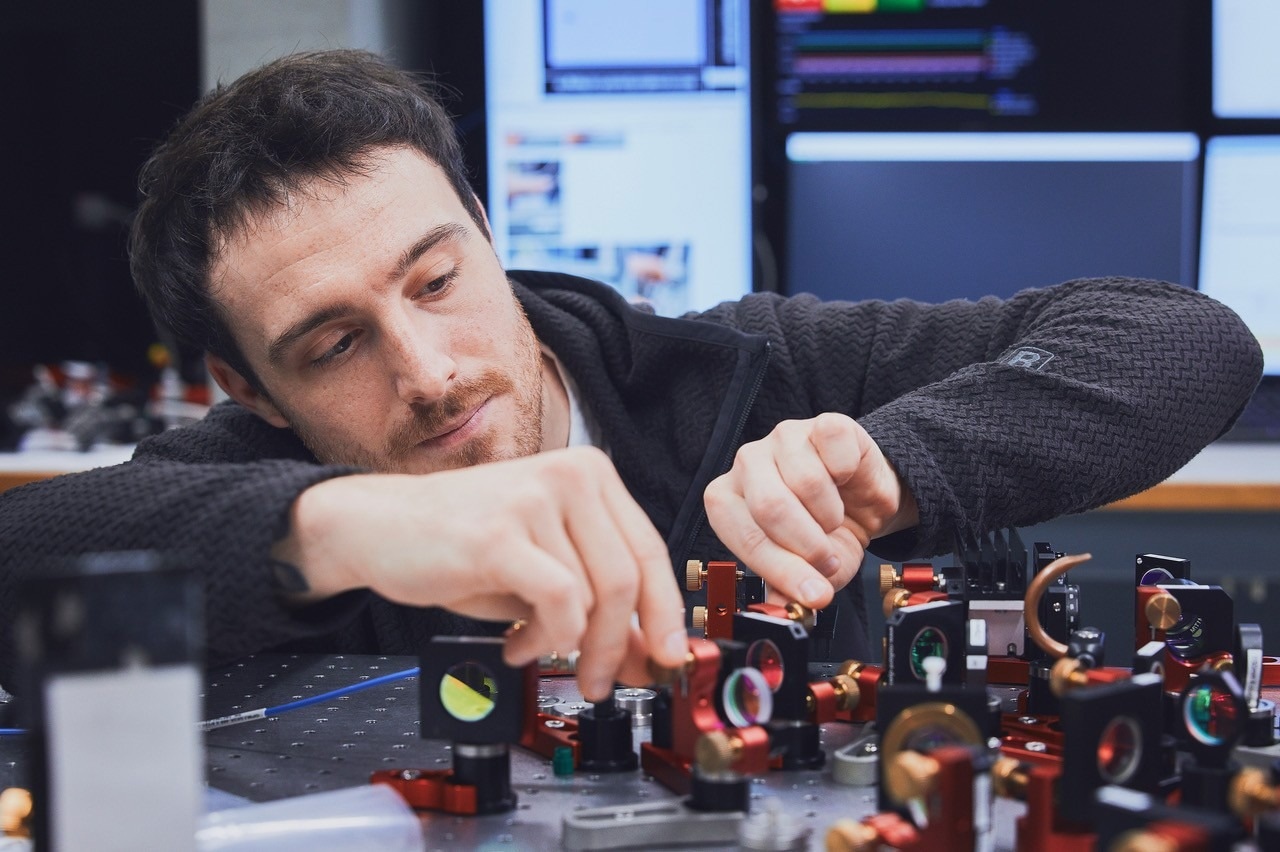
Image Credit: Kilian Kessler/ETH Zurich
At a conceptual level, how do geometric-phase operations differ from conventional dynamical gates, and why are they less sensitive to noise?
In quantum mechanics, the essential part of a quantum gate is the phase accumulated during the process. This phase can generally have two different origins: dynamical or geometric.
Most existing two-qubit gates rely primarily on dynamical phases. In these systems, the phase depends directly on quantities such as pulse energies and timings, and control fields such as light or magnetic fields. In a real experiment, however, all of these parameters are subject to unavoidable fluctuations and noise. Even very small variations can introduce gate errors because the process is highly sensitive to precise experimental control.
Our approach is fundamentally different because the dynamical phase is intentionally set to zero. The gate operation relies purely on a geometric phase, meaning that the acquired phase depends only on the trajectory of the quantum state rather than on the detailed timing of the trajectory.
One of the key advantages of this approach is that many imperfections become largely irrelevant. As long as the quantum state follows the correct overall path and returns to the desired final configuration, the fine details of the trajectory do not significantly affect the outcome. This gives the gate an intrinsic robustness against many common noise sources and experimental fluctuations.
No time now? Download your PDF for later
Your work demonstrated 99.9% precision across more than 17,000 qubits. What engineering or experimental advances made this possible?
One major advantage of optical lattice systems is that they naturally contain extremely large numbers of atoms. Simply by choosing this platform, you immediately gain access to qubit arrays that are much larger than many current state-of-the-art systems.
The fidelity value we reported for the purely geometric gate was measured as an ensemble average across the entire system. In our experiment, we apply the gate operation simultaneously to all atoms in the lattice and then extract the average fidelity from the collective response.
What surprised us most was how high this fidelity remained despite unavoidable inhomogeneities across such a large system. In practice, the actual gate fidelity for isolated atom pairs is likely even higher than the reported 99.91%, but our current detection methods only allow us to measure the ensemble average.
The most important engineering challenge was achieving exceptionally precise control over the optical lattice potential itself. Our group has extensive expertise in building highly stable optical lattice systems with dynamically tunable control parameters. Maintaining this level of stability across such a large-scale system was absolutely essential for achieving these results.
What were the main noise sources or error channels your team needed to overcome?
Like any experimental quantum platform, our system is affected by a range of imperfections and fluctuations. One important source comes from spatial inhomogeneities across the optical lattice, which can slightly modify the behavior of individual atoms depending on their location in the system.
In conventional dynamical gates, these kinds of fluctuations can quickly translate into phase errors because the gate operation depends directly on pulse amplitudes, interaction strengths, and timing precision.
The geometric approach reduces sensitivity to many of these effects because the gate depends mainly on the global trajectory of the quantum state rather than on the exact microscopic details of the evolution. In that sense, the gate is intrinsically protected against many forms of control noise.
Of course, achieving this still requires extremely stable optical potentials and careful experimental calibration. The robustness does not eliminate engineering challenges, but it changes which imperfections matter most and significantly relaxes sensitivity to certain fluctuations.
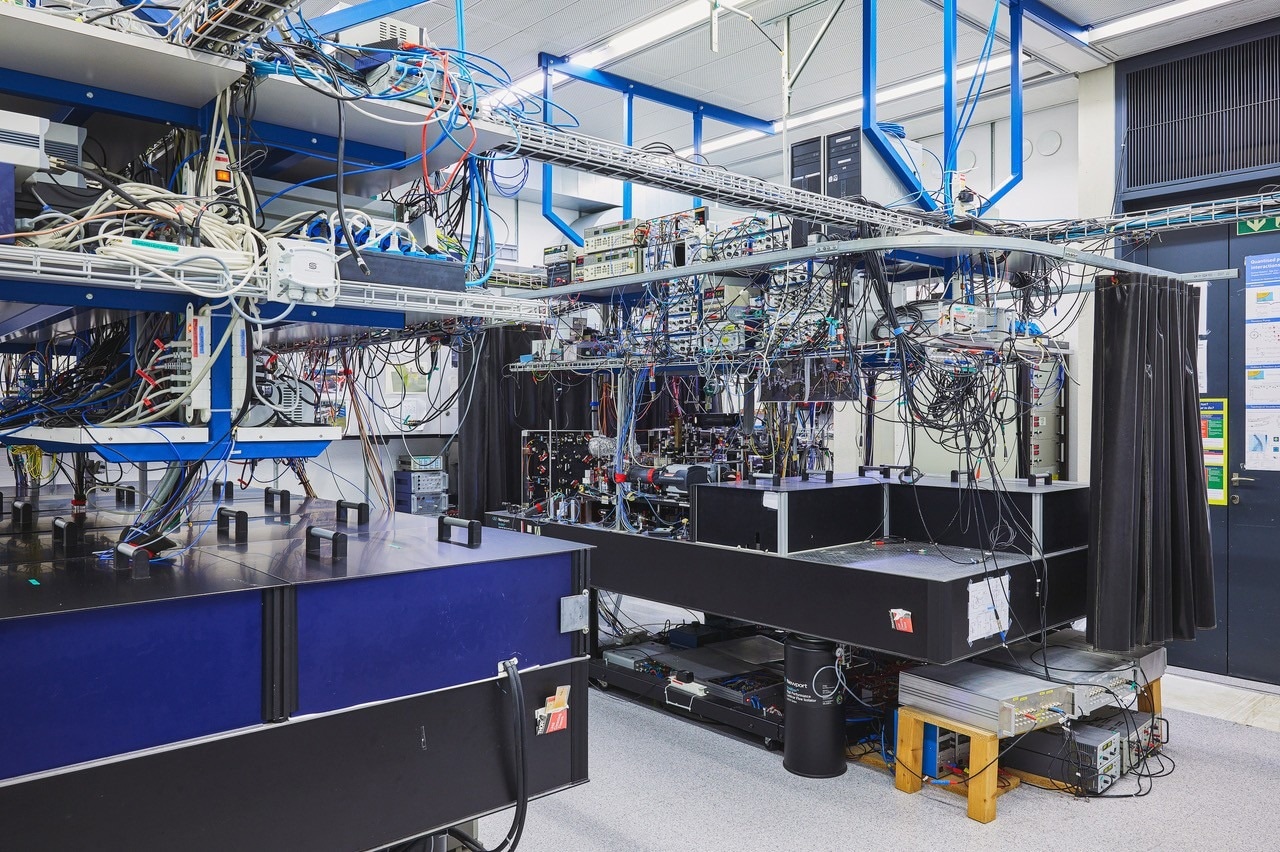
Image Credit: Kilian Kessler/ETH Zurich
From a scalability perspective, what do these results suggest about realistic paths toward fault-tolerant quantum computing?
I think these results are very encouraging because they demonstrate that highly robust gate operations can be achieved in systems containing extremely large numbers of qubits.
Neutral-atom optical lattice systems naturally offer massive scalability, which is one of their greatest strengths. The challenge has always been whether we could implement sufficiently robust and precise quantum operations across such large arrays.
Our results suggest that geometric gate mechanisms could provide an important pathway toward fault-tolerant architectures because the gates are intrinsically protected against certain types of experimental noise. Combining these robust operations with the large-scale connectivity available in neutral-atom systems opens exciting possibilities for future quantum processors.
There is still substantial work ahead, particularly regarding programmability, readout, and error-correction protocols, but these results provide strong evidence that neutral-atom platforms can play a major role in scalable quantum computing.
How do neutral-atom systems compare with superconducting and trapped-ion quantum computing platforms?
Each platform has distinct advantages, and the field is currently exploring several promising approaches in parallel.
Neutral atoms are particularly attractive because of their scalability. Optical lattice systems can naturally host enormous numbers of qubits while maintaining a high degree of coherence and control.
In addition, atomic qubits benefit from an intrinsic uniformity because every atom of a given species is fundamentally identical. As a result, the qubits themselves do not require the same degree of fabrication and tuning to achieve consistent properties across a processor, which is a significant challenge for platforms such as superconducting qubits and some other solid-state approaches.
Superconducting systems have made tremendous progress in terms of programmable quantum processors and fast gate operations, while trapped ions are known for their exceptionally high fidelities and long coherence times.
What makes neutral atoms especially exciting is the possibility of combining large-scale arrays with highly connected architectures and robust gate mechanisms. As the control techniques continue to mature, these systems may offer a compelling balance between scalability, connectivity, and coherence.
What are the next major steps needed to move from ultra-stable swap gates to fully programmable large-scale quantum computers?
One important next step is integrating these robust gate mechanisms with more advanced forms of control and programmability.
In recent years, there has already been impressive progress in combining optical lattice systems with techniques such as topological pumping and site-selective operations. These methods open the possibility of transporting atoms, connecting distant qubits, and implementing increasingly complex quantum circuits.
Going forward, the field will need improvements in several areas simultaneously, including faster data acquisition, better site-specific control, improved readout methods, and lower temperatures to further suppress decoherence.
Ultimately, the goal is to combine the natural scalability of neutral-atom systems with the programmability and flexibility needed for universal fault-tolerant quantum computation.
On a personal level, what has been the most exciting or rewarding aspect of this research for you?
One of the most rewarding aspects was definitely the moment when we realized that the phase we observed had a purely geometric origin. Initially, we were investigating what we assumed would be a seemingly trivial control experiment with the dynamical interaction effectively switched off.
When the measurements revealed a clear phase signal anyway, it immediately became obvious that something fundamentally different was happening. Those moments are incredibly exciting (and rare!) as a researcher because you suddenly recognize that the system is revealing physics you did not initially anticipate.
More broadly, it has been extremely rewarding to see optical lattice systems evolve from primarily quantum simulation platforms into serious candidates for large-scale quantum computing. It feels like the field is moving very rapidly right now, and it is exciting to contribute to that progress.
For students and early-career researchers interested in neutral-atom quantum technologies, what skills or expertise would you recommend developing?
Quantum technology is highly interdisciplinary, so a strong foundation in physics is extremely important, especially quantum mechanics, atomic physics, and condensed matter physics.
At the same time, modern experimental quantum research also relies heavily on engineering, optics, electronics, programming, and data analysis. Building and operating these experiments requires a very broad technical skill set.
I would also encourage students to remain open-minded and curious. Many of the most interesting discoveries happen when you explore unexpected results or approach problems from different perspectives. Neutral-atom systems are evolving very quickly, so there are still many opportunities for young researchers to make significant contributions.
Download the PDF of this interview here
About the Speaker
Yann Kiefer is a postdoctoral fellow and researcher at the institute of quantum electronics at the ETH Zurich. He studied in Hamburg and Paris and did his PhD on quantum simulation of one-dimensional quantum phases of low-temperature systems. For his postDoc he moved to ETH Zurich to develop digital quantum gates in optical lattice systems and has recently been awarded the ETH postdoctoral Fellowship.
Disclaimer: The views expressed here are those of the interviewee and do not necessarily represent the views of AZoM.com Limited (T/A) AZoNetwork, the owner and operator of this website. This disclaimer forms part of the Terms and Conditions of use of this website.