In a study published in the prestigious journal Physical Review Letters, researchers analyzed the decays of Bs0 mesons. These mesons decay into lighter particles, and the Standard Model allows scientists to calculate the expected rate of a given decay process and compare those predictions with experimental data.
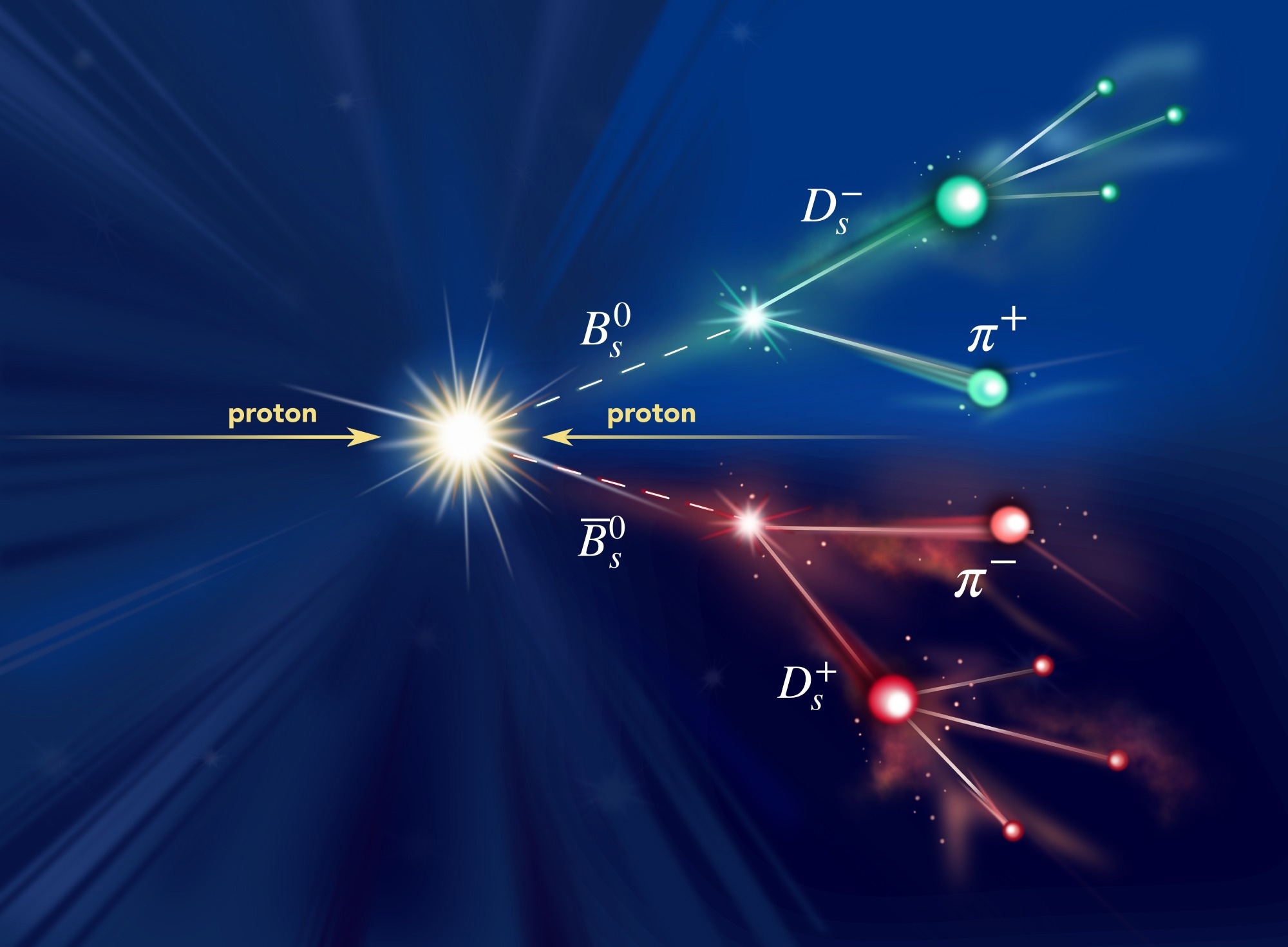 Proton–proton collisions at the LHC produce, among other particles, mesons containing beauty and strange quarks and antiquarks. Differences between matter and antimatter were investigated in their decays into secondary particles. Image Credit: IFJ PAN
The fact that the Universe is dominated by ordinary matter strongly suggests that matter and antimatter are not perfect mirror images of each other. Yet the known differences between them are far too small to explain this imbalance, leaving room for unknown physics yet to be discovered. A new analysis of meson decays by the LHCb collaboration has helped narrow the search for such new physics while setting the stage for more precise measurements in the future.
Over the past decade, scientists at the Large Hadron Collider have been searching for differences between matter and antimatter particles produced in proton–proton collisions. The latest analysis of data collected between 2016 and 2018 from the LHCb experiment was carried out by physicists from the Universities of Warwick, Manchester, and Oxford in the UK, TU Dortmund University in Germany, and the Institute of Nuclear Physics of the Polish Academy of Sciences (IFJ PAN) in Kraków.
The driving force behind this research is arguably the most basic, and most puzzling, fact about the Universe: that it exists at all. Modern physics suggests it should not. Cosmological models indicate that, shortly after the Big Bang, matter and antimatter were produced in equal amounts. Because a particle and its antiparticle annihilate on contact, converting their mass into energy, a perfectly symmetric Universe would have left no matter behind. Yet the Universe we observe is made of matter that survived. That can only mean matter and antimatter were never, and still are not, perfectly symmetric
In many physical processes, simultaneously replacing all particles with their antiparticles and inverting all spatial coordinates leaves the laws governing these phenomena unchanged. This principle is known as charge-parity symmetry, or CP symmetry. We have been searching for processes that violate this symmetry in the decays of particles produced in proton–proton collisions at the LHC, specifically in the decays of mesons containing beauty and strange quarks and antiquarks.
Dr. Agnieszka Dziurda, IFJ PAN
The Standard Model, developed in the 1970s, is a theoretical framework that describes elementary particles and their interactions. According to this model, matter is built from elementary particles called fermions, which include quarks (down, up, strange, charm, beauty, and top) and leptons (electrons, muons, tau leptons, and their associated neutrinos). Every matter particle also has a corresponding antiparticle.
Each proton–proton collision at the LHC generates a large number of massive, short-lived particles. Earlier studies of CP violation revealed asymmetries in certain decay processes involving particles and their antiparticles, but these asymmetries alone are not sufficient to explain why matter dominates the Universe today.
Interestingly, we chose to investigate a process in which the Standard Model predicts no asymmetry at all. So why study it at all? Because if an asymmetry were nevertheless observed, it could be a signal that previously unknown physics was at work. We also know that current theoretical predictions for the probabilities of certain beauty-meson decay channels differ significantly from the values obtained experimentally. This discrepancy could, for example, stem from theoretical effects that have not yet been fully accounted for in our calculations. At this stage, however, we cannot rule out the possibility that it points to physics beyond the Standard Model.
Dr. Agnieszka Dziurda, IFJ PAN
Beauty mesons proved ideal for studying CP symmetry breaking for another key reason: they rapidly flip back and forth between matter (a strange quark paired with a beauty antiquark) and antimatter (a beauty quark paired with a strange antiquark). Earlier measurements from the LHCb experiment revealed that these oscillations happen several trillion times per second, so fast that researchers did not need to identify each meson's starting state to conduct their analysis.
A major hurdle, however, was accounting for detector asymmetries, or biases in how the equipment itself records particles versus antiparticles. Because positively and negatively charged particles bend in opposite directions inside the detector’s magnetic field, and detection efficiency varies across different regions of the apparatus, the instrument can artificially skew the counts.
This can create the illusion of an asymmetry even when matter and antimatter behave identically. To eliminate these distortions, the team relied on large calibration datasets, detailed computer simulations, and periodic reversals of the magnetic field's polarity, ultimately applying corrections for detection efficiency before calculating the final asymmetry in beauty-meson decays.
We had to make sure that any asymmetry observed in the data, however small, was not caused by the detector itself. This was a crucial aspect of the entire analysis because, given the precision of our measurement, detector-related effects could have been of the same magnitude as the asymmetry we were looking for.
Dr. Agnieszka Dziurda, IFJ PAN
The LHCb data analyzed in this study showed a slight difference of roughly one to two cases per thousand decays. Because the margin of measurement uncertainty exceeded this tiny signal, the findings remain consistent with the Standard Model. While the results neither explain the universe's missing antimatter nor rule out new physics, they significantly narrow down where undiscovered phenomena could be hiding: any unknown process producing an asymmetry larger than about 2% in these decays would almost certainly have shown up.
Larger datasets already gathered by the upgraded LHCb detector will enable physicists to probe these meson decays for even subtler effects. If a hidden source of CP violation exists here, this study gives researchers a much sharper roadmap of where and how to look for it.
The Polish contribution to this study was supported by a grant from the Polish Ministry of Science and Higher Education.
Journal Reference:
Aaij, R., et al. (2026) First Measurement of the Decay-Time-Integrated CP Asymmetry in Bs0→Ds–π+ Decays. Physical Review Letters. DOI:10.1103/ljtv-y278. https://journals.aps.org/prl/abstract/10.1103/ljtv-y278.