An international research team led by Nobuhiro Yanai (University of Tokyo) and Michael R. Wasielewski (Northwestern University) has generated polarized radical pairs, molecules with unpaired electrons whose spins are aligned, inside metal–organic frameworks (MOFs), porous materials built from metal ions linked by organic molecules. The study was published in Nature Communications.
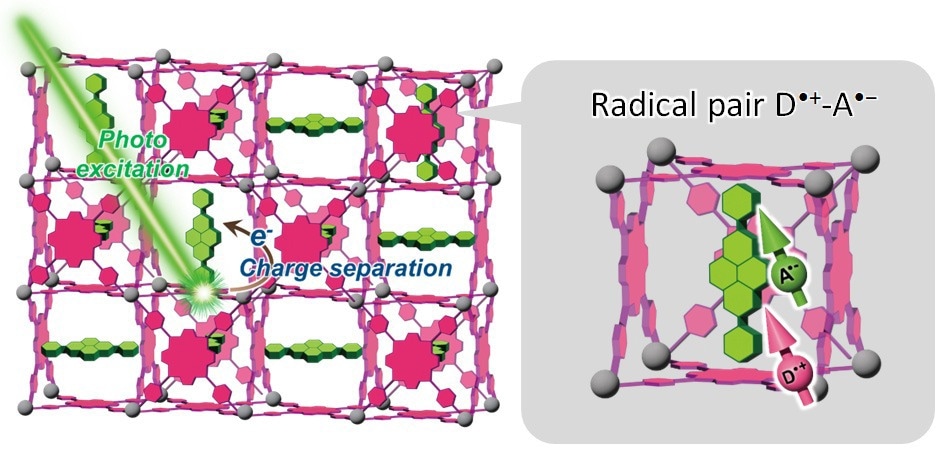 The formation of spin-polarized radical pairs in a metal–organic framework. Image Credit: The University of Tokyo
This breakthrough could lay the groundwork for future quantum chemical sensing technologies and enhance the sensitivity of existing techniques such as magnetic resonance imaging (MRI) using the quantum properties of these polarized radical pairs.
Sensing, at its simplest, is about detecting changes caused by external cues. When you smell something, airborne chemicals activate specialized nerve cells that send signals to the brain, letting you recognize aromas such as “fruity” or “floral.” Recent advances are pushing detection further, with increasingly sensitive, high-resolution methods that can operate at the quantum level.
We are interested in making a quantum nose, so to speak. Although quantum sensing has been a very hot topic in the past decades, leveraging it for chemical sensing has been lagging. Our goal is to make chemical quantum sensing a reality.
Nobuhiro Yanai, Principal Investigator, The University of Tokyo
The building blocks for this kind of sensing technology are already well understood. Metal–organic frameworks, with their highly porous structure, make excellent containers. Radical pairs, on the other hand, possess quantum properties that make them well suited as potential sensors.
Thus far, research into radical pairs has been limited to isolated molecules in solid state. So, we set out to develop a method to make an ordered array of radical pairs in a crystalline solid.
Michael R. Wasielewski, Northwestern University
The researchers designed and synthesized molecules that could transfer electrons when excited by light. Then, they evaluated each variation using ultrafast spectroscopy, electron paramagnetic resonance spectroscopy, and quantum chemical theory calculations. Such a complex project required the expertise of several teams, transcending borders.
Thanks to this collaboration. We successfully created a pair of radicals and demonstrated the response of their spin properties to some chemical substances. As the next step, we hope to explore a variety of spin systems in metal–organic frameworks and their response to chemical stimuli.
Nobuhiro Yanai, Principal Investigator, The University of Tokyo
Journal Reference:
Hamachi, T., et al. (2026) Sublevel-selective electron spin hyperpolarization of triplet radical pairs in metal–organic frameworks. Nature Communications. DOI:10.1038/s41467-026-79262-6. https://www.nature.com/articles/s41467-026-79262-6.