For scientists, the most thrilling breakthroughs often stem from unexpected turns. A research team led by Professor Oscar Dahlsten, Associate Professor at the Department of Physics at City University of Hong Kong (CityUHK), set out to prove a theoretical limitation, only to discover a novel quantum solution. This surprise breakthrough breaks traditional physical constraints and introduces an innovative strategy for harvesting energy from fluctuating sources.
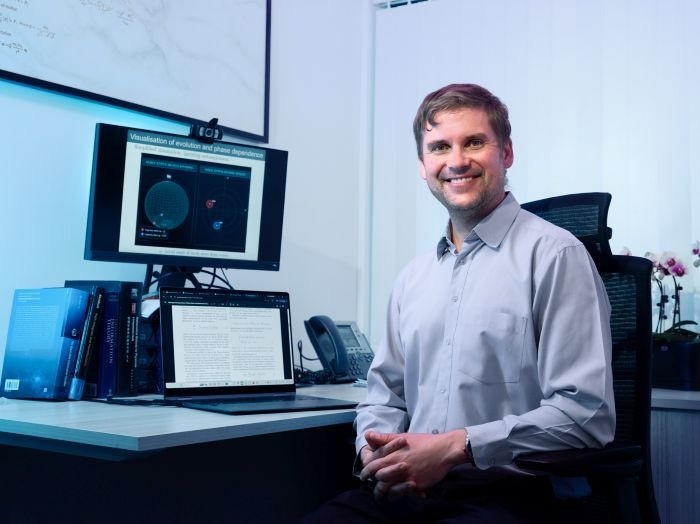 A research team led by Professor Oscar Dahlsten, Associate Professor at the Department of Physics at CityUHK, sets out to prove a theoretical limitation, only to discover a novel quantum solution. Image Credit: City University of Hong Kong (CityUHK)
The study was recently published in Physical Review Letters under the titled “Nonunique Decompositions of Mixed States and Deterministic Energy Transfers”.
Energy from natural sources is often accompanied by entropy, or randomness, making it difficult to convert into the predictable power needed to charge batteries and operate electronic devices.
The study shows that a distinctive feature of quantum theory, known as the non-unique decomposition of mixed states, can enable deterministic energy harvesting (DEH), allowing energy to be transferred from a source to a harvester without a corresponding transfer of entropy.
The key idea is that a quantum harvester can be charged through multiple ways corresponding to different intermediate superposition states. As long as the source induces one of those state-transitions in the harvester, the final state will be the charged state with certainty. This suggests a possible mechanism by which different source states could transfer energy in a predictable manner while avoiding the transfer of entropy.
“We initially set out to show that such a protocol might be impossible. To our surprise, our efforts led us to a quantum solution that could achieve exactly the deterministic energy transfer we were looking for. The shift from trying to prove a limitation to uncovering a viable solution was one of the most surprising and rewarding moments of the project,” said Professor Dahlsten.
By providing a theoretical foundation for converting ambient energy into usable power with minimal loss, the framework points toward future low-power technologies. It offers a prospective route to reduce the fundamental losses of conventional AC-to-DC rectifiers and could help power Internet-of-Things devices, wearables, smart-city sensors, and 6G devices from ambient sources.
This research was supported by a Research Grants Council General Research Fund.