Fujitsu today announced that it has developed the world’s first working prototype of a diamond-spin quantum computer incorporating tin-vacancy (SnV) centers into photonic integrated circuits. The prototype can be operated at -271.6 °C, higher than the typical operating temperature of superconducting quantum computers (-273.13 °C) and Fujitsu has demonstrated in a test environment that it can be utilized via the Fujitsu Hybrid Quantum Computing Platform without any additional specialist knowledge. This development represents an important milestone toward realizing a modular architecture, one of the most promising approaches for scaling quantum computers, due to its high fidelity and efficient optical connectivity.
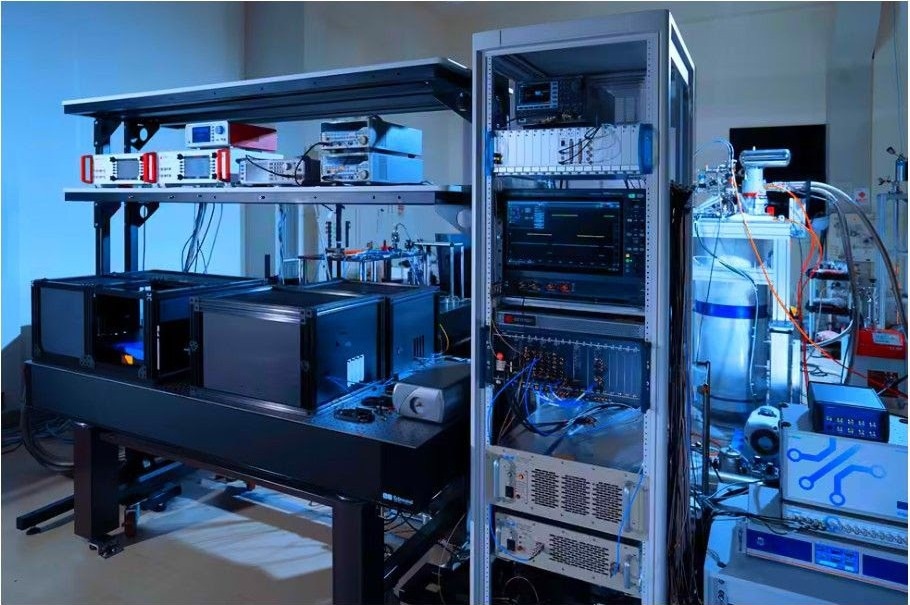 The diamond-spin quantum computer prototype. Image Credit: Fujitsu
The prototype is based on the results of joint research started in 2020 by Fujitsu, Delft University of Technology, and QuTech, a world-leading quantum technology research institute and part of TU Delft.
Fujitsu is set to develop a prototype of a multi-module diamond-spin quantum computer by 2027. In addition, Fujitsu will begin developing of technologies to integrate diamond-spin approach with superconducting approach, driving progress toward achieving large-scale quantum computers.
This initiative comes as part of Fujitsu’s quantum roadmap, which outlines company’s aim to realize practical quantum computing by 2030.
Comment from Vivek Mahajan, Corporate Executive Officer, Corporate Vice President, CTO, in charge of System Platform, Fujitsu Limited
"The diamond-spin approach we have applied in this prototype not only offers exceptional scalability in its own right, but also has the potential to be integrated with superconducting quantum computers to further extend their capabilities, enabling more complex and large-scale computations.
Under our roadmap to achieve a 250 logical qubit system by fiscal 2030 and a 1,000 logical qubit system by fiscal 2035, Fujitsu will continue advancing practical quantum computing across a broad range of areas, from software to hardware, while leveraging the key advantages of the diamond-spin approach, including high fidelity and optical connectivity."
Comment from Dr. Kees Eijkel, General Director, QuTech, Delft University of Technology
“We are delighted to announce this prototype diamond spin quantum computer as a result of the collaborative research conducted since 2020 between Fujitsu, Delft University of Technology, and QuTech. It is a major milestone in our strong collaboration. Demonstrating the scalability expected of diamond spin quantum computing remains a long and challenging journey. However, by further strengthening our collaboration with Fujitsu, we are committed to tackling this ambitious and meaningful challenge and leading the development of next-generation quantum technologies.”
Overview of Developed Technologies
The prototype features these three technologies developed by Fujitsu:
1.Heterogeneous material bonding and thinning technology for scalable quantum computing chips
To create quantum computing chips using SnV centers, Fujitsu developed heterogeneous material bonding technology to bond high-quality diamond substrates ion-implanted with tin to alumina/silicon dioxide substrates. Fujitsu also developed thinning technology to reduce the thickness of diamond substrates from several hundred micrometers to several hundred nanometers, making them suitable for use in quantum computing chips.
2.Photonics-integrated circuit fabrication technology for SnV centers
Fujitsu developed technology to fabricate photonics integrated circuits that integrate nanometer-sized diamond crystals containing SnV centers with alumina optical waveguides, which are transparent in the visible light region, to extract single photons emitted from SnV centers during qubit readout. For diamond processing, Fujitsu utilized the results of joint research with The University of Tokyo.
3. Quantum circuit conversion technology for diamond spin approach
The diamond-spin approach requires qubit control by combining light, microwaves, and radio frequency waves. Fujitsu developed a mechanism to convert quantum circuits described by quantum gates into control sequence for these physical operations for the diamond spin approach, enabling control from the Fujitsu’s hybrid quantum computing platform.
Background
The diamond-spin approach takes lattice defect structures called color centers in diamond crystals and uses them as qubits. This approach achieves high fidelity because diamond has inherent properties that allow quantum states to remain stable and could allow for logical qubits to be reliably formed from fewer physical qubits compared to superconducting and other approaches. Furthermore, light can be applied to flexibly connect several quantum modules, enabling the construction of systems with a modular architecture that can be scaled efficiently.
Typically, the diamond-spin approach uses structures called nitrogen-vacancy (NV) centers formed by nitrogen atom impurities in diamond crystals. However, in the development of this prototype, Fujitsu used tin-vacancy (SnV) centers, which feature structural symmetry and are less susceptible to external noise than NV centers, making them attractive candidates for stable, high-brightness color centers.
Research Support
A part of this work is supported by "Advanced Research Infrastructure for Materials and Nanotechnology in Japan (ARIM)" of the Ministry of Education, Culture, Sports, Science and Technology (MEXT). Proposal Number JPMXP1225NM0096. This research project is a collaboration between QuTech and Fujitsu, co-financed by Holland High Tech with a PPP allowance for research and development in the top sector HTSM and a PPP allowance for research and innovation from the Ministry of Economic Affairs.