Osaka Metropolitan University scientists deployed the Atacama Compact Array, a network of radio telescopes in Chile, to construct the initial comprehensive molecular gas map across Stephan’s Quintet, a neighboring group of interacting galaxies containing areas with unexpectedly reduced star formation efficiency. The study was published in The Astrophysical Journal.
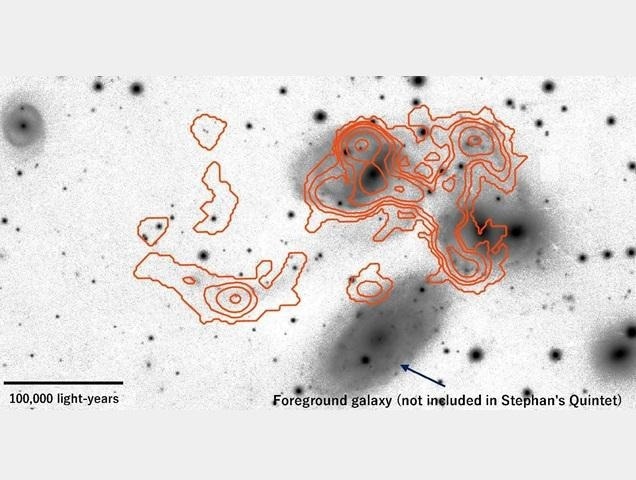 Optical image of Stephan’s Quintet galaxy group showing regions of abundant molecular gas. The contour lines show radio emissions from carbon monoxide molecules in Stephan’s Quintet, arranged like the contours on a topographic map. Just as higher contours on a map represent higher elevations, higher contour levels here represent stronger CO emission, indicating regions with more molecular gas. Image Credit: Osaka Metropolitan University
Stellar birth within galaxies correlates directly with molecular gas distribution. During earlier cosmological encounters marked by frequent galactic collisions, structural interactions compressed molecular gas reservoirs, prompting dense cloud collapse under gravitational forces to produce young stars.
Nonetheless, an unexpected pattern emerges across specific regions rich in molecular gas. Regardless of hosting ample raw material for star generation, these zones yield remarkably low stellar output. Why galactic impacts initiate star formation across certain regions while inhibiting it elsewhere remains a persistent scientific question.
Comparing gas volume and velocity dynamics against stellar creation efficiency across varied locations revealed that areas exhibiting more turbulent molecular gas motion yielded significantly lower star formation rates, despite harboring high gas abundances.
Interactions between galaxies can both compress and disperse molecular gas, creating dramatic differences in star formation activity. The findings pointed to turbulence as an important factor in regulating where stars can form.
Misaki Yamamoto, Graduate School of Science, Osaka Metropolitan University
The researchers present a mechanism in which turbulence produced by galactic interactions impedes the gas from stabilizing and undergoing gravitational collapse. Under elevated turbulence, internal gas velocities disperse the material, suppressing localized condensation, structural accumulation, and collapse. Consequently, this dynamic diminishes the conditions necessary to initiate star formation.
Star formation is one of the most fundamental processes in galaxy evolution. Studies like ours help refine our picture of the universe and encourage us to reflect on our place within it. Understanding how galaxy collisions and interactions in the early universe enhance or suppress star formation will allow researchers a better tool to trace the history of galaxy evolution across cosmic time.
Kazuyuki Muraoka, Associate Professor, Osaka Metropolitan University
Financial backing for this study was provided by JSPS KAKENHI (grant numbers JP23K13142, JP23H00129, JP23K20035, JP24H00004, JP24KJ1904, JP25K07371, and JP25K23396).
Partial funding was also received through a University Research Support Grant administered by the National Astronomical Observatory of Japan (NAOJ) under the ALMA Japan Research Grant of NAOJ ALMA Project (NAOJ-ALMA-394).
Download the PDF of this page here
Journal Reference:
Yamamoto, M., et al. (2026) Molecular Gas Structure and Star Formation Diversity in Stephan’s Quintet Revealed by ACA CO(1–0) Mapping. The Astrophysical Journal. DOI:10.3847/1538-4357/ae7b30. https://iopscience.iop.org/article/10.3847/1538-4357/ae7b30.