In a significant scientific breakthrough, published in Physical Review Letters, researchers from the Paul Scherrer Institute PSI, ETH Zurich, and the University of Amsterdam have achieved the first direct observation of the optical Magnus effect. This phenomenon, which is the optical equivalent of a classical mechanical effect, holds crucial implications for quantum computing, particularly in the precise control of qubits, the fundamental units of quantum information.
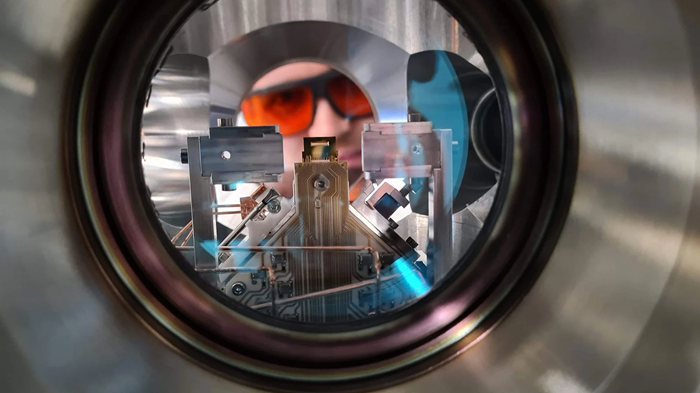 First author Philip Leindecker looks into the ultrahigh-vacuum chamber of a quantum computer at PSI that operates with trapped ions. The experimental demonstration of the optical Magnus effect could contribute to controlling such quantum computers even more precisely in the future. Image Credit: Paul Scherrer Institute PSI/Edgar Brucke
Skilled table tennis players excel at manipulating fast-moving objects. By imparting a specific spin on a serve, they can make the small white ball initially travel straight towards the table's edge before sharply curving into the left corner at the last moment. This athletic maneuver is governed by the Magnus effect, a physical phenomenon that influences balls of all sizes.
An international research collaboration at the Paul Scherrer Institute PSI has now extended this concept from macroscopic balls to the atomic realm, experimentally demonstrating the optical Magnus effect for the first time. In this context, no atom follows a curved path. Instead, the scientists direct a highly focused laser beam at a single ion and meticulously observe the resulting interaction.
Through this experiment, they successfully demonstrated that the point of peak interaction is laterally displaced. This is a vital discovery for advancing quantum computers, which rely on laser light for accurate qubit control.
When the Center is Suddenly Off-Center
When a tightly focused laser beam targets an ion, one might anticipate the strongest interaction to occur at the laser beam’s most intense point: its center. However, the act of tightly focusing the laser also alters the spatial configuration of its electromagnetic field.
Consequently, the interaction with the ion is strongest not precisely at the laser beam's center, but slightly to one side. This lateral displacement mirrors the optical counterpart of the Magnus effect observed in the flight of a table tennis ball.
Just as an unexpected deviation in sports can lead to losing the ball, in quantum computers, it can result in a loss of control. Laser light is employed in these systems to selectively modify the state of qubits. The optical Magnus effect, if not accounted for, could disrupt this precise control and contribute to errors.
Conversely, this effect also presents an opportunity.
The forces it generates could be utilized to couple qubits to one another, facilitating more complex computations.
Philip Leindecker, Study First Author, PSI Center for Photon Science
A Map of Laser Light
To visualize the optical Magnus effect, the researchers employed a single calcium ion as an exceptionally small and sensitive probe. This electrically charged atom is held nearly stationary at a fixed location within an ion trap using electromagnetic fields. Such trapped ions are also integral to quantum computers, where they function as qubits whose quantum states can be precisely manipulated with laser light.
For their experiment, the researchers investigated the strength of the calcium ion's interaction with light from a tightly focused laser at various positions.
Our ion functions as a tiny sensor that user can use to map out the structure of the laser light. This enables the measurement of a shift as small as a few hundred nanometers.
Philip Leindecker, Study First Author, PSI Center for Photon Science
The experiment also uncovered a surprising characteristic of the effect: the magnitude of the shift depends exclusively on the light's wavelength, not on the degree to which the laser is focused.
Several years prior, researchers at the University of Amsterdam had theoretically predicted the optical Magnus effect. Now, utilizing the trapped calcium ion, the team has successfully observed the effect for the first time and characterized it with greater precision.